One of these trackers costs €29 a month to start and the other $95, but the cheaper one is not always cheaper for your team. This Otterly vs Peec AI guide is for teams deciding how to measure the way ChatGPT, Perplexity and Google AI Overviews describe their brand. Both tools answer the same commercial question: when a buyer asks an AI assistant about your category, does your company get named? The real differences sit in billing structure, engine coverage and how far each plan stretches before an upgrade becomes unavoidable.
Disclosure: RankMesh is our product. We include it where it fits, and every other tool's price comes from that vendor's own pricing page.
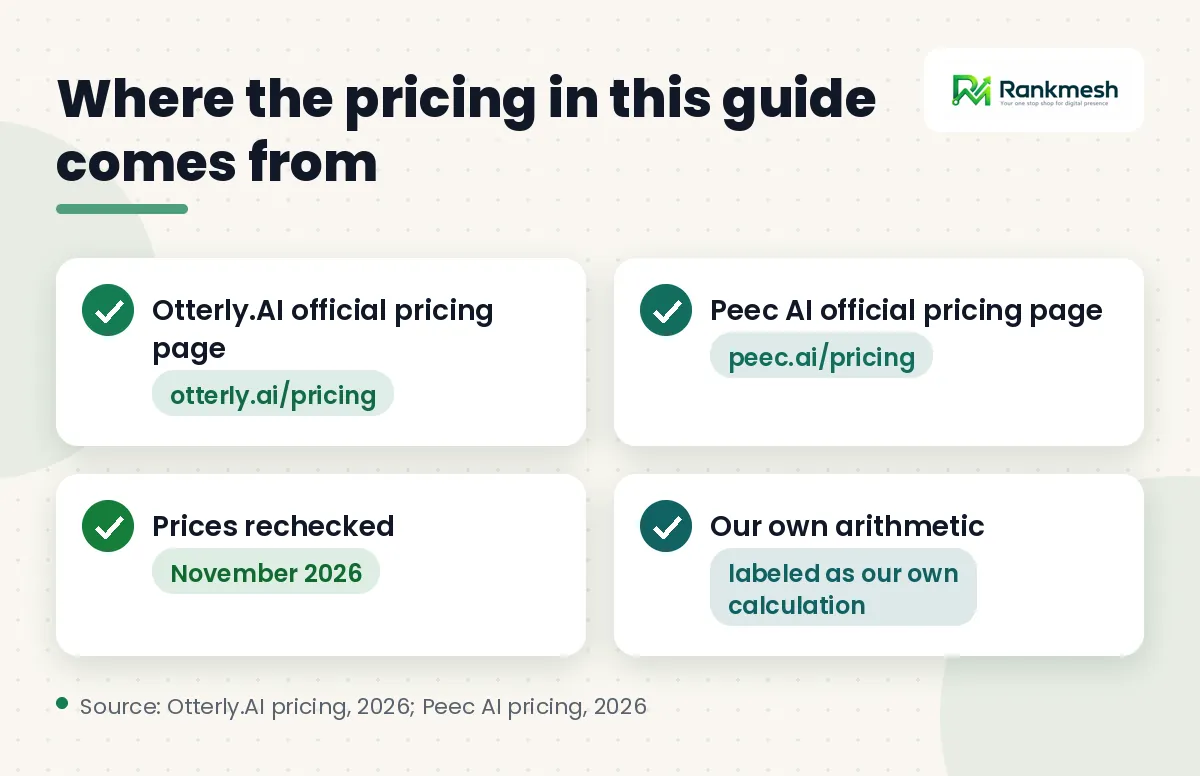
Every price in this guide comes from the official pricing pages of both vendors, rechecked in November 2026 (Otterly.AI pricing, 2026; Peec AI pricing, 2026). Where we did the arithmetic ourselves, we label it as our own calculation.
Key takeaways
- Otterly.AI is the cheaper way to start. Lite costs €29 a month for 16 prompts, while Peec AI Starter costs $95 a month for 50 prompts (Otterly.AI pricing, 2026; Peec AI pricing, 2026).
- Peec AI usually wins in the middle. Otterly jumps from Lite straight to a 120-prompt Standard plan, so teams that need a few dozen prompts often pay less with Peec AI (Otterly.AI pricing, 2026; Peec AI pricing, 2026).
- Engine coverage is the other big difference. Otterly covers Claude and Microsoft Copilot, which Peec AI does not offer on self-serve plans, while Peec AI adds regional engines such as Naver AI Briefing and Baidu's ERNIE.
- Otterly is simpler for multi-country tracking. Every Otterly plan lists unlimited countries, whereas Peec AI Starter covers one country (Otterly.AI pricing, 2026; Peec AI pricing, 2026).
- Both are trackers, not fixers. Both suggest improvements, but neither rewrites your pages, deploys schema or repairs crawl errors on your website.
At a glance
- Entry plan: Otterly Lite €29/month for 16 prompts; Peec AI Starter $95/month for 50 prompts (Otterly.AI pricing, 2026; Peec AI pricing, 2026)
- Mid plan: Otterly Standard €189/month for 120 prompts; Peec AI Pro $245/month for 150 prompts (Otterly.AI pricing, 2026; Peec AI pricing, 2026)
- Upper plan: Otterly Premium €489/month for 403 prompts; Peec AI Advanced $495/month for 350 prompts (Otterly.AI pricing, 2026; Peec AI pricing, 2026)
- Engines per plan: Otterly 4 of 7 engines; Peec AI 3 of 8 models, with extra models as paid add-ons (Otterly.AI pricing, 2026; Peec AI pricing, 2026)
- Countries: Otterly unlimited on all plans; Peec AI 1 on Starter, 3 on Pro and Advanced (Otterly.AI pricing, 2026; Peec AI pricing, 2026)
- Seats: Unlimited users on both tools
- Looker Studio and API: Otterly from Standard; Peec AI from Advanced (Otterly.AI pricing, 2026; Peec AI pricing, 2026)
- Annual billing: 15% off on both (Otterly.AI pricing, 2026; Peec AI pricing, 2026)
Otterly's page shows prices in euros (USD is also offered) and Peec AI lists dollars, so compare in one currency before you decide. Vendor pricing also changes frequently, so confirm the figures on each pricing page before you commit.
Otterly vs Peec AI: what is the real difference between the two trackers?
Otterly.AI and Peec AI both monitor how often your brand appears in AI-generated answers, how it is described and which sources get cited. Otterly bills in euros through a monthly credit pool and starts very cheaply. Peec AI bills in dollars by prompts and chosen models, starts higher and fills the gap between small and large plans more smoothly.
A prompt is a buyer question you ask the tool to monitor, such as "best CRM for small agencies" or "top payroll software in India." The tracker sends that question to each selected AI engine on a schedule, records the answer, and checks whether your brand and your competitors appear. Visibility scores, citation lists and sentiment summaries are all built from those stored answers.
The two vendors package that work differently. Peec AI counts answers as prompts multiplied by models multiplied by days, so Starter's 50 prompts across 3 models produce 4,500 answers a month (Peec AI pricing, 2026). Otterly gives each plan a credit pool instead: 2,000 credits on Lite, 15,000 on Standard and 50,000 on Premium (Otterly.AI pricing, 2026).
The credit detail matters more than it first appears. Otterly charges 3 credits for each Claude answer and 1 credit for answers from other engines (Otterly.AI pricing, 2026). By our own calculation, Lite's 2,000 credits roughly equal 16 prompts on four engines over a month, but swapping one of those engines for Claude raises the daily cost per prompt from four credits to six, which shrinks the realistic Lite allowance to about 11 prompts.
Lite customers also cannot buy extra credit packs. Standard customers can add 5,000 credits for €65 a month, and Premium customers can add 10,000 credits for €99 a month (Otterly.AI pricing, 2026). In practice, Peec AI's model is easier to forecast, whereas Otterly's model gives you more freedom to shift budget between engines as long as you watch your balance.
How much do Otterly.AI and Peec AI cost per month?
Otterly AI pricing runs €29, €189 or €489 a month across its self-serve plans, plus a custom Enterprise tier. Peec AI costs $95, $245 or $495 a month, plus custom Enterprise pricing billed annually. Both vendors offer 15% off for annual billing (Otterly.AI pricing, 2026; Peec AI pricing, 2026).
The headline price only tells half the story, because what you actually care about is the cost of each prompt you need. Dividing each monthly price by its prompt allowance gives these rough figures, which are our calculations from the official pages before tax and add-ons:
These unit rates look remarkably close. The meaningful gap comes from where each vendor places its plan steps: Otterly leaps from 16 prompts straight to 120, while Peec AI fills that space with a 50-prompt plan (Otterly.AI pricing, 2026; Peec AI pricing, 2026).
Both Otterly.AI and Peec AI include unlimited users on every self-serve plan, so seat count is unlikely to decide this purchase (Otterly.AI pricing, 2026; Peec AI pricing, 2026).
Share on LinkedIn · Share on X

Which AI engines does each tracker cover?
Otterly tracks ChatGPT, Google AI Overviews, Perplexity, Microsoft Copilot, Google AI Mode, Gemini and Claude, with a subset per self-serve plan. Peec AI lets self-serve customers choose models from a list that includes ChatGPT, Perplexity, AI Overviews, AI Mode, Gemini, Naver AI Briefing, ERNIE and Bing AI Mode. Neither vendor covers every engine on entry plans.
Otterly's plan tables list 4 of its 7 engines per self-serve plan, though the page also says every plan can track every engine, so confirm with Otterly which engines you can run at once. Enterprise lists unlimited engines, and Grok appears only as "coming soon" (Otterly.AI pricing, 2026). Peec AI's Starter, Pro and Advanced plans each include 3 active models, and a fourth model costs $30, $70 or $140 a month depending on the plan (Peec AI pricing, 2026).
The engine lists point to different buyers. Peec AI's self-serve plans do not include Claude or Microsoft Copilot. Claude appears only on Enterprise, so a developer-tools company whose buyers lean on Claude may find Otterly a better fit. Conversely, a brand selling into South Korea or China gains real value from Peec AI's Naver and ERNIE coverage, which Otterly does not list.
Otterly is the simpler choice when you sell in several markets, because every Otterly plan, including Lite, lists unlimited countries and languages. Peec AI limits Starter to one country and Pro and Advanced to three, with unlimited countries reserved for Enterprise (Otterly.AI pricing, 2026; Peec AI pricing, 2026).
Here is a concrete scenario. An Indian SaaS company selling into India, the UAE, the UK and the US needs four markets tracked. On Otterly, any plan technically covers those countries; on Peec AI, four markets push the team past Advanced and into a custom Enterprise contract (Otterly.AI pricing, 2026; Peec AI pricing, 2026).
Country coverage still interacts with prompt allowances, though. Before you buy, ask each vendor exactly how a single prompt tracked in several countries counts against your monthly limit, because that answer can change your real cost more than the sticker price.

How do reporting, API access and integrations compare?
Otterly opens up integrations earlier. Its Standard plan already includes a Looker Studio connector and API access, while Peec AI reserves Looker Studio and its API for the Advanced plan. Teams that report through dashboards, rather than inside the tool itself, should weigh this difference heavily.
On Otterly, Standard includes 2,000 API requests and 2,000 MCP requests a month, Premium raises both to 5,000, and Lite includes neither (Otterly.AI pricing, 2026). MCP, short for Model Context Protocol, lets AI assistants and agents pull data from the tool directly. Lite is also limited to one workspace, while higher plans list unlimited workspaces.
On Peec AI, projects scale from 1 on Starter to 2 on Pro and 5 on Advanced. Enterprise adds single sign-on, and Peec AI says it holds a SOC 2 Type II report, which its pricing page lists on every plan (Peec AI pricing, 2026). Both tools track daily by default, and weekly tracking appears as an option on Otterly Premium and on Enterprise plans from both vendors.
Which tracker is cheaper at your prompt volume?
The cheaper tool depends almost entirely on how many prompts you genuinely need. Otterly clearly wins at very small volumes, Peec AI tends to win in the middle, and at 300 to 400 prompts the two are close once you convert euros to dollars. These worked examples use list prices before tax, add-ons and currency conversion.
- Solo founder, about 15 prompts: Otterly Lite at €29 a month beats Peec AI Starter at $95 a month (Otterly.AI pricing, 2026; Peec AI pricing, 2026).
- Startup marketing team, about 40 prompts: Peec AI Starter at $95 a month is far cheaper than Otterly Standard at €189 a month (Otterly.AI pricing, 2026; Peec AI pricing, 2026).
- Growth team or agency, 120 to 150 prompts: Otterly Standard covers 120 prompts for €189, while Peec AI Pro covers 150 prompts for $245 (Otterly.AI pricing, 2026; Peec AI pricing, 2026).
- Larger brand, 300 to 400 prompts: Otterly Premium includes 403 prompts for €489, while Peec AI Advanced includes 350 prompts for $495 (Otterly.AI pricing, 2026; Peec AI pricing, 2026).
Remember that Otterly's figures assume a standard engine mix. If Claude is one of your tracked engines, the credit math from the earlier section applies and your effective prompt count drops.
How should your team choose in the Otterly AI vs Peec AI decision?
Start with your buyers, not with the vendors. Write down the questions your customers actually ask, the AI assistants they use and the markets they buy from, then match those facts to each plan. Following the steps below can make the decision much quicker.
- Write your prompt list first. Draft the real buyer questions you want to win, then cut duplicates. Most teams overestimate how many prompts they need.
- Name the engines your buyers use. Developer and B2B audiences may lean on Claude, while regional consumer brands may need Naver or ERNIE.
- Map your countries. Several markets favour Otterly at entry level, whereas a single home market removes that advantage.
- Decide where reports will live. If your leadership reads Looker Studio dashboards, check which plan unlocks the connector on each tool.
- Test with identical prompts. If both vendors let you start on a short monthly plan, run the same prompt set in each and compare how useful the outputs are.
What is the best Peec AI alternative if you need fixes, not just tracking?
The right Peec AI alternative depends on the job. If you only need monitoring, Otterly is the most direct swap, with a cheaper entry point and broader country coverage. If you need someone to act on the gaps a tracker finds, an execution platform that edits your site and content is the better fit.
Other Peec AI competitors, such as Scrunch AI and Rankscale, are also built mainly around measurement and reporting. That focus is valuable, yet a visibility score alone never earns a citation; the work happens on your website, in your structured data and in how consistently your brand is described across the web. We break down that trade-off in our Peec AI alternative comparison.
RankMesh sits on the execution side. Its specialised AI agents, organised into six divisions, track visibility across ChatGPT, Gemini and Perplexity today, with Claude and Grok tracking coming soon, and then act on what they find. Technical fixes can ship as GitHub pull requests for a human to review, or publish through a connected CMS such as WordPress, Shopify or Webflow, and every action can be approved, rejected or reversed.
What this means for you
A tracker tells you that a competitor is named in an AI answer and you are not. Closing that gap usually requires consistent entity signals, clear schema markup and content written in a quotable, direct-answer format. Here is how to apply that by role:
- Founders and small business owners: Start with a small, focused prompt list and a cheap plan. Spend the savings on fixing the pages AI engines should be citing.
- Marketing managers: Choose the tool whose engine list matches your buyers, then report on citation share alongside organic traffic.
- Agencies: Unlimited seats on both tools make client collaboration easy, so compare project and workspace limits instead.
- E-commerce and SaaS brands: Pair tracking with execution. Whichever side of the Otterly vs Peec AI choice you land on, data without fixes will not move your visibility. If you are also weighing Otterly against execution platforms, see our Otterly AI alternative breakdown.
Frequently asked questions
Is Otterly cheaper than Peec AI?
Otterly is cheaper at entry level, with Lite at €29 a month against Peec AI Starter at $95 a month (Otterly.AI pricing, 2026; Peec AI pricing, 2026). For teams needing a few dozen prompts, however, Peec AI Starter often costs less than upgrading to Otterly Standard.
Does Peec AI track Claude?
Peec AI's pricing page does not list Claude among the models available on its Starter, Pro and Advanced plans. Otterly does track Claude, although each Claude answer uses more credits than answers from other engines.
Which tool suits agencies better?
Both tools include unlimited users, so seat costs are not a factor. Agencies managing many clients should compare workspace and project limits, Looker Studio access and API availability, which arrive on lower plans with Otterly.
What is the best alternative to Peec AI?
For pure tracking, Otterly is the closest alternative, especially for multi-country work on a small budget. If you want a platform that also fixes technical SEO, schema and content, an execution tool such as RankMesh is the better comparison.
Can an AI visibility tracker improve my citations on its own?
No. Trackers measure where you appear in AI answers, but the improvements come from changes to your site, structured data and brand consistency, which someone still has to make.
See who AI recommends instead of you
Picking a tracker is a sensible first step, yet the real win is turning those reports into citations. RankMesh audits your site, shows where ChatGPT, Gemini and Perplexity mention competitors instead of you, and then ships reviewable fixes that you approve before anything goes live. Get your free AI recommendations report and see exactly where your brand stands today.