Peec AI is good at one job: showing how often AI assistants mention your brand. Every self-serve Peec plan includes three AI models, though, and each extra model is a paid add-on. Your team also still has to fix whatever the dashboard uncovers. If you are evaluating a Peec AI alternative, decide first whether you need a cheaper tracker, broader engine coverage or a platform that actually acts on the data.
This guide compares five options on price, engine coverage and prompt limits. Every price below comes from the vendor's own pricing page, and each figure links straight to that page so you can confirm it before you buy. Prices checked in November 2026.
Key takeaways
-
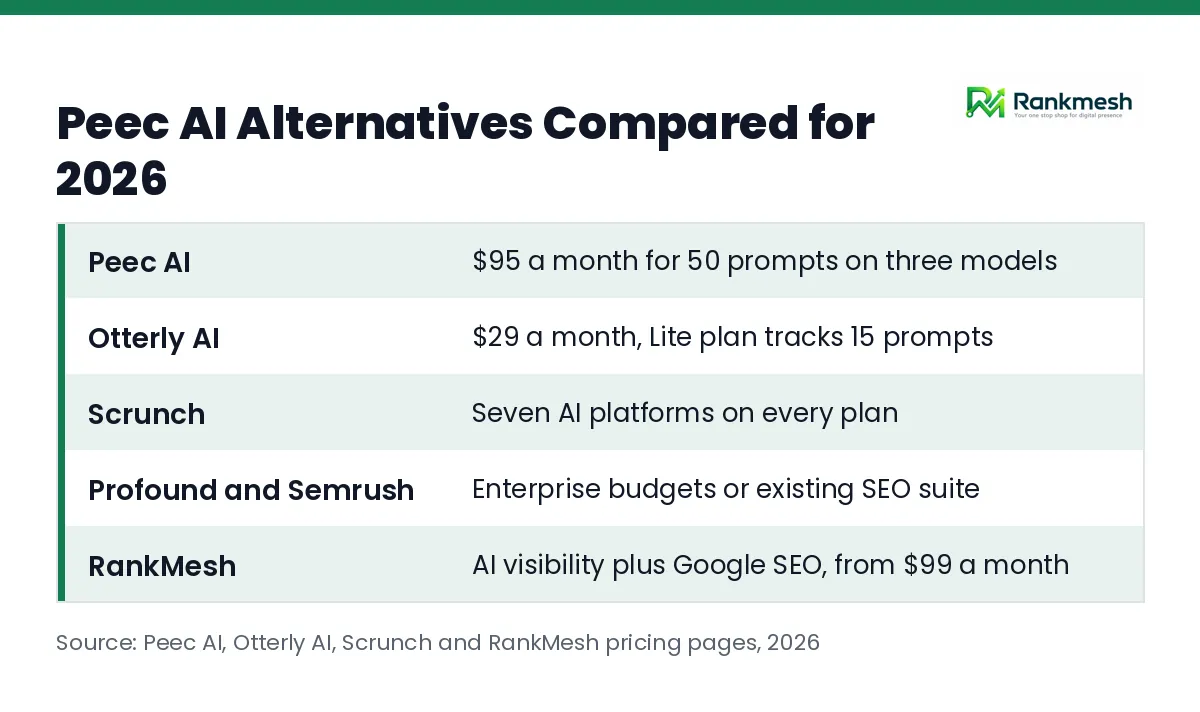
Peec AI starts at $95 a month for 50 prompts on three models you choose, and each extra model is a paid add-on (Peec AI pricing, 2026).
-
Otterly AI is the cheapest paid entry point at $29 a month, but its Lite plan tracks only 15 prompts (Otterly AI pricing, 2026).
-
Scrunch includes ChatGPT, Claude, Gemini, Perplexity, Google AI Mode, AI Overviews and Meta on every plan, which suits teams that want broad coverage from day one (Scrunch pricing, 2026).
-
Profound and Semrush make the most sense for teams with enterprise budgets or an existing SEO suite.
-
RankMesh pairs AI visibility tracking with Google SEO, then drafts content and technical fixes for your approval, starting at $99 a month on Self-Serve (RankMesh pricing, 2026).
What is Peec AI, and why do teams look for a Peec AI alternative?
Peec AI is an AI search analytics tool that runs your chosen prompts through AI models and reports brand mentions, cited sources and competitor visibility. Teams usually look elsewhere for three reasons: only three included models on self-serve plans, add-on fees for extra engines, and the fact that Peec reports problems without fixing them.
How does Peec AI pricing work?
Peec's self-serve plans scale by prompt volume rather than by engine count. Starter costs $95 a month for 50 prompts in one country, Pro costs $245 for 150 prompts across three countries, and Advanced costs $495 for 350 prompts, all limited to three active models (Peec AI pricing, 2026). Enterprise is custom-priced with unlimited prompts and models.
On those self-serve plans, you pick your three models from ChatGPT, Google AI Mode, Google AI Overviews, Microsoft Copilot, Gemini and Naver AI. Claude, Perplexity, Grok and several API-based models appear only on Enterprise, and each extra self-serve model costs $30, $70 or $140 a month depending on your plan (Peec AI pricing, 2026).
The model cap is a deliberate pricing choice rather than a flaw. It works well when you know exactly which assistants your buyers rely on, and it gets expensive when their research spreads across four or five of them.
Why a report alone does not earn citations
The second reason is the distance between a report and a result. Suppose a Peec dashboard shows that ChatGPT names three competitors for "best payroll software for startups" and skips you entirely. Someone still has to write the page, add structured data and confirm that AI crawlers can reach your site, and that work rarely fits neatly into a busy marketing calendar.
The strongest AI visibility tracking tools cover the engines your customers actually use without surprise add-on fees, track enough prompts to reflect real buying questions, and connect visibility data to action. For some teams, that means a cheaper tracker. For others, it means a platform that also writes, fixes and publishes.
Use this checklist when you compare options:
-
Engine coverage. List the assistants your buyers genuinely use. Google AI Overviews are the AI summaries shown above regular search results, while AI Mode is Google's separate conversational search experience, and vendors often price them separately.
-
Prompt volume. A prompt is a single tracked question, such as "best CRM for real estate agents." Start with your core buying questions, then add the comparison and "alternative to" variations that buyers type later in their research.
-
Tracking frequency. Frequent checks catch shifts sooner, because AI answers can change from one week to the next as models refresh the sources they draw on.
-
Google and AI in one view. Separate tools for rankings and citations mean two logins, two reports and two invoices.
-
An action layer. Check whether the tool only flags gaps or also drafts content, deploys schema markup (structured data that labels your page for machines) and fixes technical issues.
-
Human control. Any tool that edits your site should let you approve, reject or reverse each change before or after it goes live.
Why does being named inside the answer matter so much? Because clicks fall sharply once an AI summary appears on the page.
When Google showed an AI summary, users clicked a traditional search result in 8% of visits, compared with 15% when no summary appeared (Pew Research Center, 2025).
Share on LinkedIn · Share on X
If the AI answer recommends a competitor, many searchers never scroll down to your blue link. That turns citation tracking into a revenue question rather than a vanity metric.

Which Peec AI competitors are worth comparing?
Five Peec AI competitors cover most needs. Otterly AI fits low-cost monitoring, Scrunch fits broad engine coverage, and Profound fits enterprise analytics. Semrush suits teams already paying for its SEO suite, while RankMesh suits teams that want tracking tied directly to fixes and content. Each tool balances price, coverage and depth differently.
At a glance
-
RankMesh: from $99 a month on Self-Serve; tracks ChatGPT, Gemini and Perplexity, with Claude and Grok coming soon; best for tracking plus execution (RankMesh pricing, 2026)
-
Otterly AI: from $29 a month for 15 prompts; ChatGPT, AI Overviews, Perplexity and Copilot; best for budget monitoring (Otterly AI pricing, 2026)
-
Scrunch: from $300 a month on monthly billing for 350 custom prompts; seven AI surfaces including Claude and Meta; best for broad coverage (Scrunch pricing, 2026)
-
Profound: custom Enterprise pricing; up to nine answer engines; best for enterprise analytics (Profound pricing, 2026)
-
Semrush: from $199 a month on monthly billing for 50 daily prompts plus the SEO suite; best for existing Semrush users (Semrush pricing, 2026)
RankMesh: best for tracking plus execution
Disclosure: RankMesh is our own product. We include it because it pairs AI visibility tracking with content and technical fixes; judge it on the same published pricing and engine coverage as the other tools here.
RankMesh is an autonomous SEO platform where specialised AI agents, organised into six divisions, audit, fix, publish and track visibility across Google and AI search. Instead of handing you a report, the agent that finds a gap is the same system that drafts the fix, so issues do not sit in a backlog.
The Self-Serve plan costs $99 a month (Rs 10,000 plus GST in India) and covers 200 keywords, 10 competitors and 15 articles, with your team approving the work. Managed costs $399 a month (Rs 40,000 plus GST) and adds 500 keywords, 30 competitors, unlimited articles under fair use, a dedicated account manager, and agents that publish for you (RankMesh pricing, 2026).
AI visibility tracking currently covers ChatGPT, Gemini and Perplexity, with Claude and Grok listed as coming soon (RankMesh pricing, 2026). Technical changes can ship as GitHub pull requests for a developer to review, or publish through a connected CMS such as WordPress, Shopify or Webflow. Every action is logged and can be approved, rejected or reversed.
Trade-off: RankMesh tracks fewer AI engines today than Scrunch or Profound, so teams that only want deep multi-engine analytics may prefer a dedicated tracker. For a closer side-by-side view, see the RankMesh and Peec AI comparison.
Otterly AI: best for low-cost monitoring
Otterly AI lists its Lite plan at $29 a month for 15 prompts across ChatGPT, Google AI Overviews, Perplexity and Microsoft Copilot. Standard costs $189 a month for 100 prompts, and Gemini, Google AI Mode and Claude are paid add-ons on every plan (Otterly AI pricing, 2026).
The pricing page also shows a second, lower set of figures that appears to reflect annual billing, so confirm which rate applies before you commit. Trade-off: Otterly is a monitoring tool, so content creation and technical fixes stay on your team's to-do list.
Scrunch: best for broad engine coverage
Scrunch includes ChatGPT, Claude, Gemini, Perplexity, Google AI Mode, AI Overviews and Meta on every plan. Starter costs $300 a month on monthly billing or $250 a month billed annually, with 350 custom prompts and three user licenses, plus a seven-day free trial that needs no credit card (Scrunch pricing, 2026).
Scrunch also monitors AI agent traffic, meaning visits from AI crawlers to your site, which helps technical teams spot pages that bots cannot reach. Trade-off: the entry price is steep for a solo founder or a very small marketing team.
Profound: best for enterprise analytics
Profound does not publish a self-serve price on its pricing page. Its Enterprise plan is custom-quoted and tracks up to nine answer engines, including ChatGPT, Perplexity, Claude, Gemini, Google AI Mode and AI Overviews, with API access, full data history and SSO (Profound pricing, 2026).
A free trial runs a recommended set of 50 prompts daily for seven days across ChatGPT, Gemini and Google AI Overviews (Profound pricing, 2026). Trade-off: custom pricing means a sales conversation, which slows down smaller teams that want to start this week.
Semrush: best if you already use it
Semrush bundles AI visibility into its SEO plus AI Search tiers rather than selling it as a separate add-on. Starter costs $199 a month on monthly billing with 50 daily prompts, and Pro+ costs $299 with 100 daily prompts (Semrush pricing, 2026).
The same page names Google Search, ChatGPT, Perplexity and Gemini among the covered engines. Trade-off: if you do not already need Semrush's keyword and backlink tools, you are paying for a large suite to reach one feature.
Otterly AI vs Peec AI: what does a mid-sized prompt set cost?
For a team tracking around a hundred buying questions across four engines, Otterly AI usually comes out cheaper than Peec AI, because Otterly includes four engines on its base plans while Peec includes three. The comparison shifts if you need Claude, which Otterly sells as an add-on and Peec reserves for Enterprise.
Picture a B2B SaaS team that wants to track 100 prompts across ChatGPT, Google AI Overviews, Microsoft Copilot and Gemini at monthly list prices (Peec AI pricing, 2026; Otterly AI pricing, 2026):
- Peec AI: Pro covers 150 prompts and three models for $245, and adding Gemini as a fourth model costs $70, for a total of $315 a month (Peec AI pricing, 2026).
- Otterly AI: Standard covers 100 prompts on ChatGPT, AI Overviews, Perplexity and Copilot for $189, and the Gemini add-on costs $59, for a total of $248 a month (Otterly AI pricing, 2026).
In this scenario Otterly costs $67 less per month and adds Perplexity, while Peec leaves headroom for 50 more prompts as your list grows (calculated from Peec AI pricing, 2026 and Otterly AI pricing, 2026).
Neither total includes the hours someone spends turning visibility gaps into new pages, schema updates and crawler fixes. That labour is a real cost, and a subscription-only comparison quietly hides it.

How do you turn AI visibility gaps into citations?
Tracking only shows where you are missing. To earn citations, you need pages that answer buying questions directly, structured data that identifies your brand clearly, consistent entity signals across the web, and a site that AI crawlers can reach. The steps below apply whichever tracker you eventually choose.
-
Pick the prompts that drive revenue. Focus on questions buyers ask right before they choose a vendor, such as "best accounting software for freelancers" or "alternatives to [competitor]."
-
Record who gets cited instead of you. Note which competitors appear and which sources the AI engine quotes, because those sources reveal the kind of page the model trusts.
-
Rewrite the page to answer first. Open each section with a short, direct answer of two or three sentences, then add the supporting detail, examples and proof.
-
Add schema and tighten entity signals. An entity is how search engines and AI models recognise your brand as a distinct thing. Keep your name, description and category consistent across your site, social profiles and Google Business Profile.
-
Check crawler access. Confirm that your robots.txt file does not block AI crawlers such as GPTBot or PerplexityBot from the pages you want cited.
-
Re-measure after the engines re-crawl. AI engines refresh their sources on their own schedules, so compare citation share over several weeks rather than day to day.
RankMesh automates much of this list. Its agents deploy schema, strengthen entity signals and rewrite existing pages into a question-and-answer structure, while high-impact changes wait in your approval panel. You can see how that process works on the AI recommendations page.
Which is the best alternative to Peec AI for your team?
The best alternative to Peec AI depends on what slows your team down. If cost is the problem, start with Otterly AI. If engine coverage is the problem, look at Scrunch or Profound. If the real bottleneck is acting on the data, choose a platform like RankMesh that tracks and executes in one workflow.
- Solo founders and tight budgets: Otterly AI's Lite plan gives you a low-risk starting point for basic monitoring.
- Mid-market teams that need breadth: Scrunch covers the widest set of AI surfaces on its entry plan.
- Enterprises with security and compliance needs: Profound offers SSO, API access and full data history on custom terms.
- Existing Semrush customers: Semrush keeps AI visibility inside the workflow your team already knows.
- Lean teams that need work done, not more reports: RankMesh connects tracking to published content and reviewed technical fixes.
Whichever Peec AI alternative you shortlist, run a trial on your own prompts before committing. Results on a vendor's demo prompts rarely match what you will see for your own category.
What this means for you
For most startups and small businesses, the expensive part of AI visibility is not the tracker. It is the time spent turning a list of missing citations into published pages, schema updates and technical fixes. Choose a tool based on who will do that work.
-
If you run a startup or SMB: see where you stand before paying for any tracker. RankMesh's Free plan includes an AI visibility report and a summary site audit with no card required (RankMesh pricing, 2026).
-
If you are based in India: every other tool in this list that publishes prices does so in US dollars, while RankMesh lists Self-Serve at Rs 10,000 plus GST, which simplifies budgeting and invoicing (RankMesh pricing, 2026).
-
If you run an agency: look for per-client workspaces and white-label reporting. Profound mentions an Agency Growth plan with credits per client workspace, although its price is not published (Profound pricing, 2026).
-
If you are a marketing manager: pick a tool whose output you can hand to leadership, such as citation share by engine and by competitor, alongside your Google rankings.
Frequently asked questions
What is the cheapest alternative to Peec AI?
Otterly AI has the lowest published entry price in this comparison, at $29 a month for 15 prompts on its Lite plan (Otterly AI pricing, 2026). That plan suits basic brand monitoring. Teams that need more prompts or engines will quickly move to a higher tier.
Does Peec AI track Claude and Perplexity?
Only on the Enterprise plan, according to Peec's pricing page (Peec AI pricing, 2026). The self-serve plans let you choose from ChatGPT, Google AI Mode, Google AI Overviews, Microsoft Copilot, Gemini and Naver AI.
Can an AI visibility tool improve my citations, or only measure them?
Most AI visibility tools only measure, leaving the fixes to your team. RankMesh does both: it tracks citations and also deploys schema, strengthens entity signals and rewrites pages, with high-impact changes routed through your approval first.
How long does it take to see changes in AI citations?
Schema and on-page fixes can go live immediately, but AI engines re-crawl and update their sources on their own schedules. RankMesh reports that most brands see initial citation movement within a few weeks, with gains building as more pages are restructured.
See who AI recommends instead of you
If you are comparing a Peec AI alternative because your dashboard keeps showing gaps that nobody has time to fix, start with the data. RankMesh's free plan shows how AI assistants such as ChatGPT and Perplexity currently treat your brand, and the paid plans put agents to work closing those gaps under your approval. Compare RankMesh plans and get your free AI visibility report.