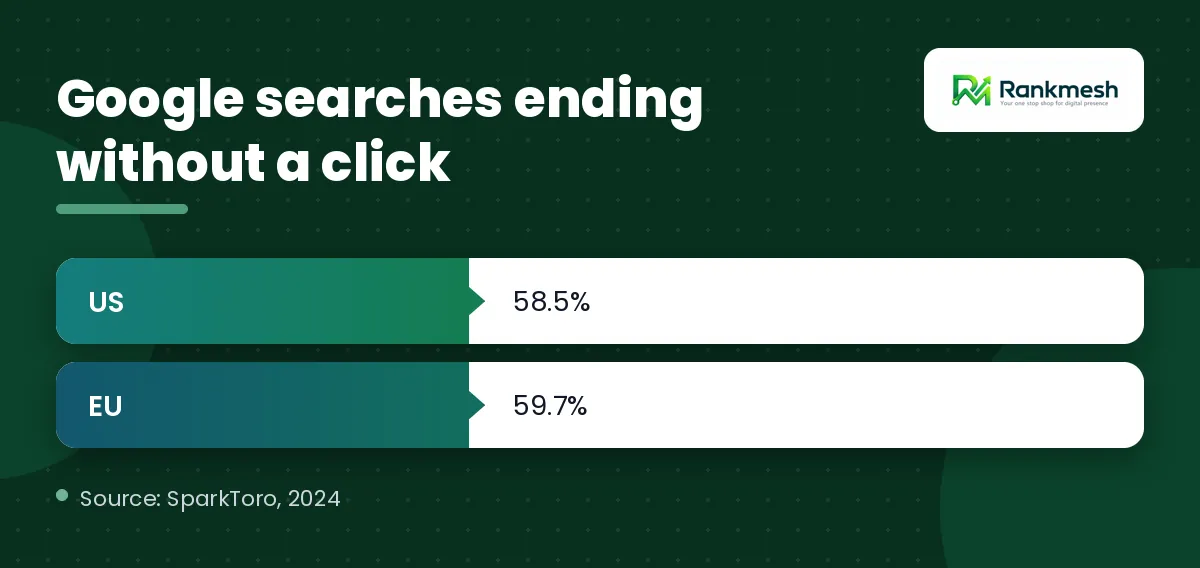
More than half of Google searches now end without a click on any website. SparkToro's 2024 study put the figure at 58.5% in the US and 59.7% in the EU (SparkToro, 2024). That is the zero click search problem, and AI-generated answers are making it bigger. The good news: visibility did not disappear. It moved, and you can follow it.
Key takeaways
- A zero-click query ends on the results page because Google or an AI assistant answers the question right there.
- AI summaries cut clicks hard. Pew Research Center found clicks on regular results nearly halved when an AI summary appeared (Pew Research Center, 2025).
- Not every query is exposed. Quick facts and definitions lose the most clicks, while comparison, pricing and buying queries still send visitors.
- The best response is to become the quoted source: answer-first content, structured data, clear entity signals and an active Google Business Profile.
- Success metrics need to change too. Track impressions, answer-box wins, AI citations and conversions, not just sessions.
At a glance
- What it is: A search that ends without a click on any website.
- Main causes: Featured snippets, AI Overviews, knowledge panels, local map packs and built-in tools like calculators.
- Most exposed queries: Short facts, definitions, conversions, weather, time and simple local lookups.
- Least exposed queries: Detailed research, comparisons, pricing, tools and purchase decisions.
- Best response: Structure content to be quoted, strengthen brand and local signals, and measure visibility beyond clicks.
What is a zero click search?
A zero-click query is a search where the person gets what they need on the results page and leaves, or searches again, without clicking any result. The answer usually comes from a featured snippet, a Google AI Overview, a knowledge panel, a local map pack or a built-in tool such as a unit converter. A website may supply the answer, but it gets no visit.
Here is the zero click searches meaning in one plain line: the searcher got the answer, and nobody got the traffic.
Think about a few everyday searches. Someone types "time in Tokyo," "how many ounces in a cup" or "who founded Airbnb." Google shows the answer at the top of the page, and the person moves on.
SparkToro counts a search as zero-click when the session ends or the person runs a new search without clicking any result (SparkToro, 2024). That definition matters. A no-click session can still be a win for a business if the searcher saw your brand name, your phone number or your review score on the way out.
How common are zero click searches in 2026?
The largest public studies available come from 2024 and 2025, and they point the same way. Most Google searches already ended without a website visit, and AI summaries push click rates down further on the searches where they appear. Treat those figures as a floor for planning, not a ceiling, because AI answers keep spreading.
Here is what the two most cited studies found.
SparkToro and Datos (2024). SparkToro's study used clickstream panel data from Datos to see what happened after real Google searches in the US and EU (SparkToro, 2024). In other words, the no-click outcome was already the majority before AI Overviews became common.
Pew Research Center (2025). Pew analyzed the browsing data of 900 US adults during March 2025, covering 68,879 unique Google searches. About 18% of those searches produced an AI summary (Pew Research Center, 2025).
Google users who saw an AI summary clicked a traditional search result in 8% of visits, compared with 15% for users who saw no summary (Pew Research Center, 2025).
Share on LinkedIn · Share on X
Pew also found that users clicked a link inside the AI summary itself in just 1% of visits. People ended their browsing session on 26% of pages with an AI summary, compared with 16% of pages with only traditional results (Pew Research Center, 2025).
One caution: studies use different data panels and definitions, so you cannot line their numbers up side by side. The direction is consistent, though. Fewer searches lead to website visits, and AI answers speed up that trend.
Why does Google answer so many queries on the results page?
Google answers queries directly because searchers want speed, and an instant answer is the fastest experience. Featured snippets, knowledge panels, local packs and now AI Overviews all serve that goal. AI assistants such as ChatGPT, Gemini and Perplexity take the same idea further by writing a full answer in a chat window.
Each results-page feature removes a different reason to click:
- Featured snippets pull a short passage from one page and show it above the regular results.
- People Also Ask boxes expand into short answers for related questions.
- Knowledge panels show facts about a brand, person or place, drawn from Google's understanding of entities (the people, companies and things it can identify).
- Local map packs show phone numbers, hours, directions and reviews, so a searcher can call without visiting a site.
- AI Overviews summarize several sources into one written answer, with small source links.
The pattern is the same in every case. The page that is easiest to quote gets quoted. Pages that bury the answer under long intros are often skipped, even when they rank well.
Which queries lose the most clicks to zero click results?
Short factual questions lose the most clicks, because one sentence fully satisfies them. Long, question-style searches are the most likely to trigger AI summaries. Queries that need comparison, trust or a purchase decision still send far more visitors, since the searcher needs more than a quick answer.
Pew's data shows how query wording changes exposure. Searches that used question words such as who, what, when or why produced an AI summary 60% of the time. Searches of ten or more words produced one 53% of the time, compared with 8% for one-word or two-word searches (Pew Research Center, 2025).
Based on those patterns and on how results pages look today, here is a practical way to sort your keywords (this grouping is our working guide, not a published study):
- High exposure: Definitions, simple how-to facts, conversions, dates, opening hours and "what is" questions.
- Medium exposure: Broad guides and explainers, where an AI summary may answer the basics but some readers still want depth.
- Low exposure: Product comparisons, pricing pages, templates, calculators, case studies and "best tool for" searches where buyers want to check details for themselves.
If most of your traffic comes from the high exposure group, expect the biggest drop in clicks. If your traffic leans toward commercial intent, your clicks are safer, but your brand still needs to show up inside AI answers.
Is zero-click behavior always bad for business?
No. A no-click search hurts publishers who earn money from page views, but it can still help brands. If the answer box, the AI summary or the map pack names your business, the searcher learns who you are without a visit. That exposure often returns later as a branded search, a direct visit or a phone call.
The real risk is invisibility, not lost clicks. When an AI summary quotes a competitor, you lose the click and the brand moment at the same time.
Competition for those quotes is real. Pew found Wikipedia, YouTube and Reddit were the most cited sources in both AI summaries and standard results, together making up 15% of AI summary sources (Pew Research Center, 2025). Smaller brands need clear, specific, well-structured pages to earn a place next to those giants.
What does zero click search optimization look like in practice?
Good zero click search optimization means structuring your site so Google and AI assistants can quote you accurately, then giving searchers a strong reason to click for more. It combines answer-first writing, structured data, consistent brand signals and local profile upkeep. The aim is to own the answer, not fight it.
Write answer-first sections
Put a short, direct answer right under each question-style heading, then add the detail. Name the subject in each passage instead of writing "it" or "this," so a quoted sentence still makes sense on its own. This is the core of answer engine optimization, and it helps you win featured snippets and People Also Ask boxes.
Add structured data
Schema markup is code that labels your content for machines, such as FAQPage, Product, Organization or LocalBusiness. It helps search engines and AI tools understand what a page says and who published it. Check that your markup is valid and matches what is visible on the page.
Strengthen your entity signals
AI assistants are far more likely to recommend a business they can identify with confidence. Keep your brand name, description, address and category the same across your website, Google Business Profile, LinkedIn and directories. Consistent signals make it easier for tools like ChatGPT and Perplexity to cite and recommend your brand instead of hedging toward a competitor.
Keep your Google Business Profile active
For local businesses, the map pack is the results page. Post updates, add fresh photos, answer questions and reply to reviews. A searcher who calls you straight from the profile never visits your website, yet that is still a customer.
Give people a reason to click
An AI summary can repeat a fact, but it cannot replace original research, a working calculator, a pricing breakdown or a detailed case study. Build pages that hold value beyond the quick answer, and point to them from your answer-first sections.
Let AI crawlers read your site
Check your robots.txt file and firewall settings so the crawlers used by AI search tools are not blocked by accident. The free GPTBot and AI crawler checker shows which AI bots can reach your pages. If they cannot read your pages, they cannot cite them.
How should you measure success when clicks fall?
Measure visibility and outcomes, not just sessions. When answers appear on the results page, a stable or rising number of impressions with fewer clicks can still mean your brand is being seen more. Pair search metrics with business results such as leads, calls and sales to judge real impact.
Useful metrics to track:
- Impressions in Google Search Console: Rising impressions with flat clicks often signal answer features, not lost rankings.
- Answer-box ownership: Which featured snippets and People Also Ask boxes show your page.
- AI citation share: How often ChatGPT, Gemini and Perplexity mention your brand for the questions your buyers ask.
- Branded search volume: Growth in people searching your name is a sign that no-click exposure is working.
- Local actions: Calls, direction requests and website taps from your Google Business Profile.
- Conversions per visit: Fewer but better-qualified visitors can produce more revenue.
If your report only shows sessions, you will read a visibility gain as a failure. Update the dashboard before you change strategy.
What this means for you
The shift does not hit every business the same way, so start with your own traffic mix.
- Startup founders and SaaS teams: Your blog's definition posts will lose clicks first. Move effort toward comparison pages, use cases and product-led content, and make sure AI assistants describe your product correctly.
- E-commerce brands: Product and category pages still earn clicks. Add Product schema, clear specs and honest FAQs so AI shopping answers can quote you.
- Local businesses: Treat your Google Business Profile as your main storefront in search. Fresh posts and quick review replies matter more than ever.
- Marketing managers and agencies: Reset reporting around impressions, citations and conversions so clients see the full picture.
You have three ways to run this work. You can do it yourself with free tools and time. You can hire an agency, which adds human capacity but usually moves on a monthly cycle. Or you can use software: Semrush, Surfer SEO and Frase give you data and content help, while RankMesh (our product) also executes the fixes.
Start with a visibility check
Before you rewrite anything, find out where you stand. Which of your pages are quoted in answer boxes, which AI assistants mention you, and where a competitor gets named instead? RankMesh runs that check and the follow-up work with more than 40 specialized AI agents across six divisions, tracks AI visibility across ChatGPT, Perplexity, Claude and Google AI Overviews, and routes every change through your approval before it goes live. You can start with a free visibility report, and paid plans begin with Self-Serve at $99 a month; see the details on the RankMesh pricing page.
FAQs
Do zero-click queries hurt my Google rankings?
No. Google does not lower your ranking because searchers got an answer without clicking. What drops is your click-through rate, so traffic can fall even when your position stays the same.
Are featured snippets still worth winning if people do not click?
Yes. If you do not hold the answer box, a competitor does, and you lose both the click and the brand exposure. A snippet keeps your name in front of the searcher and still earns clicks from people who want more detail.
How can I tell which of my pages are affected?
Open Google Search Console and compare impressions with clicks over time for each page. Pages with steady or rising impressions but falling click-through rates are usually being answered on the results page. Check those queries by hand to see which feature is showing.
Does AI search visibility matter for small businesses?
Yes. Buyers increasingly ask AI assistants for recommendations, and those tools usually name only a few businesses. Consistent business details, clear service pages and an active Google Business Profile give a small business a fair chance to be one of them.
Is SEO dead because of AI answers?
No, but the goal has widened. SEO now means earning rankings, being quoted in answer features and being cited by AI assistants. The fundamentals of clear content, technical health and trusted brand signals still drive all three.