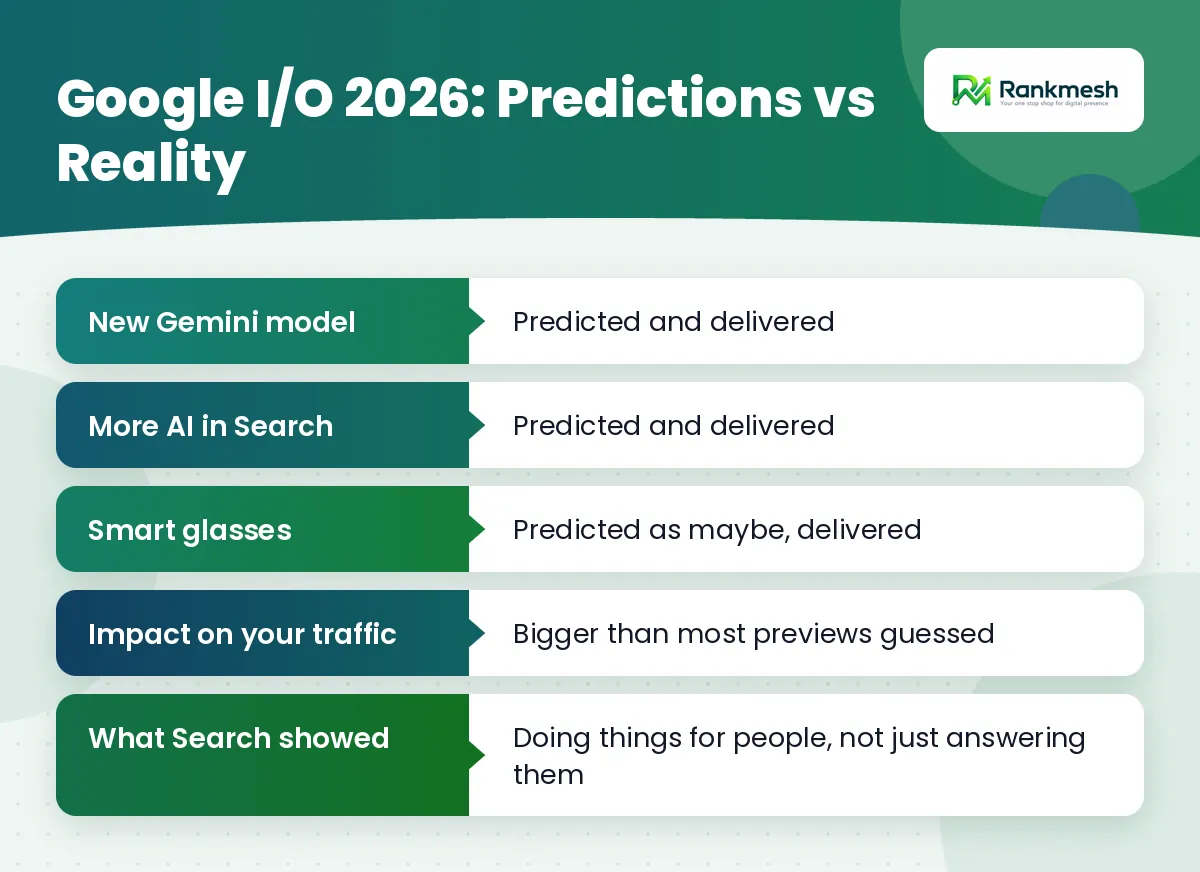
Most Google I/O 2026 predictions said the same thing: a new Gemini model, more AI in Search and maybe some smart glasses. The keynote on May 19, 2026 delivered all of that. The part that matters most for your traffic was bigger than most previews guessed, because Google spent the day showing Search doing things for people, not just answering them.
Six months later, those previews are out of date, and so are some of Google's own May timelines. Here is where things stood when we checked in mid-November 2026. Information agents went live on June 12 for Google AI Ultra subscribers in all AI Mode languages and markets, while AI Pro access was still listed as coming (PPC Land, 2026).
Universal Cart began rolling out in the U.S. on October 15 across Search and the Gemini app (Google, 2026). For Gemini 3.5 Pro, generative UI in Search, expanded agentic booking and the audio glasses, we could not confirm a full launch from an official Google source, so treat their status as unconfirmed. This post checks what came true and what missed, then gives you a step-by-step visibility playbook for local businesses, online stores, SaaS teams and agencies.

RankMesh: one autonomous SEO department for Google and AI search.
Key takeaways
- The safe predictions came true. Gemini 3.5 Flash launched and became the default model in AI Mode for everyone, worldwide.
- Most previews undersold agents: information agents, agentic booking that can call businesses, and Universal Cart for shopping.
- AI Mode did not replace the classic results page. Google made the path into AI Mode shorter and wider instead.
- Ranking reports now miss part of your real visibility, because answers are more conversational and more personal.
- For most businesses, the work comes down to three jobs: be quotable, be bookable and be machine-readable.
At a glance
- Keynote date: May 19, 2026 (Google, 2026)
- Headline model: Gemini 3.5 Flash, the default in AI Mode for everyone globally (Google, 2026)
- AI Mode reach: more than 1 billion monthly users about a year after launch (Google, 2026)
- AI Overviews reach: over 2.5 billion monthly active users (Google, 2026)
- Biggest Search change for SEO: follow-up questions asked from AI Overviews now continue inside AI Mode
- Biggest commerce change: Universal Cart, with checkout powered by the Universal Commerce Protocol (Google, 2026)
- Rolled out worldwide at launch: the new Search box (where AI Mode is available) and AI Overview follow-ups. Booking and Universal Cart started in the U.S.
What did the Google I/O 2026 predictions get right?
The previews got the direction right. Most predicted a new Gemini model, deeper AI inside Google Search and more agent features, and all three happened. Google launched Gemini 3.5 Flash, made it the default model in AI Mode worldwide, and announced agents for Search, developers and personal tasks. Where the previews fell short was scale.
Here is how the most common predictions held up:
- A new Gemini model: Correct. Sundar Pichai said Gemini 3.5 Flash was available that day across Google products and APIs, at less than half the price of comparable frontier models, with Gemini 3.5 Pro due the following month (Google, 2026).
- More AI in Search: Correct, and bigger than expected. Google rebuilt the Search box itself, which we cover below.
- Agents everywhere: Correct. Google announced Antigravity 2.0, a desktop app for running AI agents, and Gemini Spark, a personal agent that runs on dedicated Google Cloud virtual machines (Google, 2026).
- Smart glasses: Partly correct. Google said audio glasses would launch first, later in the fall, and showed display glasses as well (Google, 2026).
The usage numbers explain why Google pushed so hard. Pichai said the Gemini app passed 900 million monthly users, more than doubling in a year (Google, 2026). Google also said AI Mode queries have more than doubled every quarter since launch (Google, 2026).
Which predictions missed or only half landed?
A common prediction that missed was that AI Mode would become everyone's default Google experience, replacing the familiar page of results. Google announced a new default model inside AI Mode, not a new default results page. Classic results stayed. What changed is that getting into AI Mode became much easier, often without the searcher deliberately choosing it.
Two changes drive that shift. Follow-up questions asked from an AI Overview now continue as a conversation in AI Mode, with context carried over, on desktop and mobile worldwide (Google, 2026). The new Search box also accepts text, images, files, videos or Chrome tabs as input.
The second miss was timing. Many previews treated announcements as launches, but several features came with staged rollouts:
- Information agents: "this summer," starting with Google AI Pro and Ultra subscribers.
- Generative UI in Search: "this summer," free for everyone.
- Custom mini apps and trackers: "in the coming months," starting with Pro and Ultra subscribers in the U.S.
- Expanded agentic booking: "this summer," for everyone in the U.S.
All four timelines come from Google's own Search post (Google, 2026). Availability still varies by country and plan, so check what your customers can actually see before you rebuild a strategy around any single feature.
What were the biggest Google I/O 2026 search announcements?
Google announced five Search changes that matter for visibility: a rebuilt AI-powered Search box, follow-ups that carry from AI Overviews into AI Mode, information agents that watch the web for users, generative UI that builds custom answers, and wider Personal Intelligence. Together, these changes make Search more conversational, more personal and more active.
The new AI-powered Search box
Google called the new Search box its "biggest upgrade to our Search box in over 25 years" (Google, 2026). The box expands as people type and suggests better ways to phrase a question. It began rolling out in every country and language where AI Mode is available, and it still returns the usual range of results.
For SEO, longer and richer questions mean fewer short keyword searches. A buyer who once typed "CRM for small business" can now paste a screenshot of a spreadsheet and ask which tool fits that workflow.
Information agents
Information agents run in the background for a user. According to Google, they scan blogs, news, social posts and real-time data such as finance, shopping and sports, then send synthesized updates that can include actions (Google, 2026). Google's examples were apartment listings and sneaker drops.
The visibility lesson is simple. An agent that watches the web can only report your new listing, price change or product drop if that update is published clearly, quickly and somewhere crawlable.
Generative UI and mini apps
Google announced that Search would use Antigravity and Gemini 3.5 Flash to build custom responses on the fly, including interactive visuals, tables, graphs and simulations. Generative UI was announced as free for everyone "this summer" (we could not confirm its full rollout), and custom mini apps were announced for Pro and Ultra subscribers in the U.S. "in the coming months." For ongoing tasks, Search can also build trackers people return to, such as a fitness tracker that pulls in reviews, live maps and local weather (Google, 2026). Your data becomes an ingredient in someone else's interface.
Personal Intelligence in AI Mode
Personal Intelligence expanded to nearly 200 countries and territories in 98 languages, with no subscription required (Google, 2026). Users can choose to connect apps such as Gmail and Google Photos. Two people asking the same question may now get different answers, which is why a single ranking position tells you less than it used to.
How do agentic booking and Universal Cart change local and e-commerce visibility?
Agentic booking and Universal Cart move Google from recommending businesses to completing tasks with them. In the U.S., Search can show live pricing and availability for local experiences and services and, for categories like home repair, beauty and pet care, call businesses for the user (Google announced this for a summer rollout to everyone in the U.S.). Universal Cart tracks prices and supports checkout across merchants.
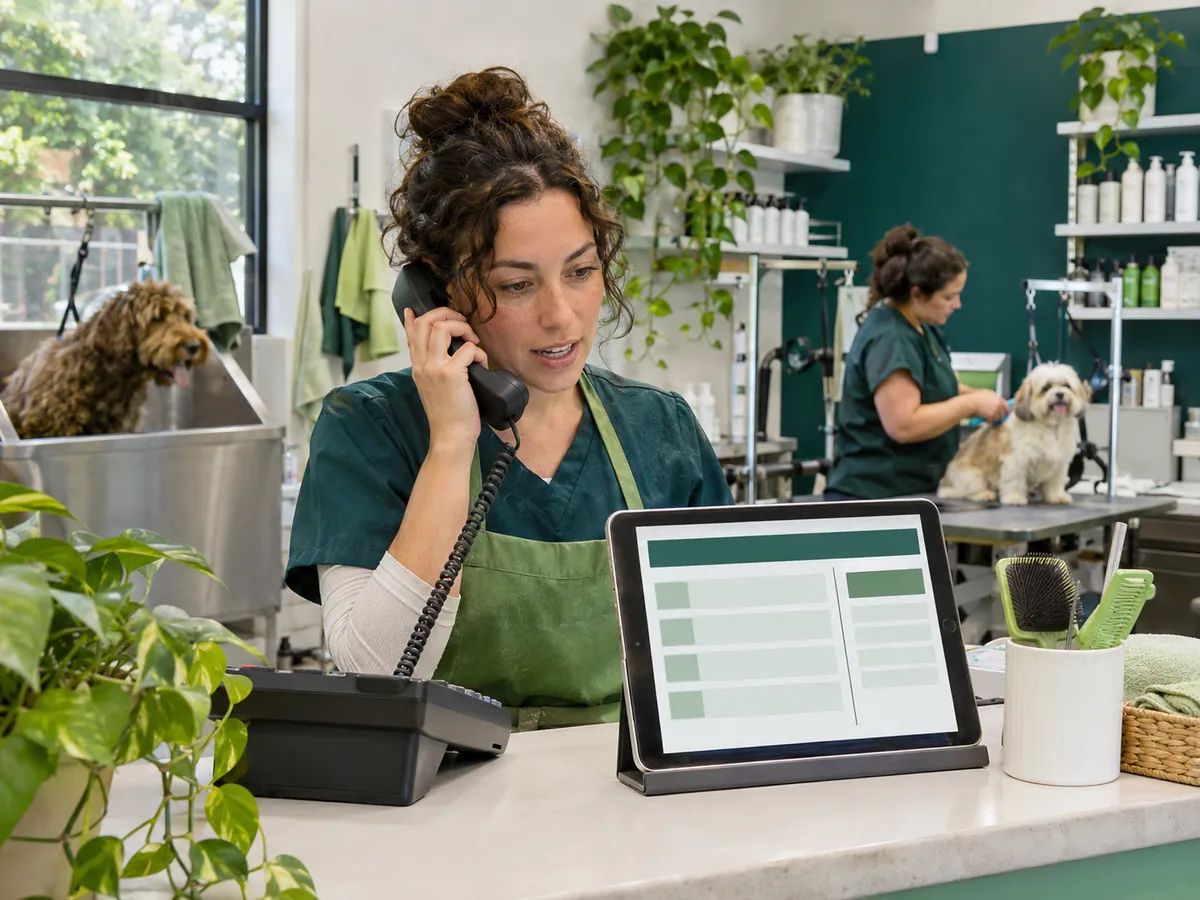
Google's booking example was a private karaoke room for six that serves food late (Google, 2026). Think about what that means for a pet groomer. If Google calls on a customer's behalf, the shop that answers the phone, lists accurate hours and shows clear services wins the job. An outdated listing simply drops out of the shortlist.
That is why a maintained Google Business Profile matters more after I/O, not less. Posts, photos, answered questions and correct categories are the facts an agent reads before it picks up the phone.
Universal Cart works across Search, the Gemini app and later YouTube and Gmail. It watches for price drops, shows price history, alerts shoppers when items are back in stock and can flag incompatible products (Google, 2026). Select checkout features were announced for merchants including Nike, Sephora, Target, Walmart and Shopify stores such as Fenty, and the brand stays the merchant of record.
Underneath sits the Universal Commerce Protocol (UCP), an open standard that gives shopping agents a common language. Google said UCP checkout would expand to Canada and Australia, later the U.K., and into hotel booking and local food delivery (Google, 2026). For Indian and other non-U.S. stores, that staged rollout is a window to clean up product data before agentic checkout reaches your market.
What is the Google I/O 2026 SEO impact?
The main SEO impact is that visibility now happens inside conversations, agents and carts, not only on a list of ten links. Rankings still matter because AI answers pull from the web, but a ranking report alone no longer shows whether Google, ChatGPT or Perplexity actually names your business when a customer asks.
The scale of AI answers makes this hard to ignore:
"AI Overviews now has over 2.5 billion monthly active users." (Google, 2026)
Share on LinkedIn · Share on X
Where AI Mode is available, an AI Overview can now lead straight into an AI Mode conversation. In practice, three jobs decide whether you show up:
- Be quotable: answer the real question in the first 40 to 60 words, then add detail. Pages built this way are what answer engine optimization targets, and they are easier for AI Overviews to cite.
- Be bookable: keep hours, prices, services, stock and contact details accurate everywhere, because agents act on them.
- Be machine-readable: use structured data and describe your brand the same way across your site, profiles and listings, so an AI system can pin down who you are.
What this means for you
The right response depends on how your customers buy. Here is a practical playbook for each audience we work with, written as steps you can start this week.
Local businesses (salons, clinics, repair services, restaurants):
- Audit your Google Business Profile: categories, hours, services, photos and unanswered questions.
- Make sure your listed phone number is answered during listed hours, since Google can now call for select categories in the U.S.
- Publish short service pages that state price ranges, areas served and booking steps in plain words.
E-commerce brands:
- Fix product feeds first: titles, prices, availability and variants must match your site.
- Add Product and Offer structured data to every product page.
- Write comparison and compatibility content, since Universal Cart can flag products that do not work together.
SaaS teams:
- List the long, specific questions buyers ask, such as "best invoicing tool for a 10-person agency in India."
- Rewrite key pages so each one answers a single question in its opening lines.
- Track whether AI answers name you, not just where you rank.
Agencies:
- Add AI visibility to client reports alongside rankings and traffic.
- Move from monthly audits to continuous fixes, because AI answers change faster than a monthly report cycle.
- Keep every change reviewable, so clients can see what moved and why.
This is the gap RankMesh was built for. Its 40+ specialized AI agents, organized into six divisions, handle technical SEO, AI visibility and entity signals, research, local listings, content and reporting. Technical fixes can ship as GitHub pull requests that a human approves before anything merges. AI visibility tracking covers ChatGPT, Perplexity, Claude and Google AI Overviews, with a daily citation monitor for new mentions.
How should you judge Google I/O predictions for 2027 and beyond?
Judge any future prediction by its rollout language, not its demo. This year's Google I/O 2026 predictions were mostly right about direction and mostly wrong about timing. A feature marked "this summer," "in the coming months" or "U.S. first" is a signal to prepare, not a reason to rebuild your whole strategy overnight.
The same filter works for longer forecasts. Over the longer term, our view (an opinion, not a Google statement) is that the fundamentals from this keynote will still hold. Search engines and AI assistants will keep rewarding businesses that are clear, consistent, current and easy to transact with.
A useful habit is to keep a simple log after each event. Note each announcement, its stated rollout, and the date it actually reached your market. Over time, that log tells you more than any preview article.
FAQs
Did the Google I/O 2026 predictions come true?
Mostly, yes. Previews correctly expected a new Gemini model, more AI in Search and more agents, and Google delivered Gemini 3.5 Flash, a new Search box and Search agents. The main misses were the idea that AI Mode would replace classic results and the assumption that every feature would launch on day one.
Is AI Mode now the default Google search?
No. Gemini 3.5 Flash became the default model inside AI Mode, but the classic results page remains. What changed is that follow-up questions from AI Overviews now move users into AI Mode conversations, so more searches end up there.
Are the new Google features available in India?
Some are. The new Search box rolled out in every country and language where AI Mode is available, and Personal Intelligence expanded to nearly 200 countries and territories. Agentic booking and Universal Cart started in the U.S., so Indian businesses should use this time to prepare their listings and product data.
Do I need to change my SEO strategy after Google I/O 2026?
You need to extend it rather than replace it. Keep technical SEO and rankings healthy, then add answer-first content, consistent structured data and accurate business details. Also start tracking whether AI answers mention your brand, because rankings alone no longer show your full visibility.
Find out if AI search is recommending you
Google's keynote made one thing clear: the businesses that get named, booked and bought from are the ones AI systems can understand and trust. Many teams don't yet check whether that is happening for them.
Start with a free check. See whether AI assistants recommend your brand or a competitor, then decide which fixes your team approves and which the agents apply automatically.