Ask Google's AI Mode or ChatGPT one question, and the system rarely runs just that one search. Through query fan out, AI search breaks your question into a cluster of smaller searches, pulls results for each one, and stitches them into a single answer. If your page only answers the headline question, you could be missing most of the searches that decide who gets cited.
Key takeaways
- AI search engines often turn one prompt into many related sub-queries, then build one answer from everything they find.
- Google confirms that both AI Overviews and AI Mode may use this fan-out technique.
- Your page can earn a citation by answering a sub-question well, even if it does not rank for the main query.
- The winning approach is to cover the full cluster of follow-up questions with clear, self-contained answers, not to spin out a thin page for every variation.
- Nobody outside Google can see the exact sub-queries, so treat fan-out generator tools as brainstorming aids rather than ground truth.
At a glance
- What it is: An AI retrieval technique that expands one user question into many related searches.
- Where Google uses it: AI Overviews and AI Mode, according to Google Search Central (accessed 2026).
- Scale: Google says its Deep Search feature can run hundreds of searches for a single request (Google, 2025).
- Can you see the sub-queries? No. Google does not publish the searches it generates.
- Biggest mistake: Creating a separate page for every possible sub-query, which Google warns can break its spam policies.
What is query fan out in AI search?
In AI search, fan-out is a retrieval technique where the system breaks one user question into several related sub-queries, runs those searches at the same time, and combines the results into one answer. Google describes the process as issuing multiple related searches across subtopics and data sources to develop a response.
The name comes from the shape of the process. One question sits at the point of a fan, and many searches spread out from it. "Retrieval" simply means the step where a search system goes and fetches documents that might hold the answer.
Classic Google search worked differently. You typed a query, Google matched it against its index, and you got one ranked list of links. With fan-out, the AI does the follow-up searching for you, the same way a good researcher would check several angles before writing a summary.
Google first named the technique when it introduced AI Mode in March 2025 (Google, 2025) and explained it in more detail at Google I/O two months later:
"AI Mode uses our query fan-out technique, breaking down your question into subtopics and issuing a multitude of queries simultaneously on your behalf." (Google, 2025)
Share on LinkedIn · Share on X
How does the fan-out technique work, step by step?
The fan-out technique works in a loop: the AI reads the question, splits it into subtopics, searches each subtopic in parallel, picks the most useful passages, and writes one combined answer with links. The user sees a single response, but that response was built from many separate searches running behind the scenes.
Here is a simplified version of the flow. Google has confirmed the splitting, parallel searching and combining steps; the passage selection detail is our plain-English reading of how these systems generally behave.
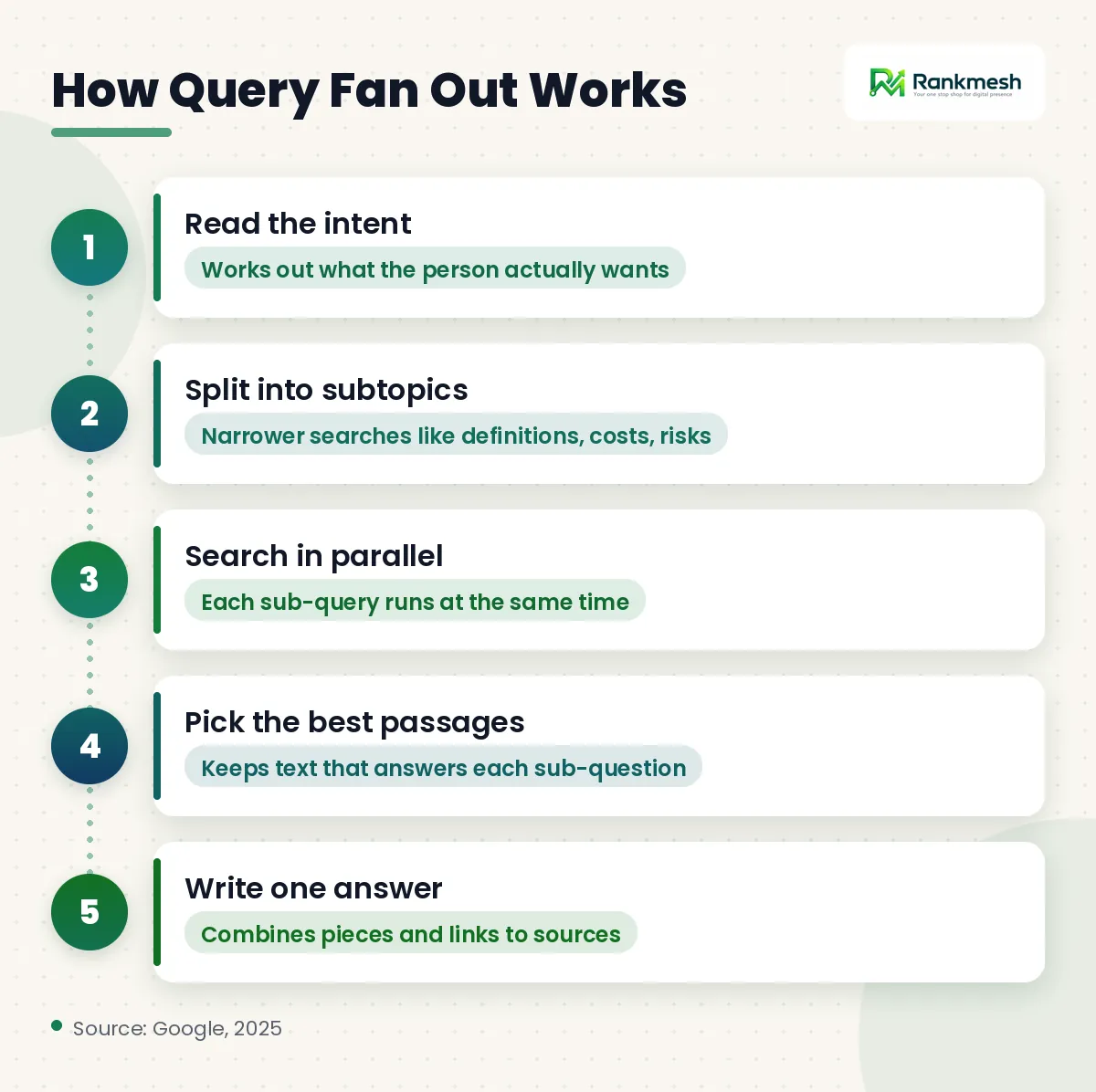
- Read the intent. The model works out what the person actually wants, including needs they did not spell out.
- Split into subtopics. The question becomes a set of narrower searches, such as definitions, comparisons, costs and risks.
- Search in parallel. Each sub-query runs at the same time. Google says AI Mode can also draw on sources like the Knowledge Graph and shopping data for products (Google, 2025).
- Pick the best passages. From all those results, the system keeps the pieces of text that answer each sub-question most clearly.
- Write one answer. The AI combines those pieces into a single response and links to the pages it relied on.
Google notes a side effect that matters a lot for site owners: because of fan-out, AI responses can show "a wider and more diverse set of helpful links" than a classic web search (Google Search Central, accessed 2026). More searches means more chances for pages beyond the usual top three to appear.

What does a fan-out example look like?
A fan-out example starts with one broad question and shows the narrower searches the AI might run to answer it. Google's own documentation uses a lawn care question, and the same pattern applies to business, software and local service searches.
Google's own example
In its guide to generative AI features, Google says the question "how to fix a lawn that's full of weeds" might fan out into searches like "best herbicides for lawns", "remove weeds without chemicals" and "how to prevent weeds in lawn" (Google Search Central, accessed 2026). Notice that each sub-query covers a different need: a product choice, a method and a prevention plan.
A SaaS founder example
Now picture a startup founder who asks an AI assistant: "How do I get my SaaS product recommended by ChatGPT without hiring an agency?" The sub-queries below are our illustration, not output captured from any AI system, but they show how wide one question can spread:
- What is generative engine optimization?
- How do AI assistants choose which brands to cite?
- Does schema markup help with AI citations?
- SEO agency cost versus SEO software
- How to track brand mentions in ChatGPT and Perplexity
- How long does it take to get cited by AI search?
A blog post that only defines "generative engine optimization" can answer one branch. A page that also covers cost, tracking and timelines can be useful for four or five branches.
A local business example
Local searches fan out too. Take "best physiotherapist in Jaipur for a sports knee injury". An AI might plausibly look for clinics near the user, the difference between sports physiotherapy and orthopaedic care, typical session costs in the city, recent patient reviews and opening hours. Again, this list is illustrative.
Most of those sub-questions are answered by a clinic's Google Business Profile, reviews and service pages, not by a single blog post. That is why local visibility in AI answers depends heavily on keeping those listings complete and current.
Why does query fan out matter for SEO?
Fan-out matters for SEO because AI answers are assembled from pages that answer the sub-questions, not only the pages that rank for the main query. A site can earn a citation by owning one strong branch of the fan, while a top-ranking page can be skipped if it ignores the follow-up questions people care about.
This changes how you should think about a keyword. In classic SEO, you picked a term and tried to rank for it. In AI search, the main query is closer to a topic, and the real competition happens across every related search the AI runs.
The good news is that the basics still apply. Google says a page only needs to be indexed and eligible to show with a snippet to appear in its AI features, with no special extra requirements (Google Search Central, accessed 2026). Fan-out does not need a secret trick. It rewards pages that answer real questions clearly and completely.
This is also where answer engine optimization comes in. Answer engine optimization (AEO) means structuring content so search and AI systems can lift a direct answer from it. When each section of your page answers one clear question, each section becomes a candidate for a different sub-query.

How do you optimize content for fan-out queries?
To optimize for fan-out queries, map the follow-up questions around each important topic, then answer them clearly on strong, well-organized pages. Lead each section with a direct answer, back claims with sources, keep your brand details consistent and track whether AI engines actually cite you.
Here is a practical process you can run on your most valuable topics:
- Pick your money questions. Choose five to ten questions that, if answered well, would bring you customers. For a payroll SaaS, that might be "how to run payroll for a small team".
- Map the fan. For each question, list the follow-ups a buyer would ask next. Pull ideas from Google's People Also Ask boxes, sales call notes, support tickets, competitor pages and by asking AI assistants the question yourself.
- Group by intent. Sort the sub-questions into buckets such as definitions, how-to steps, costs, comparisons, risks and local details. Each bucket usually becomes a section or a supporting page.
- Answer first, then explain. Put a short, direct answer of 40 to 60 words right under each heading, then add depth. That gives AI systems a clean passage to quote.
- Write passages that stand alone. Name the subject instead of writing "it" or "this". A paragraph pulled out of context should still make sense.
- Add specifics. Real numbers, named sources, prices, examples and steps make a passage more useful than a generic summary.
- Keep entity signals consistent. Describe your business the same way on your website, profiles and listings, and use structured data (schema markup, the code that labels your content for machines). Our AI recommendations page explains why assistants favour brands they can identify with confidence.
- Check the technical basics. Make sure pages are crawlable, indexed and not buried under duplicate versions.
- Track citations, not just rankings. Test your money questions in AI assistants regularly and note who gets cited.
One balance point: Google says there is no requirement to break content into tiny pieces for AI to understand it (Google Search Central, accessed 2026). Clear headings and direct answers help, but the page should still read naturally for a human.
No tool can show you the exact sub-queries Google or ChatGPT runs, because those systems do not publish them. Fan-out generators and browser extensions use language models to predict likely sub-queries. They are useful for brainstorming, but their output is an estimate, not a record of what the AI actually searched.
That does not make these tools useless. A generator can surface angles you missed, especially for topics outside your daily expertise. Just treat the list the way you would treat a keyword research export: a starting point that needs human judgment.
The more reliable signal is the outcome. If you run the same set of prompts across AI assistants over time and see your brand cited more often, your coverage of the fan is working. If competitors keep getting named and you do not, look at which sub-questions their pages answer that yours skip.
What mistakes should you avoid with fan-out optimization?
The biggest mistake is creating a separate thin page for every possible sub-query. Google warns that making content for each variation mainly to manipulate rankings or AI responses violates its scaled content abuse spam policy. Other common errors include vague writing, inconsistent brand details and judging success only by head-term rankings.
Google's warning is direct. Its guide says creating extra pages for each variation, including fan-out queries, primarily to manipulate rankings or AI answers "violates Google's scaled content abuse spam policy" (Google Search Central, accessed 2026). More pages do not make a site more helpful.
Watch out for these other traps:
- Fragmented content. Fifty tiny pages that each answer half a question are harder to trust than one complete guide.
- Pronoun soup. Passages full of "it" and "they" lose meaning when an AI quotes them alone.
- Inconsistent business details. Different descriptions, addresses or service lists across the web make it harder for AI to pin down who you are.
- Stale local profiles. For local searches, an outdated Google Business Profile can lose the branches about hours, reviews and services.
- Measuring the wrong thing. Ranking for one head term tells you little about how often AI answers cite you.
What this means for you
For founders, small business owners and marketing teams, query fan out turns SEO from a keyword list into a question map. The brands that get cited are the ones that answer the whole cluster of questions a buyer asks, clearly and consistently, across their site and profiles.
In practice, that means a few concrete habits:
- Start small. Map the fan for your top five money questions before you touch anything else.
- Upgrade existing pages first. Adding direct answers and missing sub-topics to pages that already rank is usually faster than publishing new ones.
- Keep a human in the loop. AI can draft and structure, but your team knows the real customer questions, prices and edge cases.
- Measure across platforms. Check whether you appear in ChatGPT, Gemini, Perplexity and Google's AI features, not only in the blue links.
This is the kind of work RankMesh was built to run continuously. Its AI visibility agents restructure pages into direct, quotable answers, deploy schema, keep entity signals consistent and track citations across ChatGPT, Perplexity, Claude and Google AI Overviews. Every change is logged and reviewable, and your team decides what needs approval before it goes live.
Frequently asked questions
What does fan out mean in search?
In search, fan out means one question spreads into many related searches. An AI system runs those searches at the same time and combines the results into one answer, rather than returning a single list of links for one query.
Does query fan out only happen in Google?
Google is the company that has documented the technique most clearly, for AI Overviews and AI Mode. Other AI assistants that search the web, such as ChatGPT and Perplexity, appear to work in a similar way, though they have not published the same level of detail. Treat that as an informed inference rather than a confirmed fact.
Do I need a separate page for every fan-out query?
No. Google warns that creating pages for every variation mainly to manipulate AI answers can violate its scaled content abuse policy. Cover related sub-questions on strong pages and create separate pages only for genuinely distinct needs.
How do I know if fan-out optimization is working?
Test your key questions in AI assistants on a regular schedule and record which brands get cited. Rising citations and appearances in AI answers are better signals than a single head-term ranking.
See which branches of the fan you already own
Every AI answer is built from many small searches, and each one is a chance for your brand to be the source. If you want to know where you stand today, RankMesh offers a free visibility report, and its plans cover teams that want the fixes done for them. Compare RankMesh plans and start with a free report.