Ask ChatGPT to recommend a business like yours. If a competitor's name comes back and yours does not, you have a visibility gap that no traditional rank tracker will show you. A GEO audit tells you why that gap exists, and you can run a useful one in a single afternoon with a spreadsheet, a few browser tabs and the four-hour plan below.
GEO stands for generative engine optimization: the work of getting your brand mentioned and cited inside AI-generated answers from ChatGPT, Gemini, Perplexity and Google AI Overviews. The plan below tests those four surfaces, and if you have time to spare, you can add Claude as an optional fifth engine. This guide skips the theory and gives you a timed plan you can start today.
Key takeaways
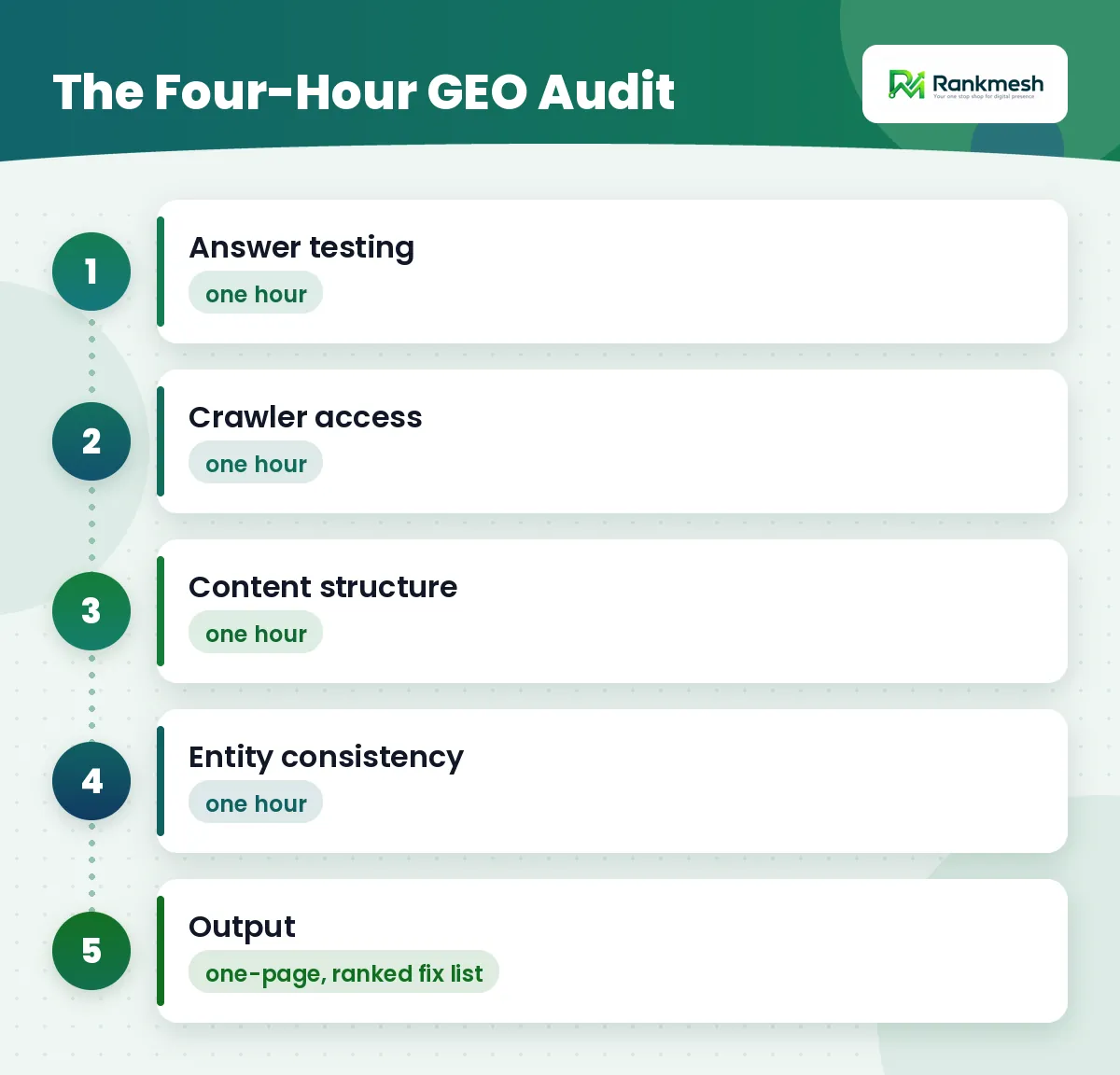
- The afternoon audit splits into four one-hour blocks: answer testing, crawler access, content structure and entity consistency.
- Google says a page only needs to be indexed and eligible to show with a snippet to appear in AI Overviews or AI Mode, with no special schema or AI text file required (Google Search Central, 2026).
- Opting out of OpenAI's search crawler keeps your pages out of ChatGPT search answers, so check your robots.txt file early (OpenAI, 2026).
- The output should be a one-page, ranked fix list, not a 60-slide deck.
- Re-run your prompt tests every month, because AI answers change.
At a glance
- Time: about four hours for one person, plus 15 minutes of prep
- Cost: free if you do it by hand; paid tools are optional
- Tools: ChatGPT, Gemini, Perplexity, Google Search, Google Search Console, a spreadsheet
- Output: a baseline mention rate plus a prioritized fix list
- Best for: founders, marketing managers and agencies auditing a client site
What is a GEO audit, and why can it fit in one afternoon?
A GEO audit is a structured check of whether AI search tools mention your brand, cite your pages and describe you accurately, plus a diagnosis of why they do or do not. The one-afternoon version works because it samples 20 buyer prompts and your 10 most important pages instead of trying to cover everything.
Many published guides describe a multi-week engagement covering hundreds of prompts. That depth has value, but it also delays action. The four-hour version trades breadth for speed and still surfaces the blockers that matter most: crawlers you are accidentally blocking, pages that bury their answers and brand facts that conflict across the web.
Think of the afternoon as triage. You are not writing the final strategy in one sitting. You are finding out where you stand and what to fix first.
What should you prepare before the clock starts?
Spend 15 minutes on setup before Hour 1 begins. You need a prompt list, a competitor list, a short list of priority pages and a spreadsheet to record what you find. Good preparation is what keeps the rest of the afternoon on schedule.
Here is the prep list:
- Write 20 prompts that a real buyer would type. Mix three kinds: category prompts ("best payroll software for startups in India"), comparison prompts ("Brand A vs Brand B for small teams") and problem prompts ("how do I automate payroll compliance for 30 employees").
- Pick three competitors you actually lose deals to, not just the biggest names in your industry.
- List your 10 priority pages: homepage, about page, top product or service pages and your best-performing articles.
- Set up a spreadsheet with columns for prompt, engine, mentioned (yes or no), position in the answer, cited URL, competitors named and accuracy notes.
- Use logged-out or private browser windows where possible, so your own history does not shape the answers.
Here is an illustrative example. A Bengaluru payroll SaaS should phrase prompts the way Indian buyers do, such as "payroll software with PF and ESI filing." Local wording matters, because AI engines answer the exact question asked.
Once the prep is done, work through the GEO audit checklist below one hour at a time. Set a timer for each block and move on when it rings, even if you are tempted to dig deeper.

Hour 1: Do AI engines mention your brand today?
Hour 1 establishes your baseline. To keep it inside 60 minutes, log only mention, citation and competitors as you go, then add accuracy notes when you revisit the answers in Hour 4. Run every prompt in ChatGPT, Gemini and Perplexity, then search the same queries on Google to see whether an AI Overview appears. Record whether your brand is mentioned, which page is cited and which competitors show up instead.
Work through the prompts quickly and log what you see rather than analyzing as you go:
- Mention: Is your brand named at all?
- Position: Are you the first recommendation, one of several, or a footnote?
- Citation: Which URL is linked? Is it your page, a review site or a competitor's comparison article?
- Accuracy: Does the answer get your pricing, location and core offer right?
- Competitors: Who gets named when you do not?
At the end of the hour, calculate a simple mention rate: answers that named you divided by total answers checked. With 20 prompts across four surfaces, that is at most 80 answers. Divide by the number of answers actually returned: log any Google query without an AI Overview as "no AI Overview" and leave it out of the total. The number is rough, but it gives you a baseline to beat next month.
Pay special attention to inaccurate answers. An AI engine repeating last year's pricing or an old office address can do more damage than no mention at all. The cause usually shows up in Hour 4.
Hour 2: Can AI crawlers reach and read your pages?
Hour 2 checks access. If AI crawlers cannot fetch your pages, no amount of content work will earn citations. Open your robots.txt file, confirm the search crawlers for each engine are allowed, then check that your priority pages are indexed and eligible for snippets in Google Search Console.
Start with robots.txt (yourdomain.com/robots.txt). Each AI company runs more than one bot, and they do different jobs:
- OAI-SearchBot (OpenAI): surfaces sites in ChatGPT search. This is the one that matters for visibility.
- GPTBot (OpenAI): collects content that may be used to train OpenAI's models. Blocking it is a separate business decision and does not control search visibility (OpenAI, 2026).
- PerplexityBot: helps sites show up in Perplexity results, and Perplexity says it is not used to crawl content for training foundation models (Perplexity, 2026).
- Googlebot: powers Google Search, which is where AI Overviews and AI Mode draw their supporting links.
- Google-Extended: a robots.txt token that controls whether Google uses your content for Gemini. It does not affect Google Search or AI Overviews.
OpenAI's documentation is blunt about what happens when you block the wrong bot:
"Sites that are opted out of OAI-SearchBot will not be shown in ChatGPT search answers." (OpenAI, 2026)
Share on LinkedIn · Share on X
Next, check the layers above robots.txt. Some CDN and firewall settings block bots by default, so ask your developer whether any bot-fighting rule is active. Both OpenAI and Perplexity recommend allowing requests from their published IP ranges, according to their crawler pages linked above.
Finally, open Google Search Console and inspect each of your 10 priority pages. Confirm they are indexed, and look for nosnippet or max-snippet tags that could stop Google from quoting them. As a precaution, view the raw page source to confirm your main text is in the HTML and not loaded only by JavaScript. If you want a broader site health pass later, our technical SEO checklist covers the rest.
Hour 3: Are your pages easy for AI engines to quote?
Hour 3 reviews content structure on your 10 priority pages. AI engines tend to pull short, self-contained passages that answer a question directly. Check whether each page states its main answer near the top, uses clear headings and names its subject in every key paragraph.
The points below are our working checklist, based on how AI answers quote pages rather than on any published ranking formula. Score each page yes or no:
- Answer first: Does the opening paragraph say what the page offers, for whom and at what price or scope?
- Question headings: Do H2s match how buyers actually ask ("How much does payroll software cost in India?")?
- Standalone passages: Would a paragraph still make sense if quoted alone, without "it" or "this" pointing to something earlier?
- Specific facts: Are numbers, locations, integrations and dates written out instead of implied?
- Fresh signals: Is there a visible last-updated date, and is the information still true?
Here is a quick before-and-after. "Our solution helps teams streamline their workflows with powerful features" gives an AI engine nothing to cite. "Acme Payroll runs monthly payroll, PF and ESI filing for Indian companies with 10 to 500 employees" can be lifted straight into an answer.
You do not need to rewrite pages during the audit. Flag the five weakest pages and note the one sentence each page should open with. Our page on answer engine optimization shows what an answer-first passage looks like in practice.
Hour 4: Do your brand facts match everywhere?
Hour 4 checks entity consistency, meaning whether the web describes your business the same way everywhere. AI engines piece together who you are from many sources. When your name, category, pricing or address conflict between those sources, engines hedge or pick a competitor they can describe with more confidence.
Open these sources side by side and compare the basics:
- Your homepage and about page
- Your Google Business Profile
- LinkedIn and other social profiles
- Review and directory sites your buyers use (for Indian businesses, that may include Justdial or IndiaMART alongside G2 or Clutch)
- Any Wikipedia or Wikidata entry, if one exists
Log every mismatch: an old company name, a discontinued product, a different founding year or a phone number that no longer works. Then go back to the inaccurate AI answers from Hour 1. You will often find the outdated fact sitting on one of these profiles.
Google says no special schema.org markup is needed to appear in AI Overviews (Google Search Central, 2026). Accurate Organization markup that links your official profiles is still good housekeeping. In our view, it helps any system confirm which profiles belong to you.
What should your GEO audit report include?
Your report should fit on one page: a baseline mention rate per engine, the accuracy problems you found, and a ranked list of fixes. Rank each fix by likely impact and effort, so the team knows exactly what to do on Monday morning.
A practical structure looks like this:
- Baseline: mention rate for ChatGPT, Gemini, Perplexity and AI Overviews, plus the three competitors named most often.
- Blockers: any crawler, indexing or snippet issue from Hour 2. These go to the top because they cap everything else.
- Accuracy fixes: wrong facts in AI answers, each traced to its likely source.
- Content fixes: the five pages to restructure, with the new opening sentence for each.
- Entity cleanup: profiles to update, in order of importance.
- Retest date: the day you will run the same 20 prompts again.
Write each fix as an action with an owner. "Allow OAI-SearchBot in robots.txt (developer, 10 minutes)" gets done. "Improve AI crawlability" sits in a backlog for months.
You can run the whole afternoon for free using the AI engines themselves, Google Search Console and a spreadsheet. Paid tools mostly save time on repeat testing and tracking over months, which matters once you move from a one-off audit to ongoing monitoring.
If you are looking for a GEO audit tool free of charge, start with what you already have. Search Console covers indexing and snippet checks, your browser shows robots.txt and page source, and the engines show their own answers. The manual method is slow, but it teaches you how each engine thinks about your category.
When you want automation, the RankMesh Free plan includes an AI visibility report and an automated site audit for one website, with no card required. RankMesh agents monitor citations across ChatGPT, Claude and Perplexity.
What this means for you
The afternoon audit gives you a starting line, not a finish line. AI answers shift as engines update and competitors publish, so a single snapshot goes stale quickly. The real value comes from fixing the top items on your list and measuring again.
Here is how to use the results based on your role:
- Founders: Fix the Hour 2 blockers yourself or with one developer this week. They are usually small changes with outsized effect.
- Marketing managers: Turn the Hour 3 page list into your next content sprint, starting with the pages buyers see first.
- Agencies: Use the one-page report as a client baseline, then show the change in mention rate each month.
- Indian businesses: Test prompts in the phrasing local buyers use, and make sure rupee pricing and city details match across every profile.
If running this every month sounds like a lot, that is the gap RankMesh was built for. Its network of specialised AI agents (up to 40+, depending on plan) keeps checking crawler access, entity signals and AI citations continuously. Technical changes can go out as GitHub pull requests for your team to check before anything merges, or publish through your connected CMS. Every action is logged, and you can approve, reject or reverse it.
Frequently asked questions
How often should you repeat an AI visibility audit?
Re-run your 20 prompts at least once a month, because AI answers change as engines update and competitors publish. Repeat the full four-hour review every quarter, or after a site migration, rebrand or pricing change.
Do I need special schema or an AI text file to appear in AI Overviews?
No. Google says there are no additional technical requirements beyond being indexed and eligible for a snippet, and no special schema.org markup is required. Strong SEO fundamentals and clear, quotable content matter more.
Should I block GPTBot?
That depends on whether you want your content used to train OpenAI's models. GPTBot handles training, while OAI-SearchBot handles ChatGPT search visibility, so you can block one and allow the other in robots.txt.
How long do fixes take to show up in AI answers?
OpenAI says robots.txt changes for search can take about a day to take effect. Content and entity fixes take longer and vary by engine, which is why a monthly retest is the best way to measure progress.
Ready to see where you stand without spending the afternoon? Start with a free AI visibility report and automated site audit on the RankMesh plans page. It takes a few minutes, needs no credit card, and shows whether AI search tools are naming you or your competitors.