AI assistants now answer buying questions before anyone clicks a search result, and most businesses have no reliable way to know whether their name appears in those answers. The best GEO tools close that visibility gap, but they do very different jobs. Some only monitor, some help you write, and a few actually fix what they find.
This guide compares 10 generative engine optimization platforms by the job each one performs. The goal is simple: help you choose the right category of tool the first time, instead of paying for a dashboard that nobody on your team has time to act on.
Key takeaways
- GEO tools fall into three groups: trackers (show where AI assistants mention you), content optimizers (help you write pages AI can quote) and execution platforms (find and fix issues for you).
- A tracker reports your position. Someone on your team still has to make the changes that improve it.
- If you already pay for Semrush or Ahrefs, test their AI visibility features before adding another subscription.
- Run any GEO tool against your own buyer prompts for 30 days before committing to an annual contract.
- For lean teams, the real cost is the hours needed to act on the data, not the license fee.
At a glance
- Best for teams that want fixes shipped, not just measured: RankMesh (tracks, fixes and publishes, with every change reviewable)
- Best for enterprise monitoring: Profound
- Best mid-market tracker: Peec AI
- Best low-cost starter tracker: Otterly.AI
- Best for AI agent readiness: Scrunch AI
- Best for prioritized recommendations: AthenaHQ
- Best if you already use Semrush: Semrush AI Visibility Toolkit
- Best if you already use Ahrefs: Ahrefs Brand Radar
- Best for writing GEO-ready content: Frase
- Best for existing Surfer users: Surfer AI Tracker
A GEO tool helps your brand get mentioned and cited inside AI-generated answers from assistants such as ChatGPT, Gemini, Perplexity and Google AI Overviews. Generative engine optimization (GEO) software tracks which prompts mention you, reveals which sources AI engines trust, and in some cases changes your pages so they are easier for AI systems to quote.
A handful of terms come up in every GEO tool demo, so here they are in plain English:
- Prompt: the question a person types into an AI assistant, such as "best CRM for a 10-person sales team."
- Mention: the AI names your brand somewhere in its answer.
- Citation: the AI links to your page as a source for its answer.
- Share of voice: how often your brand appears across a set of prompts compared with your competitors.
- Entity signals: consistent facts about your business (name, category, location, founders) that help an AI model recognize exactly who you are.
GEO overlaps heavily with answer engine optimization (AEO), which focuses on structuring pages so a search engine can lift a direct answer from them. For the AEO side in depth, read our guide to answer engine optimization. In practice, people searching for the best AEO GEO tools usually want a single platform that handles both disciplines.
Judge a GEO tool on six criteria: which AI engines it covers, whether you control the prompts, whether it shows the sources AI cites, whether it recommends specific fixes, how it fits your current stack, and how many team hours it takes to act on its findings. Dashboards look similar. These six criteria do not.
Use this checklist on every demo call:
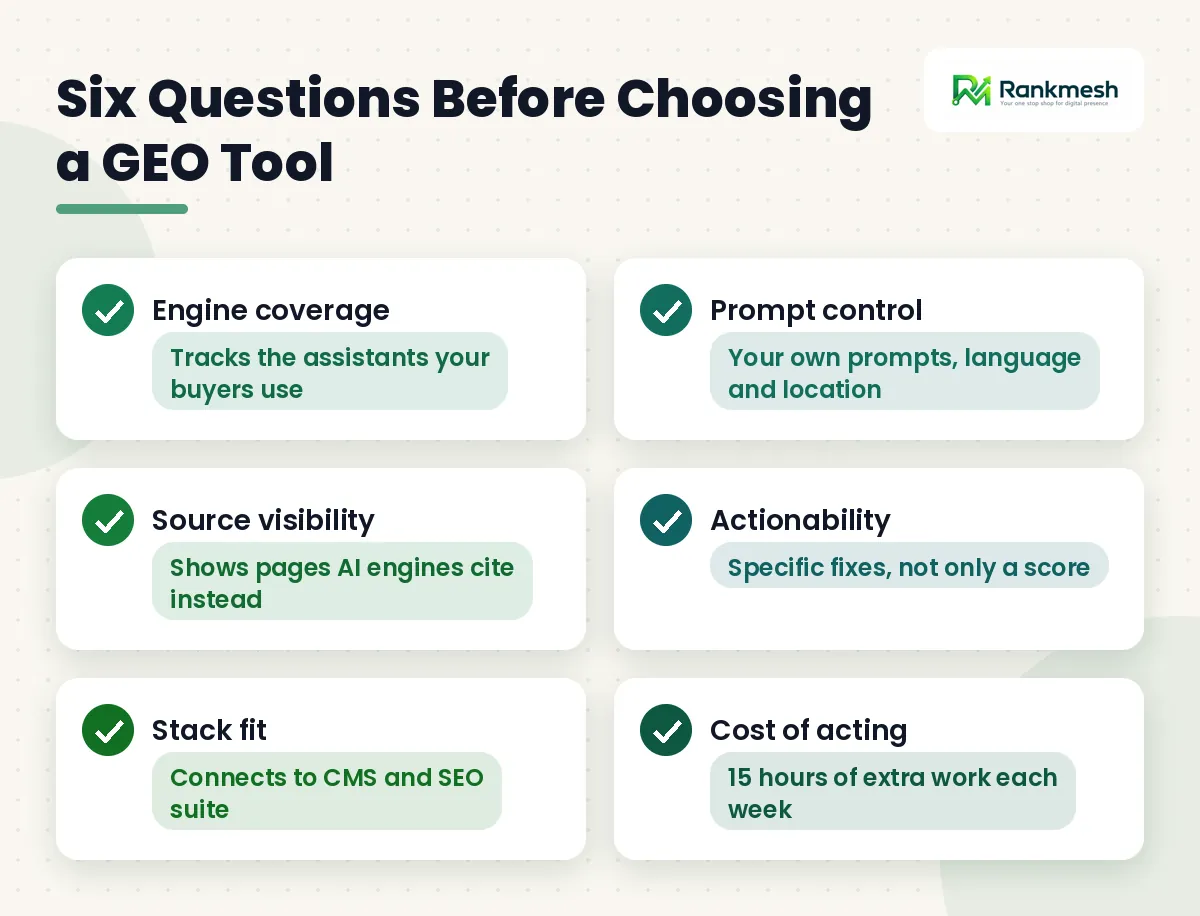
- Engine coverage: Does the tool track the assistants your buyers actually use? Ask which engines are included in the base price and which cost extra.
- Prompt control: Can you add your own prompts, written in your market's language and tied to your location?
- Source visibility: Does it show which pages and websites AI engines cite when they skip you? That list becomes your content and outreach plan.
- Actionability: Does it give specific fixes, or only a visibility score?
- Stack fit: Does it connect to your CMS (WordPress, Shopify, Webflow) and your existing SEO suite?
- Cost of acting: Who will make the changes? An inexpensive tracker that creates 15 hours of extra work each week is not actually inexpensive.
That last point matters most. Even the best GEO audit tools only produce a list of problems, so the deciding question is who will fix them and how quickly.
The tool notes below are based on public product information as of November 2026. Features and prices in this category change frequently, so confirm current details on each vendor's own website before you buy.

The 10 platforms below cover all three jobs: tracking, content and execution. Profound, Peec AI, Otterly.AI, Scrunch AI, Semrush, Ahrefs and Surfer's AI Tracker measure AI visibility. Frase supports content creation. RankMesh, and to a lesser degree AthenaHQ, move from insight to action. Choose by the job you need done, not by the longest feature list.
1. RankMesh: best for teams that want the work done, not just measured
RankMesh is our product, so weigh this entry with that in mind. RankMesh runs 40+ specialized AI agents across six divisions (technical SEO, AI visibility and entity signals, keyword and competitor research, local listings, content and reporting) against your connected website (RankMesh pricing, 2026). AI visibility tracking currently covers ChatGPT, Gemini and Perplexity, with Claude and Grok tracking coming soon.
The difference is execution. Technical fixes can ship as GitHub pull requests for a developer to review, or publish through a connected CMS such as WordPress, Shopify, Webflow, Framer, Wix or Notion Sites. Every action is logged, and you can approve, reject or reverse any change. Google Business Profile posts, photos, Q&A and review replies are kept active as part of the same workflow.
- Pricing: Free plan; Self-Serve at $99 a month (Rs 10,000 + GST in India) with 200 keywords, 10 competitors and 15 articles, approved by your team; Managed at $399 a month (Rs 40,000 + GST) with 500 keywords, 30 competitors, unlimited articles and a dedicated account manager; Enterprise is quoted (RankMesh pricing, 2026).
- Watch out for: RankMesh is broader than a pure tracker. If you only want a monitoring dashboard, it is more platform than you need.
Dedicated trackers are the right choice when you have writers and developers ready to act, and you mainly need reliable measurement. Profound suits enterprises, Peec AI suits mid-market teams, Otterly.AI suits budget-conscious starters, and Scrunch AI and AthenaHQ add guidance on what to change next.
2. Profound: best for enterprise monitoring
Profound is built for large brands that need detailed AI visibility reporting across many answer engines, regions and product lines. Its strength is depth of analysis for teams with dedicated SEO and content staff.
- Best for: enterprise marketing teams with budget and in-house execution capacity.
- Watch out for: pricing and onboarding are typically sized for larger organizations.
3. Peec AI: best mid-market tracker
Peec AI tracks brand visibility, position and the sources AI engines cite, with a cleaner interface aimed at growing teams. Its source analysis helps you see which third-party sites shape AI answers in your category.
- Best for: marketing managers who want competitor benchmarks without enterprise complexity.
- Watch out for: fixes still depend on your own team.
4. Otterly.AI: best low-cost starter tracker
Otterly.AI offers an accessible entry point for monitoring prompts across major AI assistants. It works well as a first experiment to find out whether AI engines mention you at all.
- Best for: founders and small businesses testing GEO for the first time.
- Watch out for: lower tiers limit how many prompts you can track.
5. Scrunch AI: best for AI agent readiness
Scrunch AI pairs visibility monitoring with a focus on how AI crawlers and agents read your website. That makes Scrunch AI useful for brands with complex sites that AI systems struggle to parse.
- Best for: larger sites worried about crawlability by AI systems.
- Watch out for: you still need technical resources to act on the findings.
6. AthenaHQ: best for prioritized recommendations
AthenaHQ combines tracking with suggested actions, ranking what to work on next. AthenaHQ sits between a pure tracker and an execution platform.
- Best for: lean teams that want a clear to-do list.
- Watch out for: recommendations still require someone to implement them.

If your team already uses Semrush, Ahrefs, Frase or Surfer, start with the AI visibility features those vendors now offer. Add-ons are rarely as deep as dedicated trackers, but they keep data in one place and often cost less than a new subscription.
7. Semrush AI Visibility Toolkit
Semrush has extended its SEO suite with AI visibility reporting, so existing customers can compare traditional rankings and AI mentions side by side. It is a sensible first test before buying a separate tracker.
- Watch out for: AI features may be priced as an add-on to your current plan.
8. Ahrefs Brand Radar
Ahrefs Brand Radar monitors how often your brand appears in AI answers, drawing on Ahrefs' large data set. It suits teams already doing backlink and content research inside Ahrefs.
- Watch out for: Brand Radar measures visibility but does not change your pages.
9. Frase
Frase helps writers build pages structured for both search engines and AI answers, with research and optimization features in one editor. Frase fits content-led teams publishing frequently.
- Watch out for: Frase improves content but does not handle technical fixes or local listings.
10. Surfer AI Tracker
Surfer's AI Tracker adds AI visibility monitoring alongside Surfer's well-known content editor. It is the natural choice for teams already writing inside Surfer.
- Watch out for: technical SEO fixes and local listings are outside its scope.
Buy a tracker if you already have people with spare hours to rewrite pages, add schema and pursue citations. Choose an execution platform if your bottleneck is capacity rather than data. Most small teams discover that the insight was never the problem; finding time to act on it was.
Our view at RankMesh: a recurring report still needs someone to read it and act, which is why our SEO automation fixes what it finds.
Share on LinkedIn · Share on X
The best GEO optimization tools therefore depend on your team shape. An agency with five content writers can get excellent value from Peec AI plus Frase. A two-person startup with no SEO hire will usually get further with a platform that ships fixes for review.
Test a GEO tool by tracking 20 to 30 real buyer prompts for four weeks, recording where competitors appear instead of you, making a few targeted changes, and checking whether mentions shift. A short, structured trial tells you far more than a polished sales demo.
Here is a practical sequence. As a hypothetical example, imagine a Bengaluru payroll software startup running the trial:
- Week 1, build the prompt set: list questions buyers really ask, such as "best payroll software for startups in India" or "payroll tool that handles PF and ESI." Include comparison and price questions.
- Week 1, record a baseline: note which brands appear, which pages are cited and how often you are named.
- Week 2, study the sources: identify the review sites, directories and articles AI engines cite for those prompts.
- Week 3, make targeted changes: add direct-answer sections, fix structured data, update your Google Business Profile and pitch two or three cited sources.
- Week 4, compare and decide: check whether mentions moved, and count the hours your team spent acting on the tool's findings.
AI answers vary from one session to the next, so treat a 30-day result as a direction rather than proof. The hours count in step 5 is often the most revealing number of the trial.
For Indian startups and small businesses, the strongest choice is a tool that supports local prompts, publishes clear rupee pricing with GST, and reduces manual work. Small teams rarely have a dedicated SEO specialist, so execution matters more here than extra dashboards.
Indian buyers often search with city names, price questions in rupees and "near me" phrasing, so make sure the tool lets you track those exact prompts. Local visibility also leans on an active Google Business Profile, which many pure trackers do not manage.
Billing deserves a check as well. Many international tools bill only in US dollars, so check with your accountant how that fits your GST filing. RankMesh, built by a team in Jaipur, lists rupee pricing plus GST on its pricing page (RankMesh pricing, 2026).
What this means for you
Your ideal GEO setup depends on who will do the work after the dashboard loads:
- Startup founders: begin with a free AI visibility report, then choose a platform that ships fixes, because you do not have spare hours to act on raw data.
- Marketing managers: test the AI features inside your current SEO suite first, then add a dedicated tracker only if the gaps are clear.
- Agencies: pair a tracker with a content tool, and show clients the sources AI engines cite so your outreach plan is defensible.
- E-commerce and SaaS brands: prioritize prompt control for product comparisons and "alternatives" queries, since those prompts sit closest to a purchase.
- Local businesses: make sure your tool keeps your Google Business Profile active, not only your website.
Whatever you choose, keep a human in the approval loop. Changes that affect your brand, pricing or product claims should always be reviewed before they go live.
Frequently asked questions
What is the difference between GEO and SEO?
SEO aims to rank your pages in traditional search results, while GEO aims to get your brand mentioned and cited inside AI-generated answers. Both reward clear structure, accurate entity information and content that directly answers questions, so most teams work on them together.
Are free GEO tools worth using?
Free GEO tools and free plans are useful for a baseline check of whether AI assistants mention you at all. They usually limit prompts and engines, so treat them as a starting point rather than an ongoing strategy.
How long does it take to see results from GEO?
There is no fixed timeline, because AI engines update their sources and answers at different speeds. Track a consistent set of prompts for at least a month before judging any change, and expect answers to vary between sessions.
Do I need a separate GEO tool if I already use Semrush or Ahrefs?
Not necessarily. Test the AI visibility features in your current suite first, and add a dedicated tool only if you need deeper prompt control, source analysis or help executing fixes.
Find out where you stand before you buy anything
The best GEO tools are the ones your team will actually act on, so start with evidence rather than a sales demo. RankMesh offers a free AI visibility report and automated site audit with no card required, showing whether AI assistants mention your brand or a competitor today.
Compare RankMesh plans and get your free AI visibility report