Most SEO problems are easy to detect and surprisingly hard to get fixed. An audit flags a missing canonical tag, a malformed schema block and a dormant Google Business Profile, and then the list waits for a developer, a writer or the next monthly agency call. AI SEO agents exist to close that execution gap: they detect the issue, prepare the fix and ship it once a person approves.
This guide walks through that workflow step by step, including the trade-offs, the approval controls and the planning math behind the investment.
Key takeaways
- An AI SEO agent carries a task from detection to verified fix, whereas a conventional tool usually stops at the report.
- The safest deployments route technical changes through GitHub pull requests or CMS drafts, so a named person approves each change before it goes live.
- When comparing platforms, ask who actually ships the change and whether it can be reversed, not how many features appear on the pricing page.
- Treat ROI as planning math built from hours recovered, work shipped and visibility gained, never as a guaranteed outcome.
- Agents still depend on you for brand context, product facts and high-impact decisions.
At a glance
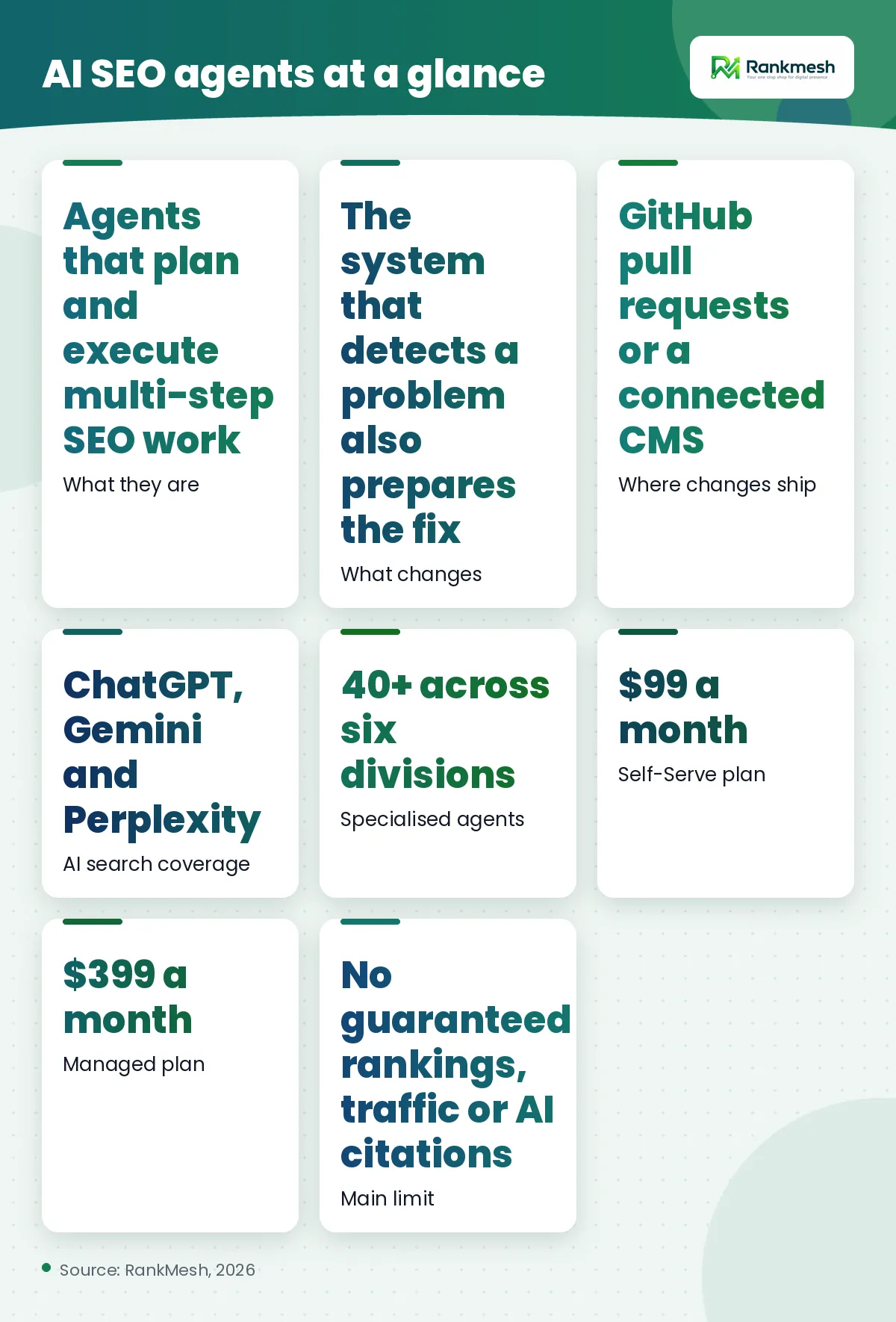
- What they are: Software agents that plan and execute multi-step SEO work, including auditing, fixing, publishing and monitoring.
- What changes: The system that detects a problem also prepares the fix, so work stops accumulating in a backlog.
- Where changes ship: GitHub pull requests or a connected CMS such as WordPress, Shopify, Webflow, Framer, Wix or Notion Sites.
- AI search coverage (RankMesh): ChatGPT, Gemini and Perplexity.
- Scale (RankMesh): 40+ specialised agents across six divisions (RankMesh, 2026).
- Cost (RankMesh): Free plan, Self-Serve at $99 a month, Managed at $399 a month, Enterprise quoted (RankMesh pricing, 2026).
- Main limit: No agent can guarantee rankings, traffic or AI citations.
An AI SEO agent is software that takes an SEO goal, breaks it into steps, uses real tools such as crawlers, CMS connections and code repositories, and then finishes the work instead of just reporting on it. A conventional SEO tool surfaces the problem; an agent drafts the fix, routes it for approval and verifies the outcome.
The term 'agent' describes a control loop: observe, plan, act and verify. A large language model (LLM), the class of AI model behind ChatGPT and Gemini, supplies the reasoning, such as working out which URLs a faulty template affects. The surrounding tool layer, meaning the software that coordinates tools, permissions and logs, supplies the action, such as editing a file or publishing a post.
Specialisation separates a dependable agent system from a general chatbot with plugins bolted on. RankMesh, for example, runs 40+ specialised agents organised into six divisions, and each agent owns one narrow responsibility (RankMesh, 2026).
Each agent has one job and does it continuously, instead of once a month in an audit deck. (RankMesh, 2026)
Share on LinkedIn · Share on X
Continuous operation matters because SEO quality degrades constantly. Deployments break templates, competitors publish new pages and AI-generated answers shift from week to week, so a quarterly audit is partly outdated by the time anyone acts on it.
What does an agentic SEO workflow look like, from detection to merged fix?
An agentic SEO workflow operates as a closed loop. One agent detects an issue, scopes it, drafts the change and submits it for review through a pull request or CMS draft. After approval, the change ships, the page is re-crawled to confirm the result, and the action is logged so anyone on the team can reverse it.
Consider an entry of the kind RankMesh shows in its sample action log: a missing canonical tag fixed on 12 product pages and shipped through a pull request (RankMesh, 2026). A canonical tag is a line of HTML that tells search engines which version of a page is authoritative. Without one, product variants and filtered URLs can compete against each other and dilute ranking signals.
Here is how that fix moves through the loop:
- Detect. A technical crawl agent identifies product pages that render without a canonical tag.
- Diagnose. The agent determines whether the affected pages share a theme template or were edited individually, because a shared template means a single fix resolves every instance.
- Draft. The agent writes the change at the template level rather than patching pages one at a time.
- Open a pull request. A pull request (PR) is a proposed code change on GitHub that displays exactly which lines change and why; nothing merges until a reviewer accepts it.
- Review. Your developer or marketer approves, rejects or comments on the proposed change.
- Verify. After the merge, the site is re-crawled to confirm the canonical tags now render on every affected URL.
- Log. The action enters a shared log, so any team member can audit or reverse it later.
The pull request stage is the part most explanations skip, and it is arguably the most important. It provides version control, a readable record of every change and a straightforward rollback path. For engineering teams researching SEO AI agents on GitHub, that is the practical advantage: the agent works inside the review process developers already trust rather than around it.
On CMS-based sites, the same loop runs through the platform's publishing workflow instead of a code repository. RankMesh lets customers approve, reject, auto-approve or reverse any action, so routine fixes can flow automatically while high-impact changes still wait for a human decision (RankMesh, 2026).

Which SEO tasks can agents handle continuously?
Agents perform best on work that is repetitive, rules-based and verifiable: technical health checks, structured data deployment, keyword and competitor monitoring, Google Business Profile upkeep, content refreshes and reporting. Strategic positioning, original expertise and brand judgement still require people, so the strongest setups divide labour deliberately rather than automating everything indiscriminately.
RankMesh organises its agents into six divisions, which also works as a useful checklist when evaluating any agent platform (RankMesh, 2026):
- Technical SEO: crawlability, site health, canonicals, redirects and template-level fixes.
- AI visibility and entity signals: structured data and consistent business facts that help AI assistants identify and cite a brand.
- Keyword and competitor research: tracking ranking movement and the pages competitors publish.
- Local listings and reputation: keeping Google Business Profile posts, photos, Q&A and review responses active.
- Content and authority building: publishing articles, refreshing existing pages and running backlink outreach.
- Reporting: a single log of what changed, why it changed and what happened afterwards.
Entity signals deserve a precise definition because they increasingly determine AI visibility. An entity is a distinct thing a search engine or language model can recognise, such as your company, founder or product. Entity signals are the consistent facts (name, address, category, offerings) that let a model identify that entity confidently instead of hedging toward a competitor.
How do AI SEO agents compare with Surfer SEO competitors and agency retainers?
Most tools in this category, including Surfer SEO and its usual alternatives, are research or optimisation products: they recommend changes, and your team implements them. Agency retainers add human capacity but typically operate in monthly cycles. Agent platforms attempt to connect diagnosis, execution and reporting so the work actually ships, with approvals preserved.
The summary below reflects how these vendors publicly position their products. Feature sets change frequently, so verify current capabilities with each vendor before you buy.
At a glance
- Content optimisation tools (Surfer SEO, Frase): strong on briefs and on-page scoring; a person still edits and publishes.
- All-in-one suites (Semrush, SearchAtlas): broad research, auditing and tracking; implementation depth varies by product and plan, so confirm what ships automatically.
- Enterprise platforms (BrightEdge): built for large organisations with reporting and governance needs; usually paired with in-house teams.
- Traditional retainer agency: human strategy and execution; pace depends on team capacity and business hours.
- Autonomous agent platform (RankMesh): continuous detection and fixing, shipped via pull request or CMS, with approve, reject and reverse controls.
The decisive question is not which product has the longest feature list. Ask who ships the change, how long a detected issue waits before it is resolved, and whether every change can be audited and reversed. A tool that produces an excellent report still depends on someone reading it and acting on it.

How should you calculate AI SEO ROI before you commit?
Calculate AI SEO ROI as planning math, not a promise. Compare what you currently spend, in money and staff time, to get SEO work shipped against the platform cost, then estimate the value of work that would otherwise sit in a backlog. Rankings, traffic and AI citations are possible outcomes, never guaranteed ones.
A defensible estimate follows a repeatable sequence:
- Baseline your current cost. Add tool subscriptions, any agency retainer and the internal hours your team spends on audits, fixes, publishing and reporting, valued at a realistic hourly rate.
- Measure your backlog. Count open SEO issues and unpublished content ideas, and note how long a typical fix waits before it ships.
- Price the alternative. Use the vendor's published pricing rather than a sales estimate.
- Estimate recovered capacity. Hours your team no longer spends on routine execution can shift to strategy, sales enablement or product marketing.
- Track leading indicators first. Watch fix throughput, pages published and citation share on tracked prompts before expecting revenue movement.
For reference, RankMesh lists Self-Serve at $99 a month (Rs 10,000 + GST in India) with 200 keywords, 10 competitors and 15 articles, approved by your team (RankMesh pricing, 2026). Managed costs $399 a month (Rs 40,000 + GST) with 500 keywords, 30 competitors, unlimited articles and a dedicated account manager who publishes for you (RankMesh pricing, 2026).
For Indian businesses weighing an AI SEO agency in India against software, rupee-denominated plans make the comparison direct: place the plan price beside a local retainer quote and the hours your team currently spends. For a fuller model, see our breakdown of the ROI of automated SEO with AI agents.
Keep timing assumptions conservative. Schema and entity fixes deploy immediately, but AI engines re-crawl on their own schedules, so most brands see initial citation movement within a few weeks rather than days (RankMesh, 2026).
How do agents earn visibility in ChatGPT, Gemini and Perplexity?
Agents improve AI visibility by making a brand easy for language models to parse and quote. They deploy structured data, keep entity facts consistent across the web and restructure pages so each core question is answered directly in the opening sentences. Then they monitor whether tracked prompts actually return the brand in AI-generated answers.
Two disciplines underpin that work. Generative Engine Optimization (GEO) optimises content, structured data and entity signals so AI assistants cite and recommend a brand. Answer Engine Optimization (AEO) structures pages so search engines and assistants can extract a direct, quotable answer for featured snippets, People Also Ask boxes, voice assistants and AI Overviews.
In practice, RankMesh's AI recommendations agents scan ChatGPT, Perplexity and Gemini daily, compare your citation share with competitors and track the specific prompts you add, week by week. Existing pages also get rewritten into the cited-fact and Q&A structure that assistants tend to quote.
What are the limits and risks of agent-driven SEO?
Agents can misjudge context, ship changes that conflict with brand guidelines or optimise aggressively for a metric that carries little commercial weight. The mitigation is governance: scoped permissions, mandatory review for high-impact changes, complete action logs and a fast rollback path. Without those controls, automation simply produces mistakes faster.
Practical guardrails worth insisting on:
- Scope permissions narrowly: grant repository or CMS access only to the areas agents genuinely need.
- Require review for high-impact changes: templates, redirects, navigation and pricing pages should never merge unreviewed.
- Supply brand context: document product facts, tone and claims your business cannot legally or ethically make.
- Audit the log regularly: a weekly scan of shipped actions catches drift before it compounds.
- Distrust guarantees: any vendor promising specific rankings or citation counts is overselling.
RankMesh pairs automation with a human growth manager who supervises every workflow, and high-impact changes route through an approval panel before going live. Automation handles execution at scale, while a person stays accountable for what ships.
What this means for you
The right adoption path depends on who you are and how much execution capacity you already have. Agents add the most value where good recommendations currently die in a backlog.
- Founders and small business owners: start with a free audit, connect one site and keep every change on manual approval until you trust the output.
- Marketing managers and growth teams: use agents to clear technical debt and refresh content while your team focuses on positioning and campaigns.
- SEO professionals and agencies: delegate execution volume to agents and keep strategy, client communication and quality control in human hands.
- E-commerce and SaaS teams: prioritise template-level fixes on Shopify, Webflow or custom codebases, where one approved change can correct many URLs at once.
- Teams in India: if you are comparing an AI SEO agency in India with software, ask both for a sample action log and a rollback process before signing.
A sensible rollout sequence looks like this:
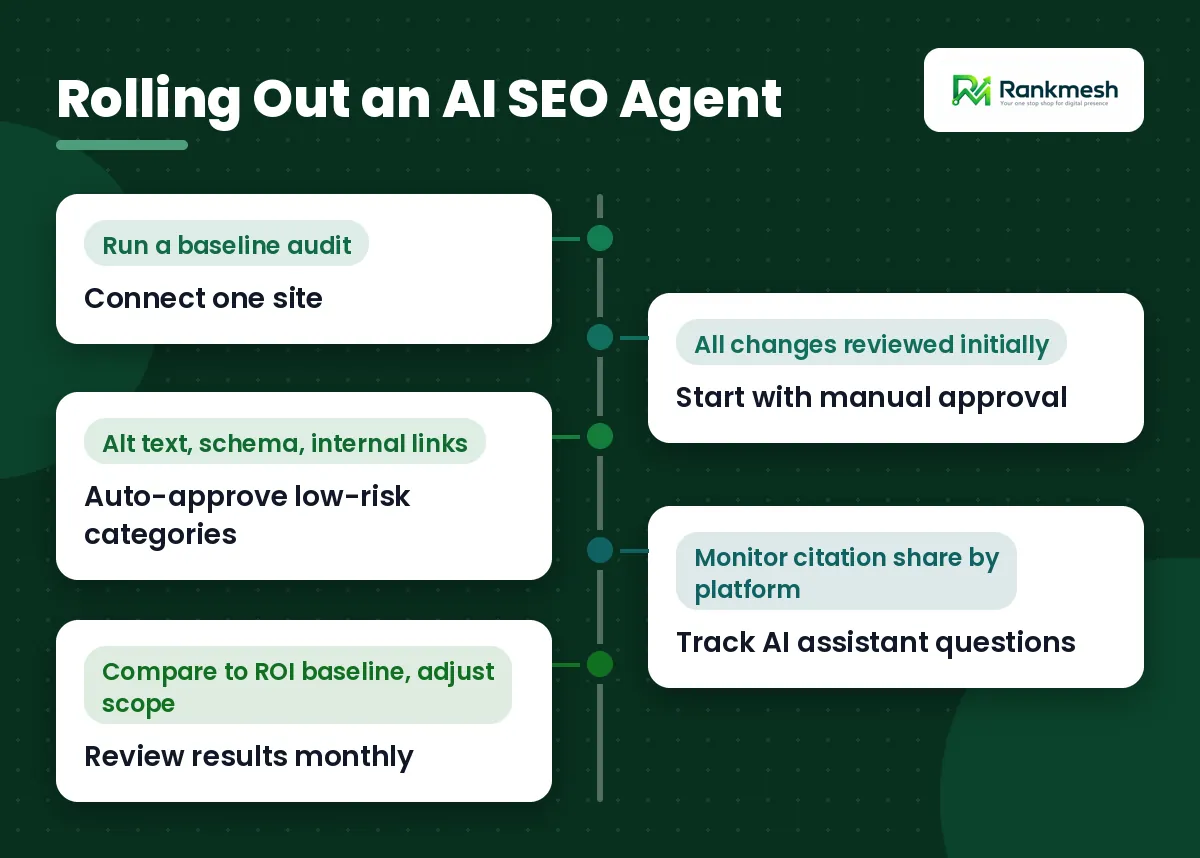
- Connect a single site and run a baseline audit.
- Keep all changes on manual approval initially.
- Move low-risk categories, such as alt text, schema and internal links, to auto-approve once quality is proven.
- Add the questions customers ask AI assistants and monitor citation share by platform.
- Review results against your ROI baseline every month and adjust scope accordingly.
Frequently asked questions
Are AI SEO agents safe to give access to my website?
They are safe when changes route through review before going live. Look for GitHub pull requests or CMS drafts, a complete action log and the ability to reverse any change, and keep high-impact edits on manual approval.
Can an AI SEO agent replace an agency?
An agent can replace much of the routine execution an agency performs, such as technical fixes, publishing and monitoring. Strategy, brand judgement and original expertise still need people, which is why some platforms offer managed plans with a human account manager.
Do SEO agents work on Shopify and Webflow?
Many do, but confirm the integration before buying. RankMesh connects to WordPress, Shopify, Webflow, Framer, Wix, Notion Sites and GitHub-managed codebases, so you do not need to migrate platforms.
How quickly do results appear?
Technical and schema fixes can ship as soon as they are approved. Search engines and AI assistants re-crawl on their own schedules, so ranking and citation movement usually takes weeks, and no vendor can guarantee a specific outcome.
See what your agents would fix first
The fastest way to judge AI SEO agents is to watch them work on your own site. Connect a site, review the first set of proposed fixes and decide what ships. Explore RankMesh's autonomous SEO workflow and see which issues are already waiting in your backlog.