Ask ChatGPT to recommend a company like yours. If it names a competitor, or gets your product, city or category wrong, adding more keywords won't fix it. The AI simply can't tell who you are.
Entity SEO closes that gap. So what is entity SEO, and how do Google and AI assistants decide that your brand is a real, distinct "thing" worth naming? This guide explains the idea in plain English and then gives you a step-by-step plan you can start this week.
Key takeaways
- Entity SEO helps search engines and AI models see your brand as one clearly defined thing with known facts and connections, not as a loose bundle of keywords.
- Google has organized search around entities since it launched the Knowledge Graph (Google, 2012).
- AI assistants rely on similar signals: a name, description, structured data and third-party profiles that all agree with each other.
- The fastest wins are usually unglamorous: Organization schema, a clear About page and matching business details everywhere.
- Treat AI search returns as planning math, not a promise. Count citations and branded demand, not just rankings.
At a glance
- What it is: Helping machines correctly identify your brand, people, products and topics
- Who needs it: Any business that wants a Google knowledge panel or mentions in AI answers
- Core tools: Organization schema, sameAs links, an About page, Google Business Profile and consistent listings
- Time to first fixes: Days for schema and profile cleanup, while AI engines update on their own schedule
- Main metric: How often, and how accurately, Google and AI assistants describe and cite your brand
What is entity SEO?
Entity SEO is the practice of making your brand, products, people and topics easy for search engines and AI models to recognize as distinct, well-described things. Keyword SEO targets phrases. Entity SEO adds consistent facts about who you are, what you do and how you connect to things machines already know.
An entity is any person, place, organization, product or idea that can be told apart from everything else. "RankMesh" is an entity. So are "Jaipur", "Shopify" and "technical SEO".
The core test is simple. When a machine reads about your company, can it tell exactly which company you mean, what you sell and who you serve? If the answer is "sort of", your entity signals need work.
What is an entity in SEO, and how does Google use entities?
In SEO, an entity is a uniquely identifiable thing with attributes and relationships. Google stores entities in its Knowledge Graph, a large database of facts about people, places, organizations and things. When Google is confident it knows your entity, it can show a knowledge panel and connect your brand to topics, even for searches that never use your exact keywords.
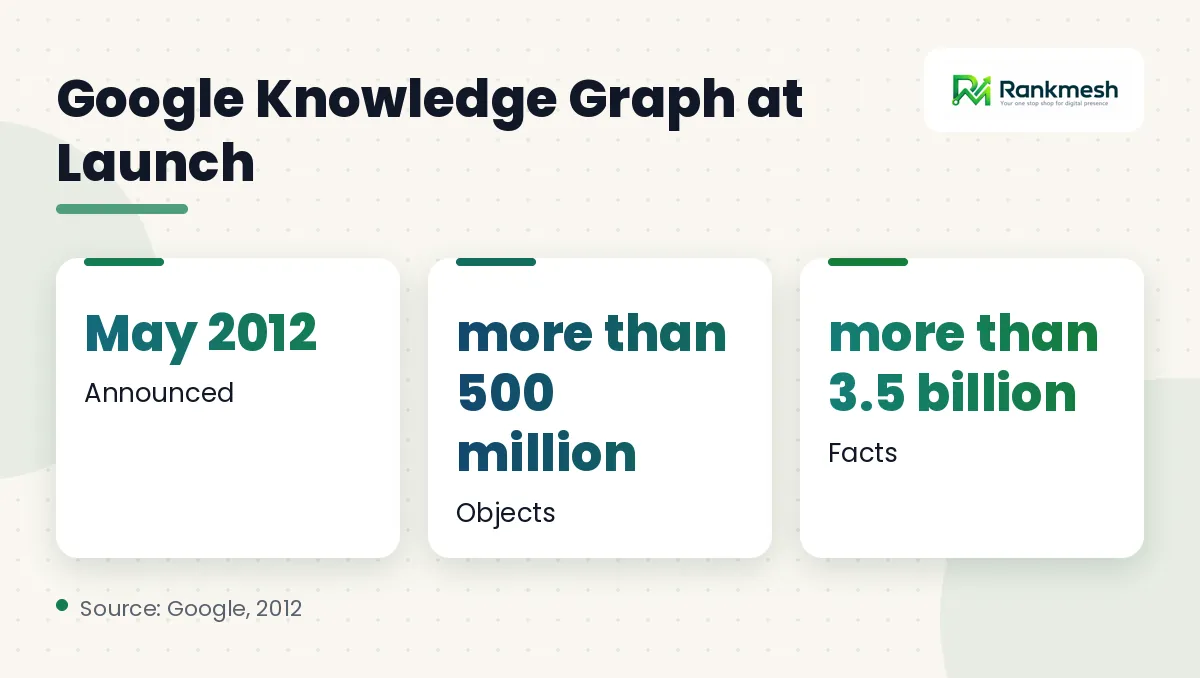
Google announced the Knowledge Graph in May 2012. At launch, the Knowledge Graph held more than 500 million objects and more than 3.5 billion facts about those objects and the relationships between them (Google, 2012).
Google built its Knowledge Graph to understand "real-world entities and their relationships to one another: things, not strings." (Google, 2012)
Share on LinkedIn · Share on X
That phrase captures the whole idea. A string is just a sequence of letters, while a thing has an identity. "Apple" the fruit and "Apple" the company share a string but are different things, so Google uses context such as nearby words, links and structured data to work out which one a page means.
For your brand, the lesson is practical. If your name is common or shared with another business, Google needs extra signals to tell you apart. Google's own documentation says Organization structured data can help Google understand your organization's details, disambiguate it from other organizations and influence which logo appears in Search and your knowledge panel (Google Search Central, 2026).

How do AI assistants like ChatGPT and Perplexity recognize your brand?
AI assistants recognize a brand by combining what they learned during training with what they find on the web when they answer. When your name, description, category and location match across your site, your schema and your third-party profiles, an assistant can cite you with confidence. When those signals conflict, the assistant tends to hedge or name a competitor.
ChatGPT, Gemini and Perplexity often search the web before they answer and then summarize what they find. None of these companies publish their exact selection rules, so the next point is an observation rather than a documented rule: assistants recommend businesses they can clearly pin down.
Picture a design studio that calls itself a "Shopify agency" on its homepage, a "branding studio" on LinkedIn and a "web developer" on its Google Business Profile. An assistant asked "Who should I hire to redesign my Shopify store?" has three conflicting descriptions to weigh. A rival that describes itself the same way everywhere is the safer answer, so the rival gets named.
What is entity based SEO compared with keyword SEO?
Entity based SEO optimizes for meaning and identity, while keyword SEO optimizes for matching phrases. Keyword SEO asks which words a page contains. Entity based SEO asks which real-world things a page is about, how they relate and how sure a machine can be. You still need both, but AI search leans heavily on the second.
Here is how the two approaches differ in practice:
- Focus: Keyword SEO targets search phrases. Entity SEO targets people, brands, products and concepts.
- Main signal: Keyword SEO relies on on-page wording and links. Entity SEO relies on consistent facts, structured data and corroboration from other sites.
- Typical win: Keyword SEO wins a ranking position. Entity SEO can earn a knowledge panel, rich results and citations inside AI answers.
- Main risk: Keyword SEO can drift into stuffing. Entity SEO breaks when your details disagree across the web.

What is entity optimization in SEO?
Entity optimization is the hands-on work of making your entities clear, consistent and connected. That work covers three jobs: mapping which entities matter to you, linking those entities to trusted references, and building authority so machines associate your brand with the right topics. Each job is explained below.
If someone asks you what is entity optimization in SEO, the short answer is "removing doubt". Every step below reduces the chance that Google or an AI model confuses your brand with something else.
What is entity mapping in SEO?
Entity mapping is the process of listing the entities your business relates to and planning how your site covers them. A useful map includes your brand, founders, products, service areas, core topics and the problems you solve. That map then guides your site structure, your internal links and your schema.
For example, a SaaS company might map its brand to its product name, its category ("project management software"), its integrations and its leadership team. Each of those entities deserves a clear page or section that states the facts plainly.
What is entity linking in SEO?
If you're wondering what is entity linking in SEO, the answer has two sides. In language processing, entity linking means connecting a mention in text to a specific entry in a knowledge base, such as Wikidata or Google's Knowledge Graph. In SEO, you help that process by pointing machines at trusted identifiers.
The practical tools are the sameAs property in your schema (which lists your official profiles on other websites), clear internal links between related pages, and descriptive anchor text. Google's documentation describes sameAs as a URL to a page on another website with additional information about your organization (Google Search Central, 2026).
What is entity authority in SEO?
Entity authority describes how strongly and consistently the web associates your brand with a topic. A brand gains that authority when its own pages cover a topic in depth and independent sources, such as reviews, directories, press and industry sites, describe the brand in the same terms. Entity authority is earned slowly and lost quickly when details conflict.
How do you do entity SEO? A step-by-step plan
Start with consistency, then add structure, then build corroboration. The order matters because schema that contradicts your listings only adds more confusion. Most small teams can finish the first three steps within a week.
- Write one canonical brand description. Agree on your exact legal and trading name, a one-sentence description, your category and your service area. Use that wording everywhere.
- Fix your About page. State who you are, what you sell, who founded the company, where you operate and who you serve. Plain facts beat clever copy here.
- Audit your listings. Check Google Business Profile, LinkedIn, social profiles, review sites and local directories. Make the name, address, phone, category and description match your canonical version.
- Add Organization schema. Put JSON-LD (a small block of structured data code) on your homepage with your name, URL, logo, description and sameAs links.
- Map and cover your core entities. Give each important product, service and topic a clear page, and link those pages to each other with descriptive anchor text.
- Rewrite key pages to be quoted. Answer common questions directly in short, self-contained sentences that name the subject instead of saying "it".
- Earn corroboration. Get listed in relevant industry directories, pursue honest reviews and seek mentions that describe your brand the same way you do.
Here is a simple Organization schema example. Replace the placeholder values with your own details:
{
  "@context": "https://schema.org",
  "@type": "Organization",
  "name": "Your Brand Name",
  "url": "https://www.example.com",
  "logo": "https://www.example.com/logo.png",
  "description": "Your one-sentence canonical description.",
  "sameAs": [
    "https://www.linkedin.com/company/your-brand",
    "https://www.instagram.com/your-brand"
  ]
}
After publishing, test the page with Google's Rich Results Test and fix any warnings. Then keep the schema in sync whenever your details change, because stale schema is a common source of conflicting signals.
A local example: one business, three names
Local businesses in India often face a specific entity problem. Here is a hypothetical but very common case: a Jaipur dental clinic listed as "Smile Care Dental" on Google Business Profile, "SmileCare Dental Clinic" on a directory site and "Dr. Sharma's Clinic" on its own website.
To a person, these are obviously the same clinic. To a machine, these could be three different businesses. The likely result is a weaker local ranking and a lower chance of being named when someone asks an AI assistant for a good dentist in Jaipur.
Most of the fix can be started in an afternoon, though some listings take days to update. Choose one name, one address format and one category, update every listing, add LocalBusiness schema to the website and link the official profiles through sameAs. The same pattern applies to an e-commerce brand selling on Shopify, Amazon and Instagram under slightly different names.
How do you measure AI SEO ROI from entity work?
Measure AI SEO ROI by tracking whether Google and AI assistants describe and cite your brand correctly, then connecting that visibility to branded searches, leads and revenue. Entity work rarely shows up as one big ranking jump. The work shows up as fewer wrong answers, more citations and steadier branded demand.
Useful signals to track include:
- Accuracy: Does ChatGPT, Gemini or Perplexity describe your category, location and offer correctly?
- Citation rate: On the prompts that matter to you, how often is your brand named compared with competitors?
- Knowledge panel: Does a panel appear for your brand name, and are the facts right?
- Branded search: Are more people searching for your name directly over time?
- Assisted conversions: Do leads mention finding you through an AI assistant?
Keep the planning math honest. Estimate what one extra qualified lead is worth, compare that value with the cost of the work, and review the trend each quarter rather than expecting a guaranteed return. For a deeper breakdown of costs and returns, read our guide to the ROI of automated SEO with AI agents.
What this means for you
Entity SEO is not a one-time project. Your details change, new directories appear and AI models refresh their sources, so consistency needs ongoing care. Here is where to focus based on who you are:
- Startup founders: Lock down your canonical description and Organization schema before you scale content. Early consistency is far cheaper than cleanup later.
- Local and small businesses: Make Google Business Profile your source of truth and match every directory listing to it.
- SaaS and e-commerce brands: Map product, category and integration entities, and give each a clear, quotable page.
- Marketing teams and agencies: Add entity checks to every audit, and track AI citations alongside rankings.
The hard part is keeping all of this current without a person checking dozens of profiles every month. That is where specialized SEO agents help. RankMesh runs AI agents across six divisions, including one focused on AI visibility and entity signals, that keep your brand details consistent, deploy AI-readable schema and monitor citations daily across ChatGPT, Perplexity and Gemini, with an AI visibility score that also covers Claude and Google AI Overviews. Every change is logged, so your team can approve or reject it before it goes live, set it to auto-approve, or reverse it later.
Frequently asked questions
What is entity SEO in simple terms?
Entity SEO means helping search engines and AI tools understand exactly who your business is and what it does. You do this with consistent details, structured data and links to your official profiles. The goal is to make your brand hard to confuse with anyone else.
Does entity SEO replace keyword research?
No. Keywords still show you what people search for and how they phrase it. Entity SEO adds a layer of identity and context on top, so search engines and AI models trust which brand and topic your pages are about.
Do I need a Wikipedia page for entity SEO?
No. A Wikipedia page can help well-known brands, but most businesses build strong entity signals through their own website, schema, Google Business Profile and consistent third-party listings. Focus on accuracy and consistency first.
How long does entity SEO take to show results?
Schema and listing fixes can go live within days. Google and AI engines then re-crawl and update on their own schedules, so changes in knowledge panels and AI answers usually appear gradually over the following weeks and months.
See how AI describes your brand today
The quickest way to start is to ask ChatGPT, Gemini and Perplexity about your business and note every wrong or missing detail. Those gaps are your entity SEO to-do list.
If you would rather have that work done and tracked continuously, explore how RankMesh AI Recommendations builds consistent entity signals, deploys schema and monitors where AI assistants cite your brand, with your team in control of every change.