Why Google Page One Fails to Guarantee AI Citations: The 11% Overlap
Ranking on Google page one no longer guarantees citations in ChatGPT and Perplexity due to an 11% domain overlap. Learn how generative engine optimization bridges the gap.
Ranking on Google page one no longer guarantees citations in ChatGPT and Perplexity due to an 11% domain overlap. Learn how generative engine optimization bridges the gap.

Securing a top organic ranking on Google Search no longer guarantees that artificial intelligence models will cite your business in generated answers. Recent search industry benchmark research reveals that ChatGPT and Perplexity share only an 11% domain citation overlap (Erlin.ai, 2026). Generative engines rely on distinct retrieval pipelines, semantic entity consensus, and vector databases rather than traditional link-equity algorithms.
At a glance
Page one Google rankings fail to guarantee AI citations because conversational models use retrieval-augmented generation pipelines that evaluate multi-source semantic consensus rather than traditional page rank signals. Google indexes documents for keyword relevance and link authority, whereas AI engines retrieve distinct information snippets to answer complex multi-part user prompts.
Traditional search engine optimization focuses heavily on PageRank, domain authority, and exact-match keyword density. These signals tell a search engine that a specific URL represents a trusted resource for a typed search query. However, conversational AI platforms operate under a completely different architecture known as Retrieval-Augmented Generation (RAG).
When a user enters a prompt into ChatGPT or Perplexity, the system does not simply run a Google search and summarize the first result. Instead, it breaks down the prompt into semantic intent, queries connected vector indexes, and extracts factual chunks from multiple independent sources. If your brand dominates Google organic search but lacks clear structured data, consistent multi-platform entity citations, or direct factual definitions, the generative model will bypass your domain in favor of a source that is easier to synthesize.
"Generative engines reward semantic clarity, authoritative consensus, and structured entity attributes across independent sources rather than isolated backlink authority." (Virayo, 2025)
Share on LinkedIn · Share on X
 ## What is generative engine optimization and how does it work?
Generative engine optimization (often abbreviated as GEO) is the process of structuring website content, technical schema, and external digital footprint data so artificial intelligence platforms cite and recommend your brand. It shifts the optimization focus from earning blue-link clicks to securing factual inclusion within generated conversational responses.
To understand this discipline, technical teams must look at how large language models process information. When an AI assistant formulates an answer, it prioritizes sources that demonstrate strong entity clarity. An entity is a distinct, uniquely identifiable concept or business defined by verified attributes such as location, founders, service categories, and verified customer reviews.
Core components of generative engine optimization include:
Modern visibility platforms like RankMesh's generative engine optimization tools automate the deployment of schema and continuously track brand citations across ChatGPT, Claude, Perplexity, and Google AI Overviews.
Answer engine optimization (AEO) is the practice of formatting content to win direct-answer search features like Google Featured Snippets, People Also Ask boxes, and conversational voice search outputs. While generative optimization targets multi-source conversational synthesis, answer optimization targets single-source direct extraction within classic search engines.
Search engines use answer engine optimization principles to resolve user queries directly on the search engine results page without requiring a click. Winning these zero-click placements requires a specific writing architecture. Content must provide a direct, self-contained definition within the first two sentences of a section before expanding into supplementary details.
Key differences between traditional SEO, answer optimization, and generative optimization include:
Businesses seeking to capture both traditional answer boxes and generative chat responses often deploy integrated answer engine optimization services alongside their technical SEO roadmap.
Google Business Profile optimization directly influences AI visibility by feeding verified, real-time entity signals into local search algorithms and conversational models. AI search engines reference active business profiles, customer reviews, and operational updates to verify that a local brand is legitimate, active, and reputable.
Conversational engines frequently receive local discovery prompts, such as recommendations for specialized B2B agencies or local enterprise service providers. When synthesizing local recommendations, AI models check whether the business entity has consistent operating data across Google Maps, Apple Maps, and verified business registries.
Maintaining active local signals requires consistent operational discipline:
Deploying automated Google Business Profile optimization services ensures that these local signals remain fresh, helping both Google Local Packs and AI models recommend your business over dormant competitors.
AI search citation requires structured schema markup, clean technical crawlability, factual passage design, and robust entity disambiguation. Large language models retrieve and quote content that is explicitly structured, logically partitioned, and free of ambiguous phrasing.
Engineering teams preparing websites for generative retrieval should implement four primary technical standards:
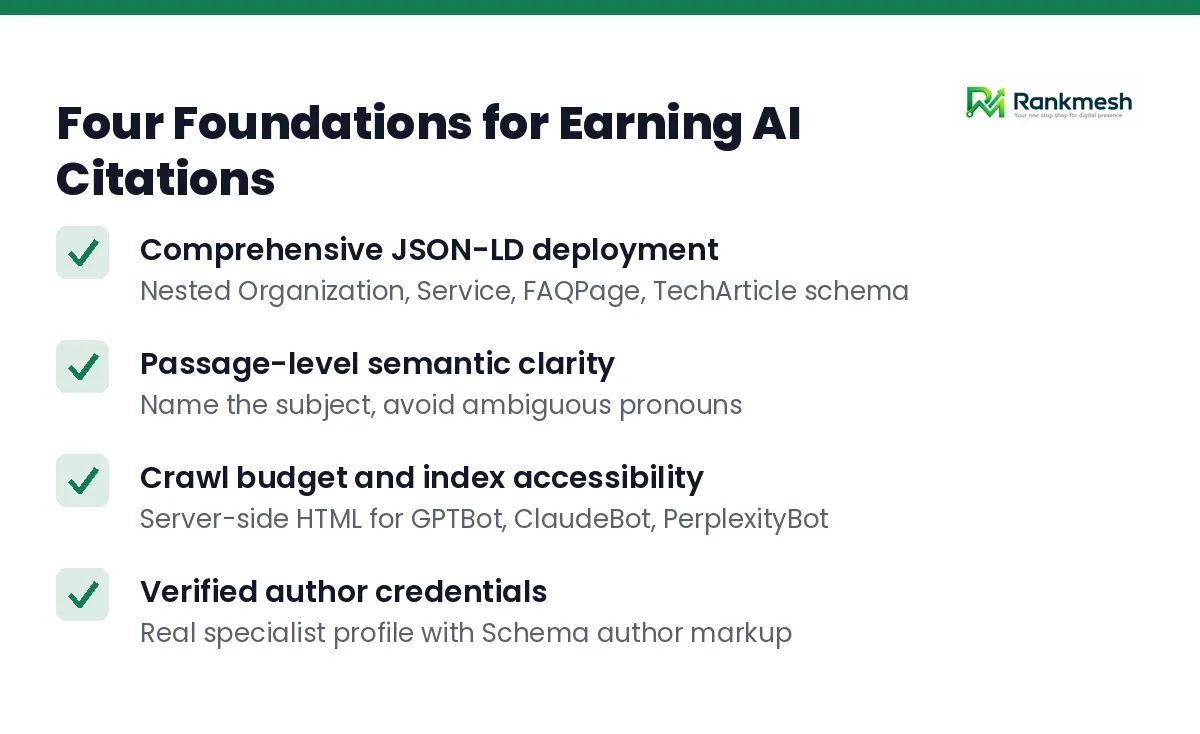 1. Comprehensive JSON-LD deployment: Mark up all web pages with nested
Organization, Service, FAQPage, and TechArticle schema to establish explicit semantic relationships. 2. Passage-level semantic clarity: Write standalone subsections where each paragraph names the subject explicitly rather than relying on ambiguous pronouns like "it" or "they". 3. Crawl budget and index accessibility: Ensure search crawlers and AI bots (such as GPTBot, ClaudeBot, and PerplexityBot) have direct access to render server-side HTML without restrictive JavaScript barriers. 4. Verified author credentials: Associate every published guide with a real human specialist profile, complete with Schema author markup and verified external professional profiles.
For startup founders, marketing leaders, and agency operators, the separation between Google Page One and AI citations means relying solely on traditional SEO metrics creates an operational blind spot. Your brand might rank in the top three organic results on desktop search while remaining entirely invisible to high-intent buyers querying ChatGPT or Perplexity.
To build durable search and AI visibility across platforms, adopt an integrated operational workflow:
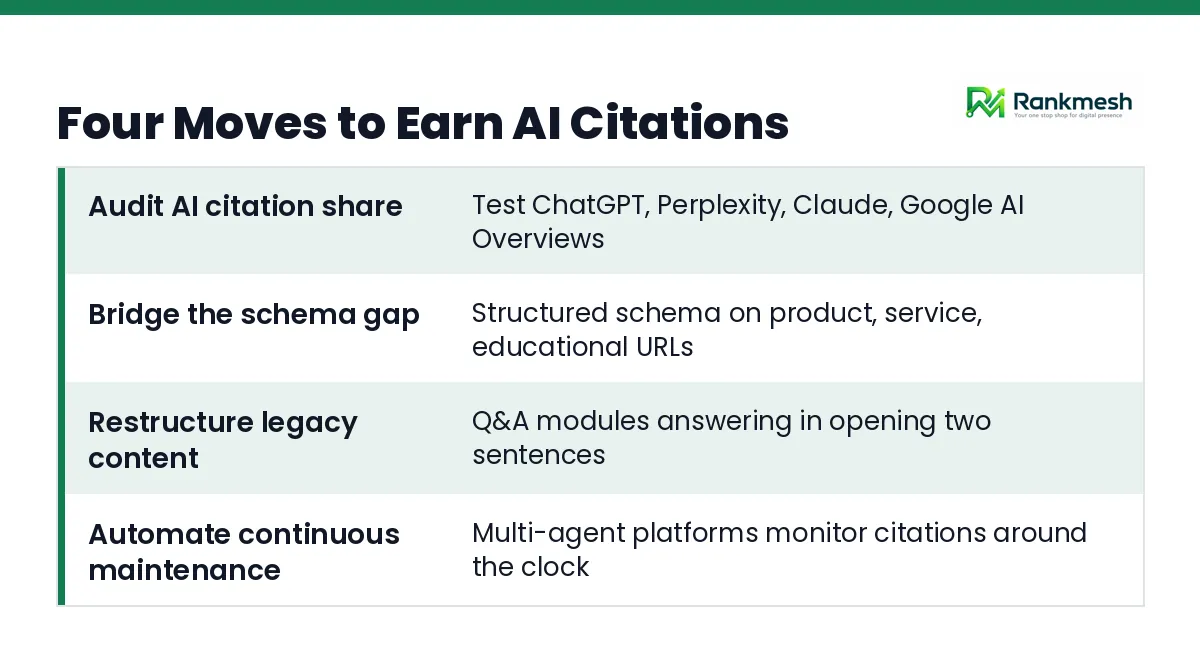 - Audit AI citation share: Test how your company appears across ChatGPT, Perplexity, Claude, and Google AI Overviews for your primary commercial queries.
Finding out whether generative search engines recommend your business or your competitors takes only minutes. Get a free AI visibility report at rankmesh.ai (about 2 minutes, no credit card required) to audit your current citations across ChatGPT, Perplexity, Claude, and Google AI Overviews.
Check your site free
See how Google and AI assistants see your business today.
Get a free AI visibility reportCreate a free accountGet a free automated AI visibility report before your next post goes out.
Get my free report