Google now answers many informational searches at the top of the results page, before anyone scrolls to a blue link. When your page is not among the sources cited in that AI-generated summary, a competitor's page is effectively explaining your category to your buyers. Learning how to appear in AI Overviews is less about finding a secret tag and more about restructuring the pages you already own, and this guide walks through six specific changes, a worked rewrite and a measurement routine.
Key takeaways
-
Google states that AI Overviews have no special requirements: a page must be indexed and eligible to show a snippet in Google Search.
-
Google can build AI Overviews from several related searches, and a useful rule of thumb (our working habit, not a Google requirement) is to answer one sub-question in the first 40 to 60 words of each section.
-
Structured data helps only when it accurately matches the text visitors can see on the page.
-
Original evidence, such as first-party numbers, photographs and documented processes, distinguishes a page from generic content Google can find anywhere.
-
Identical brand details across your website, Google Business Profile and Merchant Center help Google identify and name your business with confidence.
-
What AI Overviews are: AI-generated summaries at the top of Google results, linking to supporting pages
-
Who can be cited: Any indexed page that is eligible to appear in Google Search with a snippet
-
Special markup required: None, according to Google's documentation
-
The six changes: Answer-first openings, self-contained passages, matching schema, crawl and snippet access, original evidence, consistent entity signals
-
Cost: Free if you edit pages yourself; tools mainly accelerate the work and the tracking
-
How to measure: Search Console trends, manual query checks and an AI visibility tracker
What are Google AI Overviews, and how does Google choose sources?
Google AI Overviews are AI-generated summaries displayed above the organic results, with links to the pages that support each part of the answer. Google can assemble an overview by issuing several related searches and then citing pages whose passages answer those narrower sub-questions well, so a page competes passage by passage as well as URL by URL.
Google calls this retrieval method query fan-out: AI Overviews and AI Mode may issue "multiple related searches across subtopics and data sources" to build a single response (Google Search Central, 2025). Consider a search such as "how to choose a CRM for a 10-person sales team." That query can fan out into separate sub-questions about pricing, integrations, data migration and onboarding time.
A page with one clearly labelled section for each sub-question gives Google several distinct entry points. A page that blends all four topics into long, undifferentiated paragraphs gives Google nothing clean to quote. For a closer look at the signals behind source selection, see our breakdown of Google AI Overviews citation factors.
How to appear in AI Overviews: what does Google actually require?
Google states that no additional markup, file or special optimization is necessary. A page must be indexed and eligible to appear in Google Search with a snippet, which means Googlebot can crawl it and no preview control blocks it. Everything beyond that baseline is ordinary SEO executed carefully, with particular emphasis on clarity, access and evidence.
Google's own documentation is unusually direct on this point:
"There are no additional requirements to appear in AI Overviews or AI Mode, nor other special optimizations necessary." (Google Search Central, 2025)
Share on LinkedIn · Share on X
The practical answer to how to appear in Google AI Overviews, therefore, is to strengthen the foundations that already govern organic visibility. Be skeptical of any AI Overviews optimization package that promises a proprietary "AI tag" as a shortcut, because Google's documentation does not support that claim. What AI Overviews do reward more visibly than classic rankings are pages whose individual passages can be extracted and still read as complete, accurate answers.

Change 1: Should every page answer its question in the first lines?
Yes. Open the page, and every major section, with a direct answer of roughly 40 to 60 words, placed before any backstory, brand pitch or definitions. Retrieval systems look for a passage that settles a question quickly, and an answer-first opening is the easiest passage for Google to locate, evaluate and cite.
Most business pages bury the answer. A typical service page begins with "We are a passionate team founded in 2012," and the substantive answer surfaces in paragraph five, after the reader and the crawler have both lost interest. Reversing that order is the single cheapest change on this list.
To apply an answer-first structure:
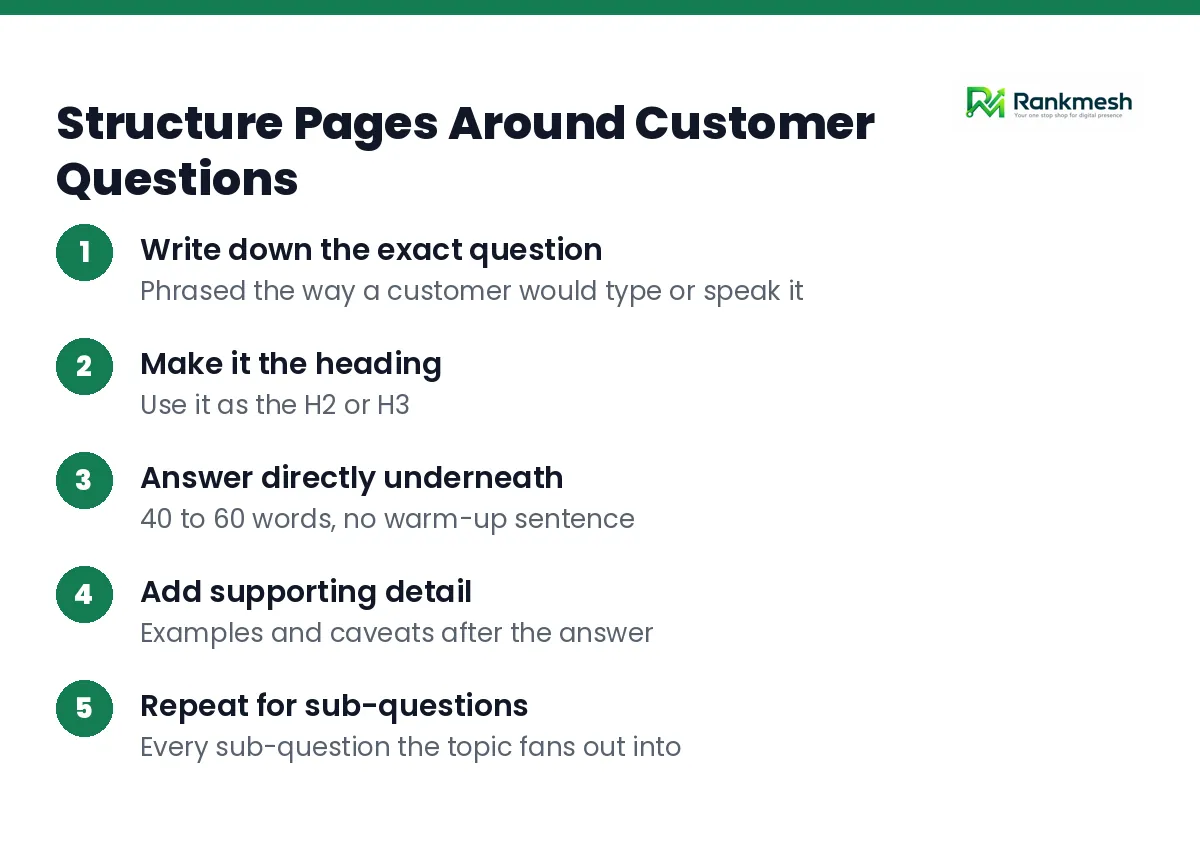
- Write down the exact question the page or section answers, phrased the way a customer would type or speak it.
- Turn that question into the H2 or H3 heading.
- Answer it in 40 to 60 words directly underneath, with no warm-up sentence.
- Add supporting detail, examples and caveats after the answer.
- Repeat the pattern for every sub-question the topic plausibly fans out into.
Change 2: How do you write passages that make sense when quoted alone?
Write each paragraph so it still makes sense, and stays accurate, if someone copies it onto a blank page. Name the subject explicitly instead of relying on "it" or "this," limit each paragraph to one idea, and define technical terms the first time they appear. Self-contained passages are the ones AI Overviews can cite without distorting their meaning.
Pronouns are the most common failure point. A sentence such as "It reduces this by about half" is meaningless once separated from its neighbours, whereas "Annual billing reduces the per-seat cost of the Pro plan" survives extraction intact. Think of this as passage independence: how much context a block of text carries on its own.
A quick self-test helps. Read any paragraph in isolation and ask whether a stranger would understand what it refers to, what it claims and why that claim is credible. If the answer to any of those questions is no, add the missing noun, number or qualifier.

Change 3: Which structured data for AI Overviews actually helps?
Structured data, meaning machine-readable labels usually written in JSON-LD using the Schema.org vocabulary, helps Google interpret what a page describes. Google lists keeping structured data consistent with the visible text as a best practice. Schema clarifies entities and page types, but it does not create eligibility on its own or compensate for weak content.
The most useful structured data for AI Overviews mirrors what the page genuinely is (Google Search Central, 2025). Match the markup to the page type:
- Organization or LocalBusiness: on the homepage and contact page, with the same name, address and phone number shown in the footer
- Product: on product pages, with price and availability that match what shoppers actually see
- Article: on blog posts and guides, with a real author name and a publication date
- FAQPage: only where the questions and answers are printed visibly on the page
The most frequent error is drift, where schema claims one price, rating or business name while the visible page shows another. Check your markup whenever prices, opening hours or product details change, because structured data that contradicts the page can mislead Google and undermine trust.
Change 4: Can Google crawl, render and quote your page?
A page cannot be cited if Googlebot cannot reach it or a preview control forbids snippets. Google advises allowing crawling in robots.txt and in any CDN or hosting layer, keeping important content in text form, and linking to key pages internally. Controls such as nosnippet, data-nosnippet and max-snippet directly restrict what AI features may display.
Access problems are surprisingly common on modern stacks. Bot-protection rules on a CDN (content delivery network) can block legitimate crawlers, JavaScript-heavy pages sometimes show their main answer only after a click, and a well-meant max-snippet setting can quietly cap what Google is allowed to quote. Google's own advice covers the first two directly: allow crawling at the CDN or hosting layer and keep important content in text form (Google Search Central, 2025).
Work through this checklist on your ten most important pages:
- Run each URL through the URL Inspection tool in Search Console and confirm it is indexed.
- Review robots.txt and CDN firewall rules for anything that blocks Googlebot.
- Search the page source for nosnippet, data-nosnippet, max-snippet and noindex, and remove any you did not set deliberately.
- Confirm the core answer exists as HTML text, not only inside an image, a PDF or a collapsed widget.
- Add at least two internal links from related pages using descriptive anchor text.
Change 5: What original evidence makes a page worth citing?
Original evidence is anything Google cannot find on a dozen competing pages: your own pricing data, photographs of real work, documented processes, customer questions you answer every week and named authors with relevant experience. Google also recommends supporting text with high-quality images and videos where they genuinely help.
This connects to what Google's quality guidelines call E-E-A-T, short for experience, expertise, authoritativeness and trustworthiness. A page that paraphrases the same five tips as every competitor offers a summarizing system little reason to prefer it, while a page that reports what actually happened in your own projects provides a distinctive passage worth attributing.
Practical sources of evidence vary by business model:
- SaaS teams: setup times observed during onboarding, screenshots of real configurations and documented integration limits
- E-commerce brands: original product photography, sizing notes drawn from return reasons and care instructions written by the maker
- Local service businesses: before-and-after photos, neighbourhood-specific advice and transparent price ranges you can stand behind
Change 6: Why do consistent entity signals help Google name your brand?
An entity is a distinct, identifiable thing, such as a business, product or person, that Google recognises across many sources. When your brand name, description, address and category match everywhere Google looks, the system can attribute information to you confidently. Google specifically recommends keeping Merchant Center and Business Profile information current.
Inconsistency forces search systems to hedge. Google advises keeping Merchant Center and Business Profile information current (Google Search Central, 2025). Here is our own example of why: if your website says "Acme Dental Care," your Google Business Profile says "Acme Dental Clinic" and a directory lists an old address, Google has three partly conflicting records to sort out.
This matters especially for small and mid-sized businesses in India, where one company may appear on its website, Google Business Profile, directories such as Justdial and several marketplace storefronts. Standardise one spelling of the business name, one description and one primary category, then update every listing to match. Our guide on how to get cited by ChatGPT, Perplexity and AI Overviews explains why the same consistency carries over to other AI engines.
What does an answer-first rewrite look like in practice?
A practical rewrite moves the answer to the top, names the subject in every sentence and replaces generic claims with specific, verifiable steps. The example below uses a hypothetical Jaipur leather-goods store targeting the query "how to clean a leather bag," a question that plausibly fans out into cleaning, stain removal and conditioning sub-questions.
Before: "At our family workshop, we have been crafting leather goods with love for three generations. We believe every bag tells a story. That's why it deserves proper care, and this guide will help you with it."
After: "To clean a full-grain leather bag, wipe the surface with a dry microfibre cloth, treat marks with a slightly damp cloth and a small amount of saddle soap, and let the bag air-dry away from direct sunlight. Apply a leather conditioner afterwards to keep the material supple."
The rewritten version answers the question within its first sentence, names the material explicitly and remains accurate when quoted alone. The brand story still has a place on the page, simply lower down, where it supports trust instead of delaying the answer.
How do you know when you get featured in Google AI Overviews?
Google includes AI feature traffic within the overall Web search type in Search Console's Performance report, without a separate AI Overviews filter. Reliable tracking therefore combines three methods: Search Console trends for impressions and clicks, manual checks of priority queries, and an AI visibility tracker that records citations over time.
Because Search Console blends AI feature traffic into ordinary search data, it cannot tell you on its own whether you get featured in Google AI Overviews for a specific query (Google Search Central, 2025). Manual checks fill part of that gap: search your priority queries in a private browser window each week, note whether an overview appears and record which domains it cites.
Manual checks become impractical beyond a few dozen queries, which is where dedicated trackers help. Whichever tracker you use, confirm which engines, regions and prompt volumes it covers. RankMesh runs a live AI visibility score across ChatGPT, Gemini and Perplexity, with Claude and Grok coming soon, so you can see which platforms recommend you and which don't, alongside its technical SEO and content agents.
What this means for you
For most teams, how to appear in AI Overviews comes down to a disciplined editing sprint rather than a new technology purchase. Start with the pages that already rank on page one, because they are often the likeliest to be picked up as sources. Then work through the six changes in order.
A realistic first month might look like this:
- Week 1: Choose ten pages that rank for informational queries and confirm indexing, crawl access and snippet settings.
- Week 2: Rewrite each page's opening and section intros into answer-first passages of 40 to 60 words.
- Week 3: Add or correct schema so it matches the visible text, and add one piece of original evidence per page.
- Week 4: Align your business name and description across your website, Google Business Profile and directories, then begin weekly citation checks.
Founders and small teams can complete this manually. Agencies and growth teams managing many sites usually find that the repetitive parts, such as schema audits, snippet-setting checks and citation monitoring, are better handled by automation with human review before anything goes live.
Frequently asked questions
Do I need special markup to appear in Google AI Overviews?
No. Google's documentation states that there are no additional requirements or special optimizations for AI Overviews. A page must be indexed and eligible to show a snippet, and structured data should simply match the visible content.
How long does it take to start appearing in AI Overviews?
There is no fixed timeline, because Google recrawls and reprocesses pages on its own schedule. Fixes to crawl access and snippet settings can take effect once Google recrawls the page, while content rewrites usually need several weeks of monitoring before you can judge the effect.
Can a small business appear in AI Overviews against larger competitors?
Yes, because AI Overviews cite individual passages that answer sub-questions well, not only the largest domains. Small businesses with specific, first-hand answers and consistent local listings can compete effectively on narrow, practical queries.
Can I stop Google from using my content in AI Overviews?
Google supports preview controls such as nosnippet, data-nosnippet, max-snippet and noindex to limit what appears from your pages. Using them restricts AI Overview citations as well as regular snippets, so apply them only where the trade-off is deliberate.
See whether AI Overviews quote you or a competitor

The six changes above work whether you make them by hand or with help. If you want to know where you stand first, RankMesh offers a free audit that checks whether AI Overviews and featured snippets are citing your pages today. You decide how much control to keep: review the agents' changes before they go live, or auto-approve them and publish straight through your CMS. Get your free AI Overviews and answer engine report.