Ask ChatGPT for the best tool, agency or store in your category and it will usually name a few businesses. If yours is not one of them, a buyer just made a shortlist without you. This guide shows you how to track brand mentions in ChatGPT step by step. You get a free manual method you can start this week, and a clear signal for when it makes sense to automate.
Key takeaways
- ChatGPT gives you no Search Console style report, so you have to measure visibility yourself by asking the questions your buyers ask.
- A good tracking setup uses a fixed prompt library, a clean testing environment and repeated runs, because answers change from one run to the next.
- Track five things for every answer: whether you are mentioned, your position, cited sources, competitors named and factual accuracy.
- Mention rate and share of voice over time matter more than any single answer.
- Tracking only pays off when you act on it: fix entity signals, structured data and page format where ChatGPT ignores or misdescribes you.
At a glance
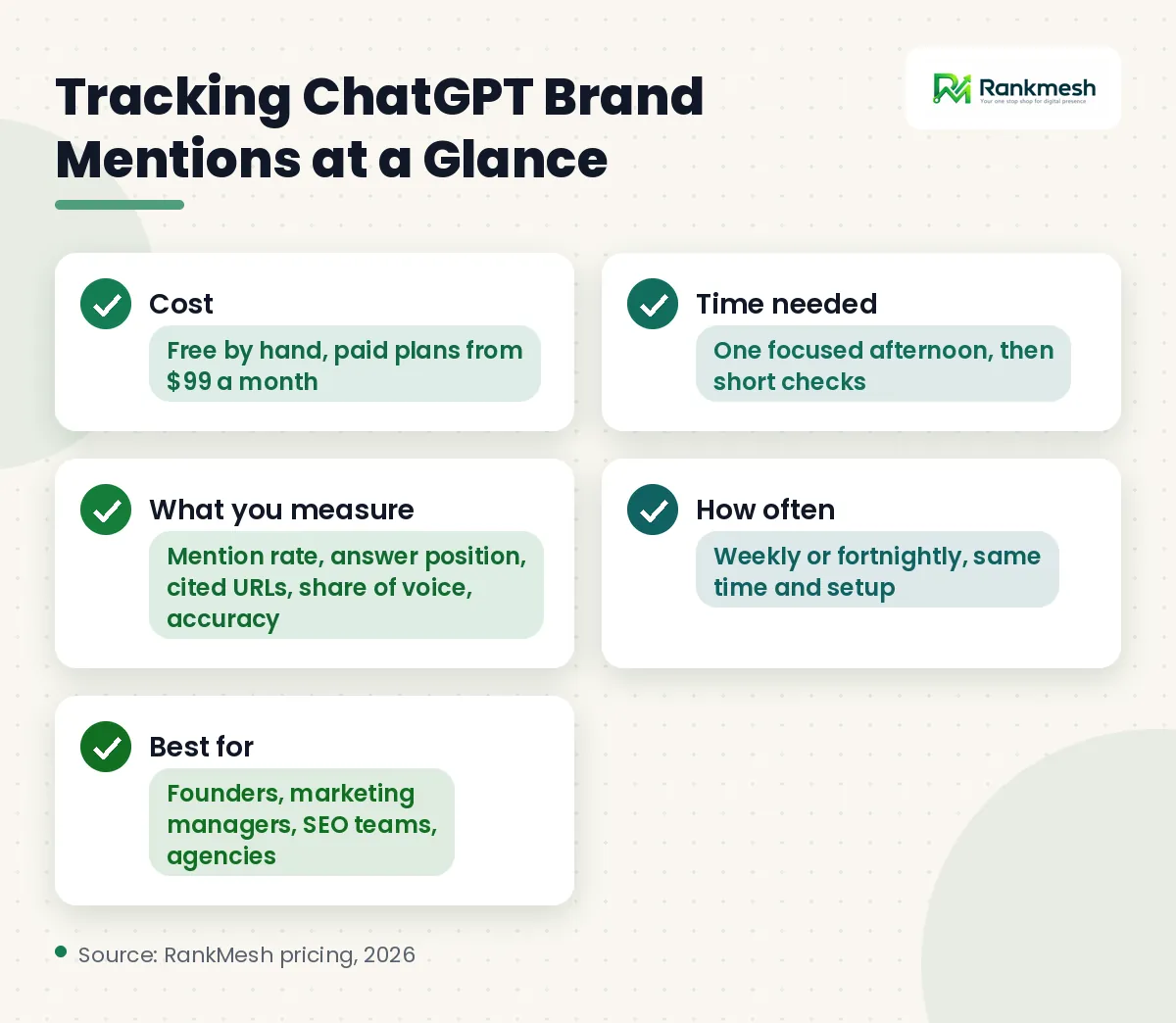
- Cost: Free if you do it by hand with a spreadsheet. RankMesh also offers a free visibility report, with paid plans from $99 a month, or Rs 10,000 + GST in India (RankMesh pricing, 2026).
- Time needed: One focused afternoon to set up, then a short check every week or two.
- What you measure: Mention rate, answer position, cited URLs, competitor share of voice and accuracy of facts about you.
- How often: Weekly or fortnightly, at the same time and in the same setup.
- Best for: Founders, marketing managers, SEO teams and agencies who want proof of AI search visibility, not guesses.
What does it mean to track brand mentions in ChatGPT?
Tracking your brand inside ChatGPT means asking the questions your buyers ask, recording whether ChatGPT names your business and noting how it describes you. You watch five things: whether you appear, where you sit in the answer, which sources get cited, which competitors show up and whether the facts about you are correct.
Google hands you rankings, impressions and clicks. ChatGPT hands you nothing. There is no dashboard that tells you how often your brand came up in conversations last month, so the only reliable way to know is to test it yourself or use a tool that tests it for you.
A few terms are worth pinning down before you start:
- Mention: ChatGPT names your brand anywhere in the answer.
- Recommendation: ChatGPT names your brand as a suggested choice, not just in passing.
- Citation: ChatGPT links to your website (or a page about you) as a source. Citations usually appear when ChatGPT searches the web to build its answer.
- Share of voice: How often you get named compared with your competitors across the same set of prompts.
- Sentiment and accuracy: Whether the description is positive and whether the details (pricing, location, features) are right.
Why do ChatGPT brand mentions matter for your business?
ChatGPT brand mentions matter because AI answers act like a shortlist. Instead of ten blue links, a buyer often sees a handful of named brands with reasons attached. If your brand is missing from that shortlist, the buyer may never visit your site, even if you rank well on Google for the same topic.
RankMesh describes the difference plainly. Traditional SEO targets ranking positions on a results page, while AI visibility targets being quoted, cited or recommended inside an AI-generated answer, where often only a handful of brands get mentioned at all (RankMesh AI Recommendations, 2026).
That changes what you need to watch. A page lower down on Google still picks up some traffic. A brand that is left out of the AI answer gets nothing from that conversation, and tracking is how you find out which side of that line you are on.

How do you track brand mentions in ChatGPT, step by step?
Build a fixed list of buyer questions, run each one several times in a clean chat, and log who gets named and cited. Then score your mention rate and share of voice. Repeat the same test on a schedule so you can see trends and connect them to the changes you make on your site.
To keep this concrete, we will follow a hypothetical example throughout: a payroll software startup in Pune that sells to small and mid-sized Indian companies. Swap in your own category as you read.
Step 1: Decide what counts as a win
Before you write a single prompt, agree on what you are measuring. For most businesses, a useful definition looks like this:
- Your brand is named in the answer (a mention).
- Your brand is suggested as a good option (a recommendation).
- Your website is linked as a source (a citation).
- The description of your product, price and location is accurate.
Write these definitions down and share them. If two people on your team score answers differently, your data turns into noise.
Step 2: Build a buyer-intent prompt library
Your prompt library is the fixed set of questions you test every time. Write prompts the way real buyers talk, not the way marketers write keywords. Cover each stage of the buying journey:
- Discovery: "How do small companies in India handle payroll compliance without an accountant?"
- Comparison: "What is the best payroll software for a startup in India?"
- Alternatives: "What are good alternatives to [big competitor] for a growing team?"
- Validation: "Is [your brand] reliable for PF and ESI filings?"
- Local: "Which payroll providers support companies in Pune and Bangalore?"
A couple of dozen prompts is plenty to start. Pull ideas from sales calls, support tickets and the search terms already sending you traffic. Once the list is set, freeze it, because changing prompts every week makes trends impossible to read.
Step 3: Set up a clean testing environment
ChatGPT can personalise answers using memory and past chats. If you test from your own account, it may already know your brand and flatter you. A clean setup keeps the results honest.
- Use a Temporary Chat or a fresh account with memory turned off.
- Note which model you used, and stick with it between rounds.
- Record whether web search was on. Answers built with search usually show cited links, while answers without it lean on what the model already learned.
- Test both modes if you can, because each tells you something different.
Step 4: Run each prompt more than once
ChatGPT does not give the same answer twice. Run each prompt several times in separate fresh chats and record every result. One run tells you what happened once, while repeated runs show you what usually happens.
For the Pune payroll startup, this might show that the brand appears steadily for the non-branded local prompts but only now and then for the comparison prompts. (Validation prompts already include your brand name, so a high mention rate there is expected and tells you little.) That pattern is far more useful than a single screenshot.
Step 5: Log every answer in a simple spreadsheet
A spreadsheet is enough for manual tracking. Give each answer its own row with these columns:
- Date, model and search mode
- Prompt and buying stage
- Mentioned (yes or no) and recommended (yes or no)
- Position in the answer (first named, middle, last)
- Competitors named
- URLs cited
- Accuracy notes (wrong price, old feature, wrong city)
Paste the full answer text into a linked document too. When something changes later, you will want to see the exact wording, not just a yes or no.
Step 6: Score your mention rate and share of voice
Your mention rate is the number of answers that name you divided by the total number of answers you collected. Your share of voice is how often you are named compared with every brand named across the same prompts.
Work these out for each buying stage, not only overall. The payroll startup might find a healthy mention rate on validation prompts but a weak share of voice on "best payroll software" prompts, where two larger rivals dominate. That tells the team exactly where to focus.
Step 7: Check accuracy and the sources ChatGPT cites
A mention with the wrong facts can cost you a sale. Flag any answer that gets your pricing, features, location or audience wrong. Then look at the cited URLs, because they show where ChatGPT is learning about your category.
If ChatGPT keeps citing a review site, a directory or a competitor's comparison page, those pages are shaping its view of you. Your own website may not be in the conversation at all.
How do you turn tracking results into real fixes?
Use the gaps in your log as a to-do list. Where ChatGPT ignores you, strengthen your entity signals and structured data. Where it cites other sites, earn a place on those sites. Where it misdescribes you, correct the facts on your own pages and every profile you control, so the details match everywhere.
AI assistants are cautious about naming businesses they cannot clearly identify.
"Consistent entity signals are what let an AI engine cite your brand with confidence instead of hedging toward a competitor." (RankMesh AI Recommendations, 2026)
Share on LinkedIn · Share on X
In practice, the fixes usually fall into four groups:
- Entity consistency: Use the same brand name, description, category and location on your site, LinkedIn, directories and Google Business Profile. An entity is simply a clearly defined thing, like your company, that search engines and AI models can recognise.
- Structured data: Add schema markup (code that labels your page content for machines) for your organisation, products and FAQs, so language models can parse your pages more easily.
- Answer-ready pages: Rewrite key pages into short, factual sentences and clear Q&A blocks. This is the shape assistants pull answers from.
- Third-party presence: Get listed and reviewed on the sources ChatGPT already cites in your category.
For a deeper playbook on the content side, read our guide on how to get cited by ChatGPT, Perplexity and AI Overviews.
Re-run your prompt library after each round of fixes. AI engines refresh their retrieval indexes on their own schedule, so give changes a few weeks before you judge them.

What mistakes make ChatGPT tracking unreliable?
The most common mistakes are testing from a personalised account, changing prompts between rounds, trusting a single run and only checking branded prompts. Each one makes your numbers look better or worse than reality. A steady, boring process beats a clever one you cannot repeat.
Watch out for these traps:
- Only asking about yourself. "What is [your brand]?" proves ChatGPT knows you exist. It says nothing about whether you get recommended when buyers ask open questions.
- Ignoring competitors. Your mention rate means little without context. Share of voice shows whether you are gaining or losing ground.
- Mixing models and modes. Comparing a search-on answer from one month with a search-off answer from the next tells you nothing.
- Tracking without acting. A log that nobody turns into fixes is just a record of lost shortlists.
When should you automate ChatGPT visibility tracking?
Automate ChatGPT visibility tracking once the manual version stops keeping up: when your prompt list grows, when you want daily rather than weekly checks, or when you need to track several AI platforms and competitors at once. Manual tracking is a great start, but it gets slow and patchy as you scale.
An automated tool runs your prompts on a schedule, stores every answer and charts trends for you. RankMesh, for example, runs a daily scan of ChatGPT, Perplexity and Gemini to detect when your brand is mentioned or recommended. It also offers prompt-level tracking week by week and a competitor citation comparison broken out by platform (RankMesh AI Recommendations, 2026). Its live AI visibility score runs across ChatGPT, Gemini and Perplexity, alongside Google AI Overviews data from Search Console (RankMesh AI Recommendations, 2026).
The bigger difference is what happens after the data comes in. RankMesh's agents also deploy AI-readable schema, keep entity signals consistent and restructure pages into the format language models prefer to quote. High-impact changes route through your approval panel first, so a person on your team stays in control of what ships.
What this means for you
AI search visibility is now part of how buyers find and judge businesses. You do not need a big budget to start measuring it, but you do need a consistent process. Here is how to apply this guide based on your role:
- Startup founders: Spend one afternoon building a prompt library and running a first baseline. It will show you whether ChatGPT knows your product exists.
- Small and medium business owners: Add local prompts with your city name. If ChatGPT gets your address or services wrong, fix your Google Business Profile and website first.
- Marketing managers: Report mention rate and share of voice next to organic traffic. Leadership understands "we were named in fewer answers than our main rival" instantly.
- SEO professionals and agencies: Treat the prompt library like a keyword set. Freeze it, track it, and tie every content or schema change to a later re-run.
- E-commerce and SaaS brands: Focus on comparison and alternatives prompts, where buying decisions actually get made.
Businesses that track brand mentions in ChatGPT consistently can spot lost shortlists early and start fixing them sooner. If you want more ideas on earning those mentions, see our guide on getting your business mentioned by ChatGPT.
FAQs
Can I track brand mentions in ChatGPT for free?
Yes. A fixed prompt library, a Temporary Chat and a spreadsheet are enough to run a reliable manual test. The trade-off is time, because you have to run the prompts, log the answers and calculate your scores yourself.
How often should I check my ChatGPT brand mentions?
Weekly or fortnightly works well for most businesses. Test at a similar time, with the same model and search setting, so changes in your results reflect real shifts rather than differences in setup.
Why does ChatGPT give different answers to the same prompt?
ChatGPT generates each answer fresh, so wording and brand choices can vary from run to run. Memory, web search and model updates add more variation. That is why you should run each prompt several times and look at trends, not single answers.
Does ranking on Google mean ChatGPT will mention my brand?
Not always. Google rankings help, but AI assistants also lean on consistent entity signals, structured data and third-party sources that describe you clearly. A brand can rank well on Google and still be left out of AI answers.
See where your brand stands today
Manual tracking tells you where you are. Closing the gap takes steady work on entity signals, schema and page format, week after week. If you would rather have that work done for you, with every change reviewable before it goes live, start with a free visibility report. You can also compare RankMesh plans on the pricing page.