Your customers already ask ChatGPT, Gemini and Perplexity which product or service to choose in your category. Most brands have never seen those prompts, so they can't tell whether their name shows up in the answer. This guide shows you how to find customer AI prompts using data you already own, then turn them into a tracking list you can test every month.
Key takeaways
- AI prompts are longer and more personal than keywords. A prompt usually includes a budget, a location, a team size or a specific problem.
- The best prompt ideas come from your own sales calls, support tickets and reviews, not from a keyword tool.
- Sort prompts by what the buyer is trying to do: discover, compare, solve a problem or choose locally.
- Test every prompt on more than one AI platform, and run each one more than once, because answers change.
- A prompt list only pays off when you act on the gaps: missing pages, unclear brand details and competitors who get named instead of you.
At a glance
- Goal: Build a list of the questions buyers actually ask AI assistants about your category
- Time needed: About an afternoon for a first list if your sales and support data is easy to export (our estimate, not a benchmark)
- Cost: Free with a spreadsheet and manual checks; paid trackers automate the testing
- Best sources: Sales calls, support tickets, reviews, community threads, People Also Ask, Search Console and site search
- Platforms to test: ChatGPT, Claude, Gemini, Perplexity and Google AI Overviews
- Refresh cadence: Review the list every month and after every product launch
Why are AI prompts different from search keywords?
AI prompts are full sentences with context, while keywords are short fragments. A keyword might be "payroll software." A prompt is "What payroll software works for a small startup in India that pays some contractors in dollars?" That extra context changes which brands an assistant recommends, so keyword lists alone miss much of this context.
People talk to AI assistants the way they talk to a smart colleague. They explain their situation, list their limits and ask for a short list. The assistant then picks a few brands that clearly match those details.
That difference matters because an AI answer usually names only a handful of businesses. On a Google results page you can rank lower down and still get some clicks. Inside a ChatGPT answer, your brand is either named or it isn't. For the bigger picture on this shift, our post on why customers ask AI instead of Google explains the behaviour change.
One quick note: this guide is about the questions buyers ask when choosing a product or service. Here, prompt research means understanding buyer questions.
How do you find customer AI prompts step by step?
Start by collecting real questions from your sales, support and review data. Rewrite each one in the detailed, natural way people speak to an assistant. Group the prompts by buyer intent, test each one on ChatGPT, Gemini and Perplexity, and record which brands get named. Then fix the gaps and repeat the test monthly.
Here is the full process in order:
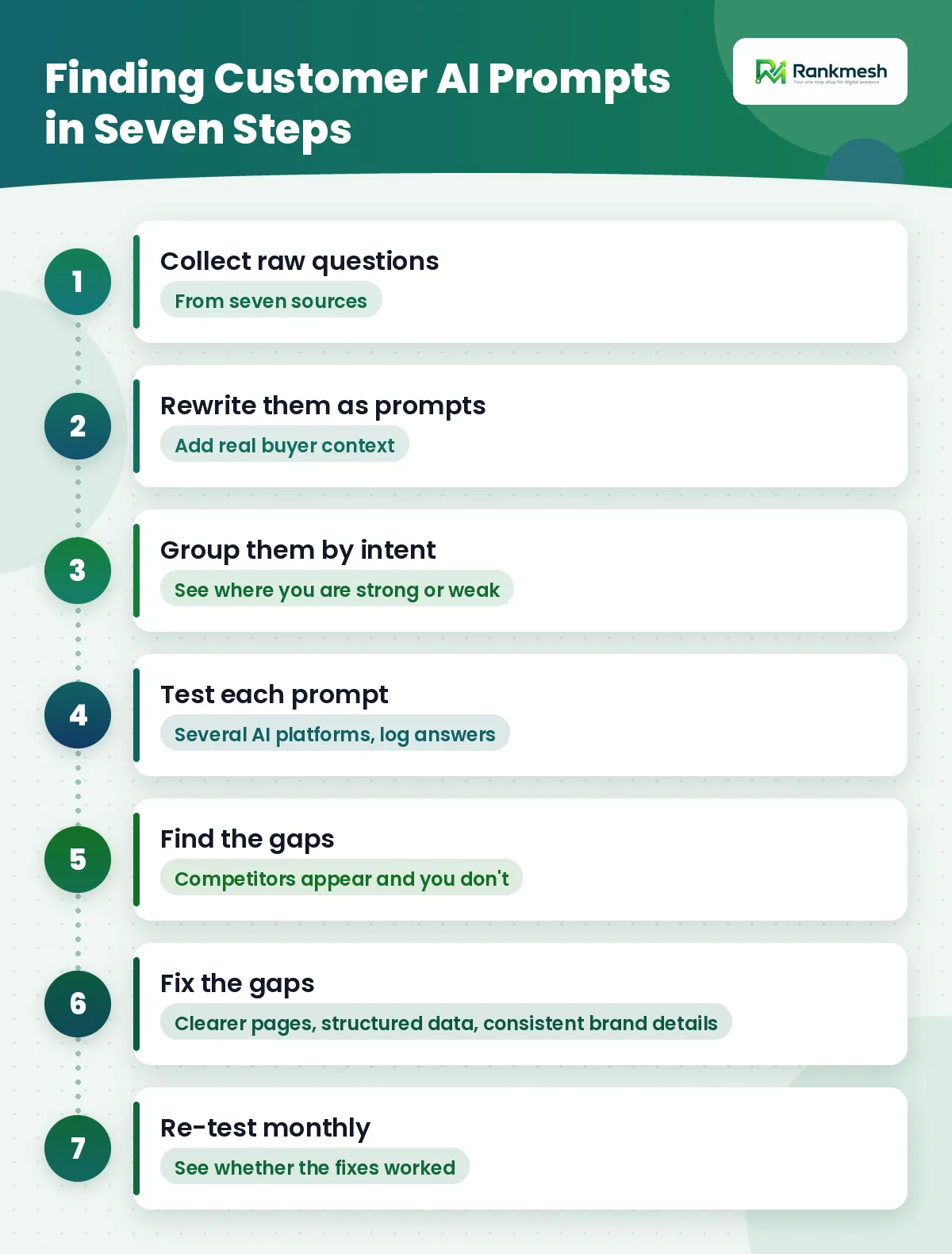
- Collect raw questions from the seven sources in the next section.
- Rewrite them as prompts with the context a real buyer would add.
- Group them by intent so you can see where you are strong or weak.
- Test each prompt on several AI platforms and log the answers.
- Find the gaps where competitors appear and you don't.
- Fix the gaps with clearer pages, structured data and consistent brand details.
- Re-test monthly to see whether the fixes worked.
Testing is where many teams stop. The real value sits in the last three steps, because a list of prompts with no follow-up action is just a spreadsheet.

Where do your customers' real questions already live?
Your customers' real questions already sit in seven places: sales call notes, support tickets, reviews, community threads, Google's People Also Ask boxes, Search Console queries and your own site search. These sources capture the exact words buyers use, and those are the same words they type into AI assistants.
If you've been wondering how to find AI prompts customers use, this is the honest answer: they are mostly hiding in conversations you already have. AI prompt research works best when it starts with your own data and only then moves to outside tools.
Sales call recordings and notes
Sales calls are the richest source. Listen for the first question a prospect asks and the objections that come up. A line like "We tried a cheaper tool but it couldn't handle GST invoices" is almost a ready-made prompt.
Support tickets and live chat logs
Support data shows the problems people hit after buying. Many of those same problems are what new buyers ask AI about before they buy. Export the last few months of tickets and look for themes that repeat.
Customer reviews, yours and your competitors'
Reviews on Google, G2, Capterra, Amazon or your Google Business Profile show how people describe a good or bad experience. Competitor reviews are just as useful, because the complaints there often turn into prompts like "What's a better alternative to [competitor] for faster support?"
Community threads
Reddit, Quora, LinkedIn comments and industry Slack or WhatsApp groups are where people ask for honest recommendations. Look for posts that start with "Has anyone used..." or "What do you recommend for...". Those openers map almost directly to AI prompts.
People Also Ask boxes
Google's People Also Ask boxes show the follow-up questions searchers have. Search your main category terms and note every question that appears. Each one is a strong seed for a longer, more personal prompt.
Google Search Console queries
Search Console shows the real queries that already bring people to your site. Filter for long queries and ones that start with question words such as how, what, which or best. Long, question-style queries are the closest thing to a prompt that classic search data gives you.
Your own site search
If your website has a search bar, its logs show what visitors couldn't find on their own. Those gaps are often the exact questions people end up asking an assistant instead.
How do you turn raw questions into realistic prompts?
Turn a raw question into a realistic prompt by adding the context a real buyer would include: who they are, what problem they have, their limits and their location. A raw question like "Do you ship to Pune?" becomes a full request for a recommendation that matches the buyer's situation.
Here is a concrete example for an Indian skincare brand that sells online:
- Raw support question: "Do you ship to Pune?"
- Realistic prompt: "Which Indian skincare brands for oily skin offer fragrance-free products and fast delivery to Pune?"
- Raw review complaint: "The sunscreen left a white cast."
- Realistic prompt: "What's a good sunscreen for darker Indian skin tones that doesn't leave a white cast?"
And one for a B2B software company:
- Raw sales objection: "Your competitor is too complex for our team."
- Realistic prompt: "What's a simple project management tool for a small marketing agency that doesn't need much training?"
To build each prompt, add these layers where they fit:
- Role: "I run a small bakery" or "I'm a marketing manager at a SaaS startup."
- Problem: The pain that started the search.
- Limits: Budget, team size, tools they already use or must work with.
- Location: City or country, which matters a lot for local and Indian buyers.
- Format request: "Give me three options" or "Compare these two."
Write a few versions of each important prompt. Real buyers phrase the same need in different ways, and assistants can answer each version differently.

How should you group prompts by buyer intent?
Group prompts by what the buyer is trying to do at that moment: discover options, compare brands, solve a specific problem, choose a local provider or check whether a brand is trustworthy. Grouping by intent shows you where your brand gets named and where it disappears.
Use these five groups:
- Discovery: "What are the best accounting tools for freelancers in India?"
- Comparison: "Is [your brand] or [competitor] better for a growing e-commerce store?"
- Problem solving: "How do I stop my Shopify store from losing rankings after a redesign?"
- Local: "Which dentist near Malviya Nagar in Jaipur is open on Sundays?"
- Trust check: "Is [your brand] legit? What do customers say about it?"
Many brands show up well in trust checks, where their name is already in the prompt, but vanish in discovery prompts. Discovery is where new customers come from, so pay extra attention to that group.
How do you test prompts and track brand mentions in ChatGPT?
Test each prompt in a fresh chat on every platform you care about, then log which brands get named, in what order and which sources get cited. Run each prompt more than once, because AI answers vary between sessions. A simple spreadsheet is enough to start.
The simplest way to track brand mentions in ChatGPT by hand is to open a temporary chat so your past conversations don't shape the answer. Paste the prompt, save the response and note the result. Then repeat the same prompt in Gemini, Perplexity and a Google search that triggers an AI Overview.
For each test, record:
- Prompt and intent group
- Platform and date
- Was your brand named? Yes or no
- Position: First mention, middle or last
- Competitors named
- Sources cited: Perplexity and AI Overviews often show the pages they used
- Tone: Positive, neutral or hedged
The sources column is gold. When a competitor gets named, the cited pages show you which listicles, review sites or forum threads the assistant trusted. Those are pages you can earn a place on, or topics you can cover better on your own site.
Manual testing works for a small list, but it gets slow once you track many prompts across several platforms every month. AI visibility tracking tools run the prompts on a schedule, log the answers and show trends over time. Pick a tool based on platform coverage, refresh frequency and whether it helps you fix gaps.
There are now several dedicated trackers, such as Peec AI and Scrunch AI. If you're comparing Peec AI alternatives, or looking for a tool that also fixes the gaps it finds, ask these questions first:
- Coverage: Which AI platforms does it test today, and which are only planned?
- Prompt input: Can you add your own prompts, or only use generated ones?
- Frequency: How often does it re-run each prompt?
- Action: Does it only report gaps, or does it help fix them?
- Pricing: Is it billed in your currency, and does the plan fit your prompt count?
That fourth question matters most. A report that nobody acts on doesn't change what ChatGPT says about you. RankMesh was built around that idea: its AI agents track visibility across ChatGPT, Claude, Perplexity and Google AI Overviews, and they also deploy the structured data, entity fixes and content updates that close the gaps. Every action is logged, high-impact changes wait for your approval, and your team can reverse any change later.
What should you do with the gaps you find?
Fix gaps by giving AI assistants clear, consistent and quotable information about your brand. That means creating pages that answer the missing prompts directly, adding structured data, keeping your brand details identical everywhere and earning mentions on the sources assistants already cite.
"The answer box goes to whoever is structured to be quoted." (RankMesh, 2026)
Share on LinkedIn · Share on X
Work through the gaps in this order:
- Missing answers: If a discovery prompt never names you, check whether your site has a page that answers that exact question. If not, write one that gives the answer in the first few lines.
- Unclear entity details: An entity is how search engines and AI models understand your business as a distinct thing. Make sure your name, category, location and description match across your website, Google Business Profile, LinkedIn and directories.
- Structured data: Schema markup is code that labels your content (products, FAQs, reviews, location) so machines can read it. Add it to key pages.
- Third-party sources: Reach out to the review sites, lists and publications that assistants cite for your category.
- Answer structure: Rewrite key pages into short question-and-answer sections. Our answer engine optimization page explains how that structure works.
After each round of fixes, re-run the same prompts. AI engines refresh on their own schedule, so give changes a few weeks before you judge them.
What this means for you
You don't need a big budget to find customer AI prompts and act on them. You need your own customer data, a spreadsheet and a monthly habit. Here is how that looks for different teams:
- Startup founders: Pull the top objections from your sales calls and turn them into discovery prompts. Those are the moments where a competitor can win the recommendation without you ever knowing.
- Small business owners: Focus on local prompts with your city or neighbourhood name. Keep your Google Business Profile active, because local answers often lean on it.
- Marketing managers and SEO pros: Add a prompt list next to your keyword list in monthly reporting. Track how often the brand is named, not just where pages rank.
- Agencies: Offer prompt research as part of onboarding. It gives clients a clear before-and-after story they can understand.
- E-commerce and Indian D2C brands: Include delivery cities, price points in rupees and skin, size or fit details in your prompts, because that is how Indian shoppers actually ask.
Start small. A short list of high-value prompts that you test and fix every month beats a huge list you look at once.
Frequently asked questions
How many prompts should I track?
Start with enough prompts to cover each intent group for your main products or services, then grow the list as you learn. Quality matters more than volume. A focused list built from real customer questions tells you more than hundreds of generated prompts.
Can I see exactly what people type into ChatGPT?
No. AI companies don't share individual user prompts with brands. That is why the best approach is to rebuild likely prompts from your own sales, support and review data, then test them yourself.
Why does ChatGPT give different answers to the same prompt?
AI assistants generate each answer fresh, so wording and brand choices can change between sessions. Running each prompt more than once and across several days gives you a more reliable picture than a single test.
Is AI prompt tracking different from keyword rank tracking?
Yes. Keyword tracking shows where a page ranks on a results page. Prompt tracking shows whether your brand is named or cited inside an AI answer, where often only a few brands appear at all.
See which prompts name your competitors instead of you
Finding the prompts is the first step. Knowing where you're missing, and fixing it, is what changes the answer. RankMesh's free report shows whether ChatGPT, Claude and Perplexity recommend your brand today, and its agents can close the gaps, with high-impact changes going to your team for approval first. Get your free AI recommendations report and see where you stand.