When a buyer asks ChatGPT or Perplexity for a vendor shortlist, the assistant names a handful of brands, and some buyers go no further. A brand left out of that answer loses the deal before any website visit shows up in analytics. This guide answers what is AI share of voice, explains how to calculate it with a method you can defend to leadership and shows how to raise it across the assistants your customers actually consult.
Key takeaways
- AI share of voice (AI SOV) is your brand's portion of all brand mentions inside AI-generated answers for a fixed, representative set of category prompts.
- The core calculation divides your mentions by the total mentions of every tracked brand and expresses the result as a percentage. Prompt coverage, citation share and sentiment make that headline figure actionable.
- Generative answers are non-deterministic, meaning the same prompt can return different brands on different runs, so reliable measurement depends on repeated runs, a stable prompt set and separate reporting for each platform.
- Consistent entity signals, machine-readable structured data and pages written to be quoted are the main levers for growing your share.
At a glance
- What it measures: How often AI assistants name your brand relative to competitors for the same buyer questions
- Core formula: Your brand mentions divided by all tracked brand mentions, expressed as a percentage
- Where to track: ChatGPT, Claude, Gemini, Perplexity, Google AI Overviews and any other assistant your buyers rely on
- Minimum setup: A fixed prompt set, a defined competitor list and repeated runs on each platform
- Review cadence: Monthly trend reviews, with weekly spot checks on high-value prompts
What is AI share of voice?
AI share of voice is the percentage of brand mentions your company earns inside AI-generated answers, measured against every competitor named for the same set of prompts. AI share of voice shows how often assistants such as ChatGPT, Gemini and Perplexity recommend your brand when buyers ask category questions, rather than where your pages rank on a results page.
The AI share of voice meaning becomes clearer with a concrete prompt. A large language model (LLM, the system that generates the answer) asked for the best project management tools might list several products. If your product appears in that list, you hold part of the answer; if it does not, your share for that prompt is zero, regardless of your Google ranking.
Some marketers use the term "share of model" for a closely related idea. Share of model usually describes how a model portrays a brand from its training data, whereas AI share of voice typically covers live answers that may also draw on real-time web retrieval. In practice, because share of model reflects training data and AI share of voice reflects live retrieval, it makes sense to track both side by side.
How is AI share of voice different from traditional share of voice?
Traditional share of voice measures a brand's portion of total category visibility, whether that visibility comes from ad spend, media coverage or organic search impressions. AI share of voice applies the same logic to a different surface: brand mentions inside synthesised answers, where an assistant names only a few brands instead of showing ten ranked links.
So, what is share of voice in its original sense? Share of voice in advertising refers to a brand's portion of total paid impressions or media spend within a category. In SEO, the term usually means a brand's share of estimated clicks or impressions across a tracked keyword set. Both definitions assume the buyer scans a list and chooses from it.
Generative answers break that assumption in three important ways:
- Scarce slots. A generated answer often names only a few brands, so the gap between inclusion and exclusion is far wider than the gap between ranking fourth and sixth.
- No fixed position. Because model outputs vary between runs, a single screenshot proves very little about your real visibility.
- Framing changes value. An assistant may present your brand as the top recommendation, a budget alternative or a cautionary example, so raw mention counts can mislead without a sentiment check.
For these reasons, AI share of voice requires its own measurement method rather than a relabelled rank-tracking report.

Why does AI share of voice matter for business growth?
AI share of voice matters because assistants increasingly form the vendor shortlist before a buyer opens a browser tab. If a model consistently names three competitors and omits you, your brand loses consideration at the research stage, and a strong Google ranking cannot recover a buyer who never ran a Google search.
AI share of voice also exposes demand that conventional analytics miss. Many AI answers generate no click, so a brand can be recommended frequently without visible referral traffic, or ignored entirely while dashboards look stable. Tracking AI SOV brings that hidden layer of the buyer journey into your reporting.
The deciding factor is usually entity clarity, meaning how confidently a model can identify who you are, what you sell and whom you serve.
Our AI Recommendations page sums it up: "An assistant only names a business it can pin down."
Share on LinkedIn · Share on X
AI share of voice is therefore partly a measure of how consistently your brand is described across your website, business listings, reviews and third-party publications.
How do you calculate AI share of voice?
To calculate AI share of voice, run a fixed set of category prompts through each assistant several times, count every brand mention, then divide your mentions by the total mentions of all tracked brands and express the result as a percentage. Report the figure separately for each platform, because ChatGPT, Claude, Gemini and Perplexity often return different brands for the same prompt.
The headline percentage is useful for trend lines, but on its own it hides where you are winning and losing. Pair it with a few supporting metrics so the number leads to decisions.
At a glance
- AI share of voice: Your mentions as a share of all tracked brand mentions; best for competitive benchmarking
- Prompt coverage: The share of tracked prompts where your brand appears at least once; best for spotting topic gaps
- Citation share: How often your own domain is cited as a source in answers that show sources; best for content strategy
- Sentiment-weighted share: Mentions adjusted for positive, neutral or negative framing; best for reputation risk
- Answer position: Whether you are named first, in the middle or last; best for gauging recommendation strength
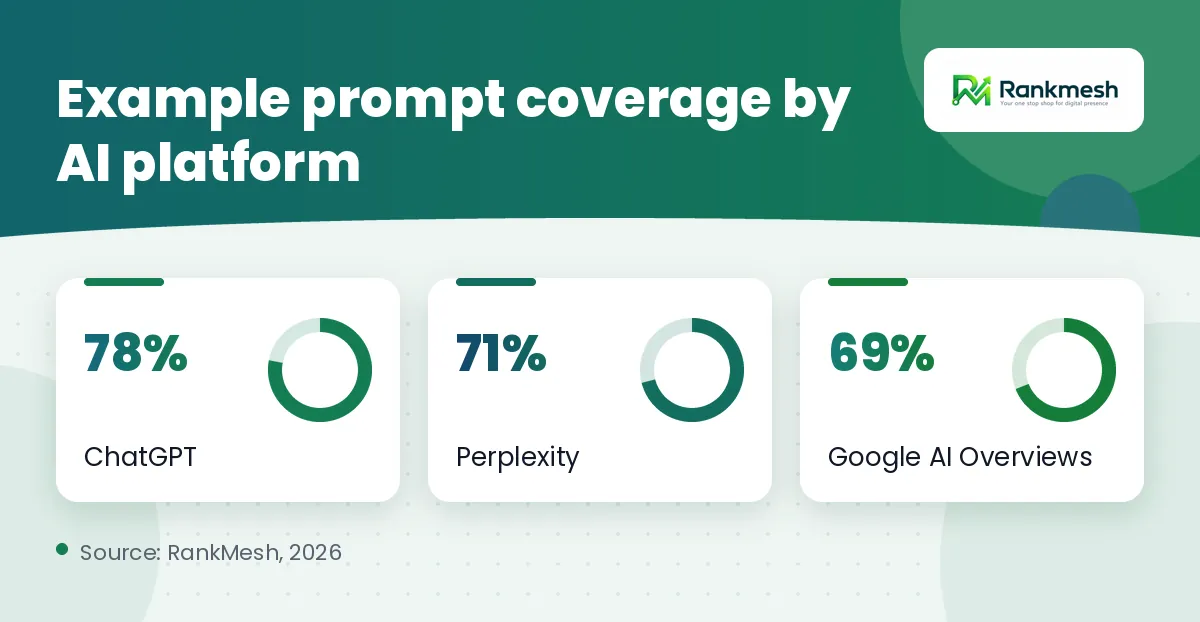
RankMesh publishes an illustrative example of prompt coverage by platform, in which a brand is cited in 78% of tracked prompts on ChatGPT, 71% on Perplexity and 69% in Google AI Overviews (RankMesh, 2026). Those figures describe a scenario rather than a benchmark, yet they illustrate why platform-level reporting matters: the same brand can perform very differently from one assistant to the next.

What does a worked AI share of voice example look like?
A worked example makes the formula concrete. Imagine a hypothetical payroll software company in Pune, here called PayLedger, that sells to Indian startups and competes with four better-known brands. The figures below are invented for illustration only.
PayLedger tracks twenty buyer prompts, such as "best payroll software for startups in India" and "payroll tool that handles TDS (tax deducted at source) filing". The team runs each prompt three times on ChatGPT, Gemini and Perplexity, producing one hundred and eighty answers. Across those answers, the assistants mention brands six hundred times, and PayLedger accounts for ninety of those mentions, giving it an AI share of voice of fifteen percent.
The supporting metrics tell a more useful story. PayLedger appears in eight of the twenty prompts, a prompt coverage of forty percent, and almost all of those appearances come from generic "best payroll software" prompts. On every compliance-focused prompt, including the TDS question, competitors dominate because they publish detailed, well-structured compliance guides.
That diagnosis turns a vanity metric into a roadmap. PayLedger's next quarter should prioritise answer-first compliance pages, schema markup and consistent product descriptions across review sites, then re-run the same prompt set to measure the change.
How to measure AI share of voice step by step
Learning how to measure AI share of voice comes down to controlling variables. The method below works whether you use a spreadsheet or a dedicated platform, because the discipline matters more than the software.
- Build a representative prompt set. Draw prompts from sales calls, support tickets and keyword research, covering discovery ("best X for Y"), comparison ("X vs Y") and problem-led questions.
- Define your competitor list. Include direct rivals plus the brands assistants actually name, which often differ from the competitors your sales team watches.
- Fix your conditions. Use logged-out or clean sessions where possible, record the model and date, and keep prompt wording identical between runs.
- Run each prompt several times per platform. Because outputs vary, repeated runs give you a distribution instead of an anecdote.
- Log every mention with context. Record the brand, its position in the answer, its framing and any cited source URL.
- Calculate the core metrics. Compute AI share of voice, prompt coverage and citation share for each platform before blending them into an overall view.
- Diagnose and act. Group the prompts you lose by theme, map each theme to a content, schema or entity fix, and re-measure on the same prompt set.
Keep the prompt set stable for at least a full reporting cycle. Changing prompts every month makes trends impossible to read, so add new prompts as a separate cohort rather than replacing old ones.
How should Indian and regional brands adapt their prompt sets?
Brands selling in India, or in any market with strong regional nuances, should write prompts the way local buyers actually phrase them. Generic English prompts often surface global brands, which can understate or overstate your real visibility among the customers you serve.
Practical adjustments include adding city and state modifiers ("best CA firm in Jaipur"), local compliance terms such as GST, TDS or specific state regulations, and pricing in rupees. Conversational phrasing that mixes Hindi and English is worth testing too, because buyers increasingly type to assistants the way they speak.
Local service businesses should also check whether assistants pull information from their Google Business Profile. An outdated profile with old posts, unanswered questions and unreplied reviews gives a model less confident material to work with when it recommends local providers.
AI share of voice tools fall into four broad groups: manual tracking in spreadsheets, AI visibility modules added to established SEO suites, standalone AI visibility trackers, and platforms that both track citations and act on the gaps they find. The right choice depends on how many prompts you track and whether you have the capacity to fix what the data reveals.
- Manual spreadsheets: Free and educational, but slow, hard to repeat consistently and impractical beyond a few dozen prompts.
- SEO suite add-ons: Convenient if you already pay for a large SEO platform, though they typically report visibility and leave the fixes to your team.
- Standalone AI visibility trackers: Built specifically for monitoring mentions across assistants, usually with stronger prompt management but no execution layer.
- Autonomous execution platforms: Combine tracking with automated fixes such as schema deployment, entity cleanup and content rewrites.
RankMesh sits in the last group. Its live AI visibility score, outlined on the AI Recommendations page, tracks assistants such as ChatGPT and Perplexity, with a daily citation monitor for new mentions. A network of 40+ specialised AI agents then works on the gaps the tracking reveals. Every action is logged, high-impact changes go through your approval panel, and you can approve, reject, auto-approve or reverse what the agents do.
How do you increase AI share of voice?
You increase AI share of voice by making your brand easy for models to identify, trust and quote. That means consistent entity information everywhere, structured data on key pages, content that answers buyer questions directly and credible third-party mentions that corroborate what your own site claims.
Focus on these levers in roughly this order:
- Entity consistency. Use the same brand name, category description and core attributes on your website, social profiles, directories and review platforms.
- Structured data. Add schema markup (machine-readable code that labels your organisation, products and FAQs) so models can parse your pages reliably.
- Answer-first content. Open each section with a direct, self-contained answer, an approach closely tied to answer engine optimization.
- Third-party corroboration. Earn mentions in reviews, comparisons and industry publications that assistants already cite.
- Active local profiles. Keep Google Business Profile posts, photos, Q&A and review replies current if you serve local customers.
Results are rarely instant. Schema and entity fixes can deploy immediately, but AI engines re-crawl and update their retrieval indexes on their own schedules, so initial citation movement typically appears over a few weeks (RankMesh, 2026).
What this means for you
AI share of voice gives every growth team a sharper question than "where do we rank?": when buyers ask an assistant for help, are we part of the answer? The practical response depends on your role.
- Founders and SMB owners: Start with the twenty or so prompts that most resemble real sales conversations, and fix entity consistency before investing in new content.
- Marketing managers: Report AI SOV next to organic traffic and pipeline, by platform, so leadership sees the influence of zero-click recommendations.
- SEO professionals: Treat prompt coverage gaps like keyword gaps, and map each lost theme to a specific page, schema or citation fix.
- Agencies: Offer AI SOV baselines as a distinct deliverable, since clients increasingly ask why competitors appear in ChatGPT answers and they do not.
The common thread is closing the loop. Measurement without execution simply documents the problem, so pair whichever tracking method you choose with a reliable way to ship fixes and re-test.
Frequently asked questions
What is AI share of voice in simple terms?
AI share of voice is the percentage of brand mentions you receive in AI-generated answers compared with your competitors. If assistants mention brands in your category many times and you account for a small fraction of those mentions, your share is low. The metric shows how often AI recommends you when buyers ask for help.
How many prompts do I need to measure AI share of voice?
There is no universal number, but the prompt set should cover your main buyer intents, including discovery, comparison and problem-led questions. Small businesses can start with a focused set and expand later. Consistency matters more than volume, so keep the same prompts across reporting periods.
Is AI share of voice the same as share of model?
The two terms overlap heavily and are often used interchangeably. Share of model usually refers to how a model represents a brand from its training data, while AI share of voice usually includes live, web-retrieved answers. Most practical tracking programmes measure both together.
How often should I track AI share of voice?
Monthly reviews work well for trend reporting, because answers vary from run to run and short-term swings are noisy. Weekly spot checks on your highest-value prompts help you catch sudden drops, such as a competitor launching a strong comparison page.
Start measuring your AI share of voice
You cannot improve a number you have never measured, and most brands have no idea whether ChatGPT, Gemini or Perplexity recommends them today. RankMesh offers a free plan that shows where you stand, and paid plans start at $99 a month (Rs 10,000 + GST in India) when you want agents to track and fix the gaps (RankMesh pricing, 2026). Compare RankMesh plans and get your free AI visibility report to see who AI recommends instead of you.