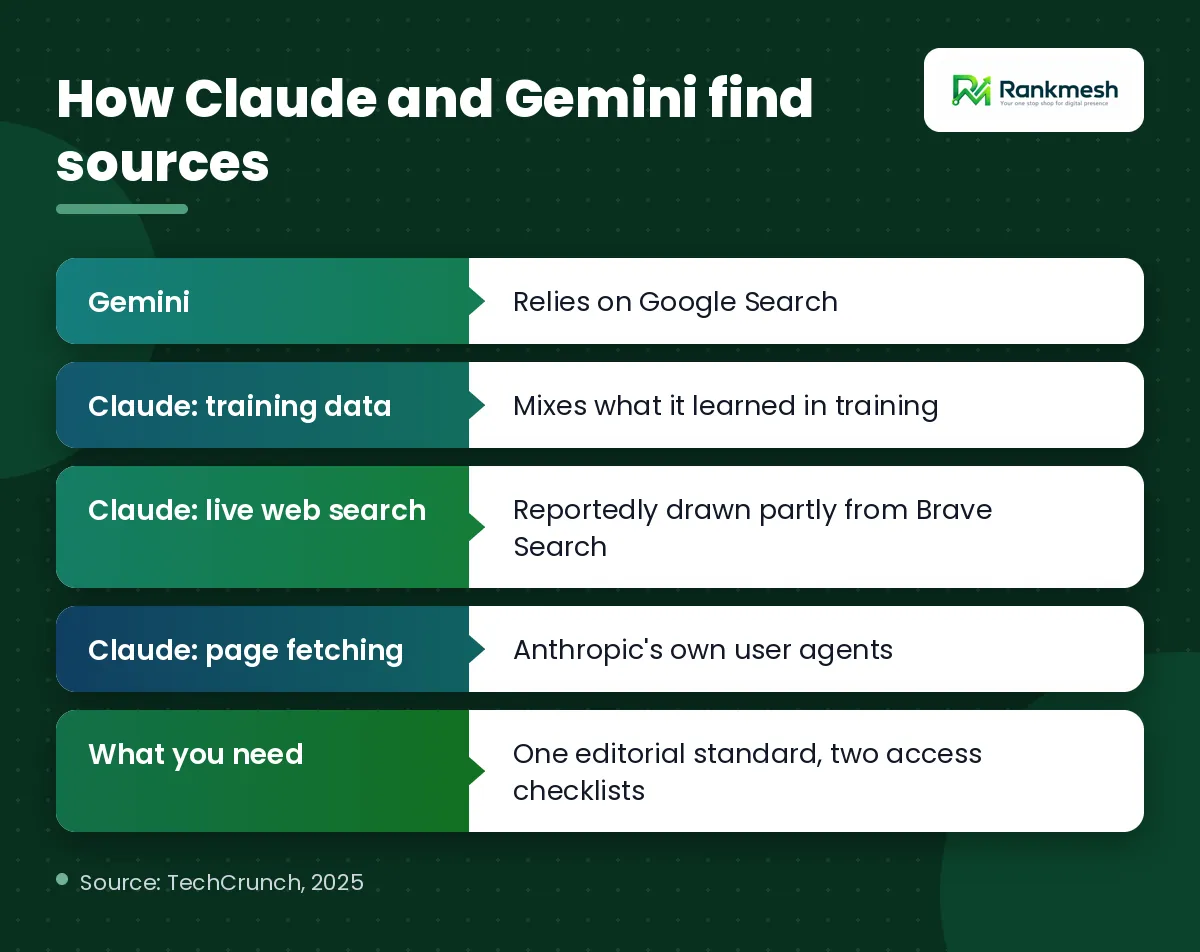
Gemini might name your brand while Claude recommends a competitor, and the reason can be access as much as content. Both assistants answer high-intent questions like which agency to hire or which platform to buy, but they find and cite their sources in very different ways. Gemini relies on Google Search. Claude mixes what it learned in training with live web search results, reportedly drawn partly from a third-party index, Brave Search (TechCrunch, 2025), and it fetches pages with Anthropic's own user agents. So if you want to optimize for Claude and Gemini at the same time, you need one editorial standard and two separate access checklists.
Key takeaways
-
Gemini's live answers depend on Google Search, so a page must first be indexed by Google and remain eligible to appear with a snippet.
-
Claude answers either from training data or from a live web search, and Anthropic's three crawlers honor robots.txt, so one outdated rule can quietly remove your site from consideration.
-
Both assistants favor self-contained passages in which the subject is named explicitly, the answer arrives immediately and every fact can be verified.
-
Consistent entity signals (the same brand name, category and description everywhere) allow both models to describe your business with confidence.
-
Visibility must be measured per platform, because a Gemini citation reveals nothing about whether Claude mentions you.
-
Gemini's live source: Grounding with Google Search, which returns inline citations tied to specific spans of text
-
Claude's live source: Claude's built-in web search, launched by Anthropic in March 2025 with direct citations
-
Crawlers to check for Gemini: Googlebot for Search eligibility, plus the Google-Extended token for Gemini training and grounding
-
Crawlers to check for Claude: ClaudeBot (training), Claude-SearchBot (search quality) and Claude-User (user-initiated fetches)
-
Shared content standard: Direct answers, named subjects, sourced facts and schema that mirrors the visible text
-
Best first fix: Audit robots.txt and firewall bot rules for both vendors before rewriting a single page
How do Claude and Gemini choose which sources to cite?
When grounding is active, Gemini cites pages it retrieves through Google Search, so Google's index determines whether a page is even eligible. Claude either answers from its training data or runs a live web search, then fetches and cites the pages it finds. Both reward quotable text, but they reach that text through entirely separate pipelines.
Grounding, in this context, means connecting a language model to external documents at the moment it answers, so its claims can be traced to a source. Google's developer documentation states that "Grounding with Google Search connects the Gemini model to real-time web content," and adds that, when needed, "the model automatically generates one or multiple search queries and executes them" (Google AI for Developers, 2026).
The same documentation explains that each citation annotation links a defined segment of the answer to a specific source URL. Gemini grounding with Google Search is therefore, in practical terms, a layer of query generation and synthesis operating on top of Google's existing index, with attribution applied sentence by sentence rather than page by page.
Claude operates differently. Anthropic added web search to Claude on March 20, 2025, explaining that the feature "provides direct citations so you can easily fact check sources" (Anthropic, 2025). Before that launch, Anthropic had argued that Claude was "designed to be self-contained" (TechCrunch, 2025).
Our inference, rather than an Anthropic statement, is that a meaningful share of Claude conversations still never trigger a search. So, the way your brand is represented in Claude's training data carries more weight than it would for an assistant that searches before answering nearly every prompt.
What does Gemini reward in its answers?
Gemini rewards pages that already perform well in Google Search: indexed, crawlable and snippet-eligible documents whose content anticipates the follow-up questions behind a query. Google states that no special AI markup is required, so the work is conventional SEO executed rigorously, with every important answer phrased so that a model can quote it accurately.
Google index eligibility comes first
Google's guidance for its AI features is unambiguous: to appear as a supporting link, a page "must be indexed and eligible to be shown in Google Search with a snippet" (Google Search Central, 2025). Google also says you do not need new machine-readable files, AI text files or special schema.org structured data to qualify.
"There are no additional requirements to appear in AI Overviews or AI Mode, nor other special optimizations necessary." (Google Search Central, 2025)
Share on LinkedIn · Share on X
That guidance formally covers Google's AI search features, but grounding in the Gemini API also draws on the Google Search index. A page that is blocked, set to noindex or restricted by nosnippet, data-nosnippet or a very tight max-snippet value therefore begins at a disadvantage wherever Google's AI looks for sources.
Coverage of the follow-up questions
Because Gemini can generate several search queries from a single prompt, a buyer's question such as "best SEO platform for a Shopify store" may expand into separate searches about pricing, integrations and migration risk. This expansion is often called query fan-out. Our inference is that pages answering those adjacent sub-questions explicitly, under clear headings, give the model more opportunities to retrieve and cite them.
Precise, attributable sentences
Gemini's span-level citations suggest a practical writing rule: every important sentence should state one verifiable claim and name its subject. A sentence such as "Our plans start at a competitive price" offers nothing to attribute, whereas a sentence stating the plan name, price and inclusions gives the model a clean span to cite.
Google-Extended controls Gemini use, not Search ranking
Google-Extended is a robots.txt product token, meaning a name you can address in robots.txt rules, that governs whether content Google crawls may be used to train future Gemini models and to ground answers in Gemini Apps and Vertex AI. Google states that Google-Extended "does not impact a site's inclusion in Google Search nor is it used as a ranking signal" (Google Search Central, 2026). Blocking Google-Extended therefore preserves your Search rankings while potentially reducing your presence in Gemini Apps answers.
What does Claude reward in its answers?
Claude rewards brands that are both well represented in its training data and reachable by Anthropic's crawlers at the moment a user's question triggers a search. In practice, that requires permissive robots.txt rules for three distinct bots, pages whose key text loads without heavy client-side scripting, and a brand description that stays identical across the web.
Three crawlers, three different consequences
Anthropic documents three user agents, and each one affects a different stage of visibility (Anthropic Help Center, 2026):
- ClaudeBot collects "web content that could potentially contribute to" model training. Blocking ClaudeBot excludes your future content from training datasets.
- Claude-SearchBot "navigates the web to improve search result quality for users." Blocking Claude-SearchBot prevents indexing for search, which may reduce visibility in user search results.
- Claude-User "supports Claude AI users" by retrieving pages in response to a user's query. Blocking Claude-User prevents that retrieval entirely.
A ClaudeBot robots.txt rule blocks training collection and nothing else, but a blanket wildcard rule blocks far more, including Googlebot and every other crawler. A wildcard rule (User-agent: * with Disallow: /) or a firewall that challenges unfamiliar bots can quietly shut out all three crawlers at once. A minimal configuration that admits every relevant crawler looks like this:
User-agent: ClaudeBot
Allow: /

User-agent: Claude-SearchBot
Allow: /

User-agent: Claude-User
Allow: /

User-agent: Google-Extended
Allow: /
Some businesses deliberately block training crawlers for licensing reasons, which is a legitimate choice. The important point is that the decision should be intentional and documented, rather than inherited from an old configuration nobody remembers writing.
Training data rewards consistent entity signals
An entity, in search terminology, is a distinct, identifiable thing (a company, product or person) that a system can recognize across many documents. When Claude answers without searching, it relies on patterns learned from training data, so a brand described identically on its website, LinkedIn page, directory listings and press coverage becomes far easier to recall and recommend. RankMesh's own guidance on consistent entity signals makes the same point: an assistant names businesses it can pin down with confidence.
Claude web search SEO: what a fetched page needs
If you are working out how to get cited by Claude during a live search, think about what happens after the fetch. The following practices are our practitioner recommendations rather than published Anthropic requirements:
- Render the primary answer in the initial HTML, because a crawler that does not execute JavaScript may see an empty template.
- Place a direct, 40 to 60 word answer immediately below each question-style heading.
- Name the subject in every key sentence instead of relying on "it" or "this," so a quoted passage still makes sense in isolation.
- Show a visible publication or update date, since recency often matters for commercial comparisons.
How do you optimize for Claude and Gemini with one workflow?
You can serve both assistants with one sequence: confirm crawler access for both vendors, verify Google indexing, map the prompts buyers actually ask, rewrite key passages into answer-first form, align entity signals across the web and then measure each platform separately. Access always comes before content, because unreachable pages cannot be cited.
- Audit access. Review robots.txt and any CDN or firewall bot-management rules for ClaudeBot, Claude-SearchBot, Claude-User, Googlebot and Google-Extended.
- Confirm Google indexing. Use Search Console's URL Inspection tool on your most commercially important pages, and remove accidental noindex or nosnippet directives.
- Map prompts, not only keywords. Write down the full questions prospects ask, such as "Which SEO platform suits a 20-person SaaS team?", including the follow-up questions about price and integrations.
- Rewrite key passages. Adopt an answer-first page structure: question heading, direct answer, then supporting detail.
- Source every claim. Link each statistic to its original page and year, which helps both human readers and span-level citation systems.
- Align entity signals. Make your brand name, category, location and one-sentence description identical on your About page, social profiles, Google Business Profile and directories.
- Add accurate structured data. Organization and FAQPage markup should mirror the visible text exactly; Google says special schema is not required for its AI features, so treat markup as clarification rather than a ranking lever.
- Measure per platform. Track each assistant individually, because results diverge.

What does a citation-ready rewrite look like?
A citation-ready passage names the business, its category, its audience and one verifiable differentiator within the first two sentences. Vague brand language gives neither Claude nor Gemini anything to extract, whereas specific, self-contained statements can be quoted accurately and attributed to your page.
Consider a fictional Bengaluru agency, Kestrel Commerce, whose service page originally read: "We're passionate about crafting beautiful online stores that convert. Our experienced team delivers results for brands of every size." Neither sentence names a platform, a customer type or a measurable promise, so an assistant has no reason to recommend Kestrel for any particular question.
The rewritten version reads: "Kestrel Commerce is a Shopify development agency in Bengaluru that rebuilds stores for mid-size D2C retailers. Kestrel Commerce migrates stores from WooCommerce to Shopify, preserves existing URLs with 301 redirects and publishes fixed project pricing on its website." Each sentence now answers a likely prompt, repeats the entity name and contains facts that could be verified elsewhere.
For an Indian business, this specificity matters twice over. Prompts often include a city or a market qualifier, and an assistant can only match "Shopify agency in Bengaluru" to a brand whose pages and profiles state that location plainly and consistently.
How should you measure Claude and Gemini visibility separately?
Measure each assistant against the same fixed set of buyer prompts, recording whether your brand is mentioned, whether a URL is cited and which competitors appear instead. Repeat the checks on a regular schedule, because generated answers vary between runs and a single test can mislead.
A simple tracking log should capture the prompt, the platform, the date, whether the brand appeared, the cited URL and the competitors named. Over several weeks, the log reveals patterns that a single snapshot conceals, such as Gemini citing a comparison page while Claude recommends a competitor with a clearer About page.
RankMesh's live AI visibility score runs across ChatGPT, Perplexity, Claude and Google AI Overviews, and a daily citation monitor scans ChatGPT, Perplexity and Gemini for new mentions of your brand. Until Claude tracking launches, teams should run a short manual Claude check each month using the same prompt set, so the two datasets remain comparable.
What this means for you
If you lead marketing for a startup, SMB or SaaS company, the practical lesson is that generative engine optimization begins with infrastructure, not prose. Start with the crawler audit this week, because a single blocked user agent can nullify months of content work, then rewrite your five most commercially valuable pages into answer-first form.
Agencies and in-house SEO teams should add AI search citations to client reporting as a separate metric, broken out by platform, because clients increasingly ask why a competitor appears in an assistant's recommendation. E-commerce brands, particularly those competing in specific Indian cities, should prioritize location and category consistency across Google Business Profile, marketplaces and their own site.
The ongoing work (monitoring bots, refreshing entity data, rewriting pages and tracking prompts) is continuous rather than quarterly. That is the gap RankMesh was built for: audits, fixes and tracking are handled for you, and schema updates deploy automatically. The Free plan shows where you stand today, Self-Serve costs $99 a month (Rs 10,000 + GST in India) with your team approving the work, and Managed costs $399 a month (Rs 40,000 + GST) with a dedicated account manager publishing for you.
FAQs
Do I need different content to rank in Claude and Gemini?
Usually not. Both assistants favor self-contained, answer-first passages with named subjects and sourced facts, so one well-structured page can serve both. The real differences lie in access: Gemini depends on Google indexing, while Claude depends on Anthropic's crawlers being admitted through your robots.txt and firewall.
Does blocking Google-Extended remove my site from Google Search?
No. Google states that Google-Extended does not affect a site's inclusion in Google Search and is not a ranking signal. Blocking the token does, however, limit how Google may use your content for Gemini training and for grounding in Gemini Apps and Vertex AI.
Which Anthropic crawler matters most for live Claude citations?
Claude-SearchBot and Claude-User matter most for live citations, because Anthropic says blocking them can reduce search visibility and prevent retrieval in response to a user query. ClaudeBot governs training data collection, which shapes what Claude knows when it answers without searching.
Do I need special schema or an AI text file for Gemini?
Google says you do not need new machine-readable files, AI text files or special schema.org markup to appear in its AI features. Accurate structured data remains sensible general practice, but indexing and snippet eligibility come first.
Find out whether Claude and Gemini recommend you
Knowing what each model rewards is useful only if you can see where you stand today. A free RankMesh audit shows whether ChatGPT, Gemini and Perplexity currently recommend your brand. From there, the AI visibility score and daily citation monitor show which platforms recommend you and which don't. Compare RankMesh plans and pick the level of support that fits your team.