Your keyword tool shows a phrase with almost no monthly searches, so you skip it. Meanwhile, a buyer asks ChatGPT that same question in a full sentence, and the assistant recommends a competitor whose page answers it clearly.
That gap is why keyword research for AI search has to start with questions, not volume. This guide shows how to build a question-first keyword plan, how to prioritize questions when there's no volume data, and how to turn those questions into pages that AI assistants can quote.
Key takeaways
- Volume data comes from typed Google queries. AI assistants get longer, conversational prompts that most keyword tools don't measure well.
- The most valuable AI search keywords are real buyer questions: comparisons, "best for" queries, cost questions and "how do I" problems.
- Prioritize questions by buying intent and by whether you can give the best answer, not by monthly searches.
- Each important question needs a clear, direct answer on your site, written so an assistant can quote the passage on its own.
- Track whether ChatGPT, Gemini and Perplexity mention you for those questions, then update the pages that don't get cited.
At a glance
- What changes: You research the questions buyers ask, not only short keywords with high volume.
- Main inputs: Sales calls, support tickets, People Also Ask boxes, forums and test prompts in AI assistants.
- Main output: A ranked question map, with each question assigned to one page.
- How you measure success: Whether AI answers mention or cite your brand, plus your normal Google rankings.
- Time to first results: Page fixes can ship quickly, but AI engines re-crawl on their own schedule, so expect weeks, not days.
Why does search volume mislead keyword research for AI search?
Search volume measures short queries typed into Google. People ask AI assistants long, specific questions packed with context, such as budget, industry or location. Those prompts rarely appear in keyword databases, so they look like zero-volume terms. Yet they often carry the strongest buying intent, which means a volume-first plan hides your most valuable topics.
Traditional keyword research grew up around a simple model. People type two to four words, Google shows a page of links, and the highest-volume term usually wins the budget. That model still matters for Google rankings, so don't throw your keyword tool away.
The problem starts when you use the same filter for AI answers. A person who types "CRM software" into Google is browsing. A person who asks Perplexity "Which CRM works for a small real estate team that already uses Google Workspace?" is close to a decision. The second query will never show real volume, but the brand named in that answer is the one most likely to get the demo.
There's also a structural difference. A Google results page gives many brands a spot. Inside an AI-generated answer, often only a handful of brands get mentioned at all. Ranking eighth on Google still brings some traffic. Being absent from an AI answer usually means getting nothing from that question.
How do people search differently in ChatGPT, Gemini and Perplexity?
People talk to AI assistants the way they would talk to a knowledgeable colleague. Conversational search queries are longer, include personal context and often ask for a recommendation or a comparison. Follow-up questions are common, so one conversation can cover research, shortlisting and a final choice without a single visit to a search results page.
These prompt patterns show up again and again:
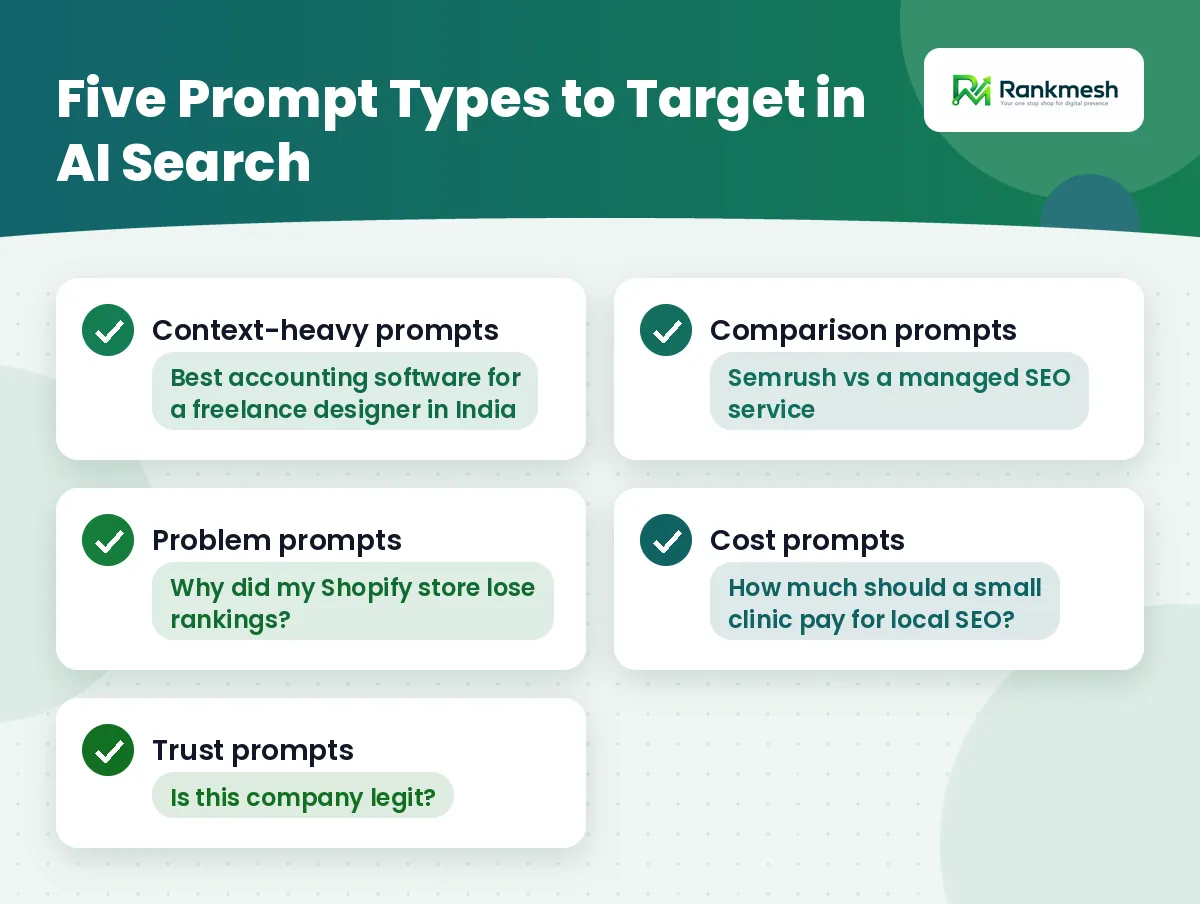
- Context-heavy prompts. "Best accounting software for a freelance designer in India who invoices in USD."
- Comparison prompts. "Semrush vs a managed SEO service for a small startup."
- Problem prompts. "Why did my Shopify store lose rankings after I changed themes?"
- Cost prompts. "How much should a small clinic pay for local SEO each month?"
- Trust prompts. "Is this company legit?" or "What do customers say about this tool?"
Each pattern points to a different stage of the buying journey. A good question map covers all five, because an assistant draws on different pages for each one.
This shift is also why the debate over AI search market share matters less for planning than it seems. Whatever the exact split between Google and AI assistants this year, your buyers already ask full questions in both places. Google's own AI Overviews and People Also Ask boxes reward the same direct, question-shaped answers. For the bigger picture on buyer behavior, read our piece on why customers ask AI, not Google.

What does a question-first keyword process look like?
A question-first process collects the real questions buyers ask, groups them by intent, checks how AI assistants answer them today and assigns each question to one page. Volume data comes last, as a tiebreaker. The goal is a short, ranked list of questions your site should own, not a spreadsheet of thousands of loosely related terms.
Good AI search keyword research starts in your inbox, not in a keyword tool. Here is a sequence you can run in a week:
- Mine your own conversations. Pull questions from sales calls, demo notes, support tickets, live chat logs and onboarding emails. Write them down in the buyer's exact words.
- Add public question sources. Check People Also Ask boxes, Reddit threads, Quora, industry forums and review sites in your category. Note the questions that keep repeating.
- Test prompts in AI assistants. Ask ChatGPT, Gemini and Perplexity the questions you collected. Record which brands get named, which sources get cited and what the answer gets wrong.
- Group by intent. Sort each question into learn, compare, choose or fix. Comparison and "best for" questions usually sit closest to revenue.
- Assign one page per question cluster. Decide whether an existing page can answer the cluster or whether you need a new one. Avoid two pages competing for the same question.
- Check volume last. Use your keyword tool to find the shorter Google phrase behind each question, so the same page can rank in classic search too.
Step 3 is easy to skip, but it's the most revealing. If an assistant already recommends three competitors for your core question, you know exactly which answer you need to beat.
How do you prioritize questions without volume data?
Prioritize questions by three signals: how close the asker is to buying, how often the question comes up in your own sales and support conversations, and whether you can honestly give the best answer. A question that scores high on all three deserves a page this month, even if a keyword tool reports zero searches for it.
A simple scoring pass works well for small teams. Give each question a rating of low, medium or high on these points:
- Buying intent: Does the question mention a budget, a comparison, a "best for" need or a deadline?
- Frequency in your data: Do prospects ask it on calls or in tickets again and again?
- Answer strength: Do you have real expertise, product details or examples nobody else can offer?
- Current AI coverage: Are assistants giving weak, outdated or competitor-only answers today?
- Google overlap: Is there a shorter version of the question with some search volume?
Start with the questions that rate high on intent and answer strength. Those are the prompts where a clear page has the best chance of changing what an assistant says about your category.

How do you turn questions into pages AI assistants can quote?
Put the question in a heading, answer it directly in the first two or three sentences, then add detail, steps and examples below. Name the subject in each passage instead of writing "it" or "this," so a quoted paragraph still makes sense alone. Add FAQ schema and consistent brand details so assistants can extract and attribute the answer.
In AI search optimization GEO work, question research is always the first step. GEO stands for generative engine optimization, the practice of getting your brand cited and recommended inside AI-generated answers. RankMesh's own product team frames the overlap with classic SEO this way:
"Ranking on page one of Google and getting recommended inside those answers are related problems: both reward clear structure, real entity signals, and content written to be quoted, not just to be found." (RankMesh About page, 2026)
Share on LinkedIn · Share on X
In practice, a quotable page has a few consistent traits:
- Direct answers first. A short answer of roughly 40 to 60 words sits right under the question, which also matches the format Google tends to use for featured snippets.
- Self-contained passages. Each paragraph names the product, service or problem it discusses.
- Structured data. FAQPage schema helps Google and AI assistants find question-and-answer pairs on the page. You can build the markup with the free FAQ schema generator.
- Consistent entity signals. Your brand name, category, location and offering should read the same way on your site, your Google Business Profile and your social profiles.
- Real specifics. Prices, steps, timelines and examples give an assistant something concrete to cite.
This is the same discipline behind answer engine optimization: structure each page so it is the easiest one to quote for the question it targets.
How do you track whether your question research is working?
Re-run your priority prompts in ChatGPT, Gemini and Perplexity on a regular schedule and record whether your brand is mentioned, cited or recommended. Compare the results with your Google rankings for the shorter phrases behind each question. Pages that rank but never get cited usually need a clearer direct answer or stronger entity signals.
You can track prompts by hand in a spreadsheet when you only have a dozen questions. Once the list grows, manual checks get slow and inconsistent, because AI answers change from one session to the next.
You have a few options at that point:
- Manual tracking: Free and useful for learning, but hard to keep up past a small set of prompts.
- Dedicated AI visibility trackers: Tools such as Peec AI and Scrunch AI focus on monitoring brand mentions across AI assistants. They focus mainly on reporting where you appear, so most of the fixing usually stays with your team.
- Classic SEO suites: Platforms like Semrush handle Google keyword data well and have added AI visibility features of their own.
- An autonomous SEO department: RankMesh (our product) tracks AI visibility across ChatGPT, Perplexity, Claude and Google AI Overviews. Its agents also rewrite pages into a question-and-answer structure and deploy schema, and every action is logged and can be reviewed or reversed.
Pick based on who will act on the data. A tracker is enough if you have writers and developers ready to make changes. If nobody has time to act on a report, tracking alone won't move your citations.
What this means for you
If you run a startup, a small business or a lean marketing team, you don't need a bigger keyword list. You need a shorter list of the right questions and a page that answers each one better than anyone else.
Here is a practical starting plan for the next 30 days:
- Collect 30 to 50 real buyer questions from calls, tickets and forums.
- Test your top 10 to 20 in ChatGPT, Gemini and Perplexity and note who gets named.
- Rewrite or create one page per high-intent question, leading with a direct answer.
- Add FAQ schema and check that your brand details match across your site and profiles.
- Re-test the same prompts in a few weeks and update the pages that still aren't cited.
Agencies and SEO professionals can run the same process per client and report on AI mentions alongside rankings. Keyword research for AI search becomes much easier to explain to a client when you can show the exact prompt, the current answer and the page built to change it.
Frequently asked questions
Is keyword volume still useful for AI search?
Yes, but as a tiebreaker rather than a starting point. Volume helps you find the short Google phrase behind a buyer question, so one page can rank in classic search and get cited in AI answers.
How many questions should a small business target first?
Start with 10 to 20 high-intent questions tied to what you sell. A focused list you can answer well beats hundreds of thin pages that no assistant wants to quote.
What is the difference between GEO and AEO?
Answer engine optimization targets structured answer formats in traditional search, such as featured snippets, People Also Ask and voice answers. GEO targets citations inside generative AI answers from tools like ChatGPT and Perplexity. Both reward clear structure and schema, so it makes sense to work on them together.
How long does it take to get cited by AI assistants?
Page and schema changes can go live right away, but AI engines re-crawl and update their indexes on their own schedule. Most brands should expect to see movement over weeks rather than days, and results are never guaranteed.
Can I do question-first keyword research without paid tools?
Yes. Your sales notes, support tickets, People Also Ask boxes, forums and free AI assistant accounts are enough to build a solid first question map. Paid tools mainly save time once you need to track many prompts at scale.
Find out which questions you're missing
The fastest way to start is to see where you stand today: which questions AI assistants answer with your brand, and which ones they hand to a competitor. RankMesh runs the research, rewrites pages into quotable answers and tracks citations, while high-impact changes wait for your approval and every action stays logged and reversible. Compare RankMesh plans and turn your buyers' real questions into pages that get recommended.