You want to know if ChatGPT recommends your startup, but Profound's public pricing now points most buyers toward a custom Enterprise quote. Profound is one of the best-known AI visibility platforms, and its pricing page now lists only a free trial and a custom Enterprise plan (Profound, 2026). For a startup, that usually means a sales call and a contract built for a much bigger brand. This guide covers the best Profound alternatives for startups that publish their prices, what each one actually does, and how to pick one in a single week.
Disclosure: RankMesh is our product. We include it where it fits, and every other tool's price comes from that vendor's own pricing page.
Key takeaways
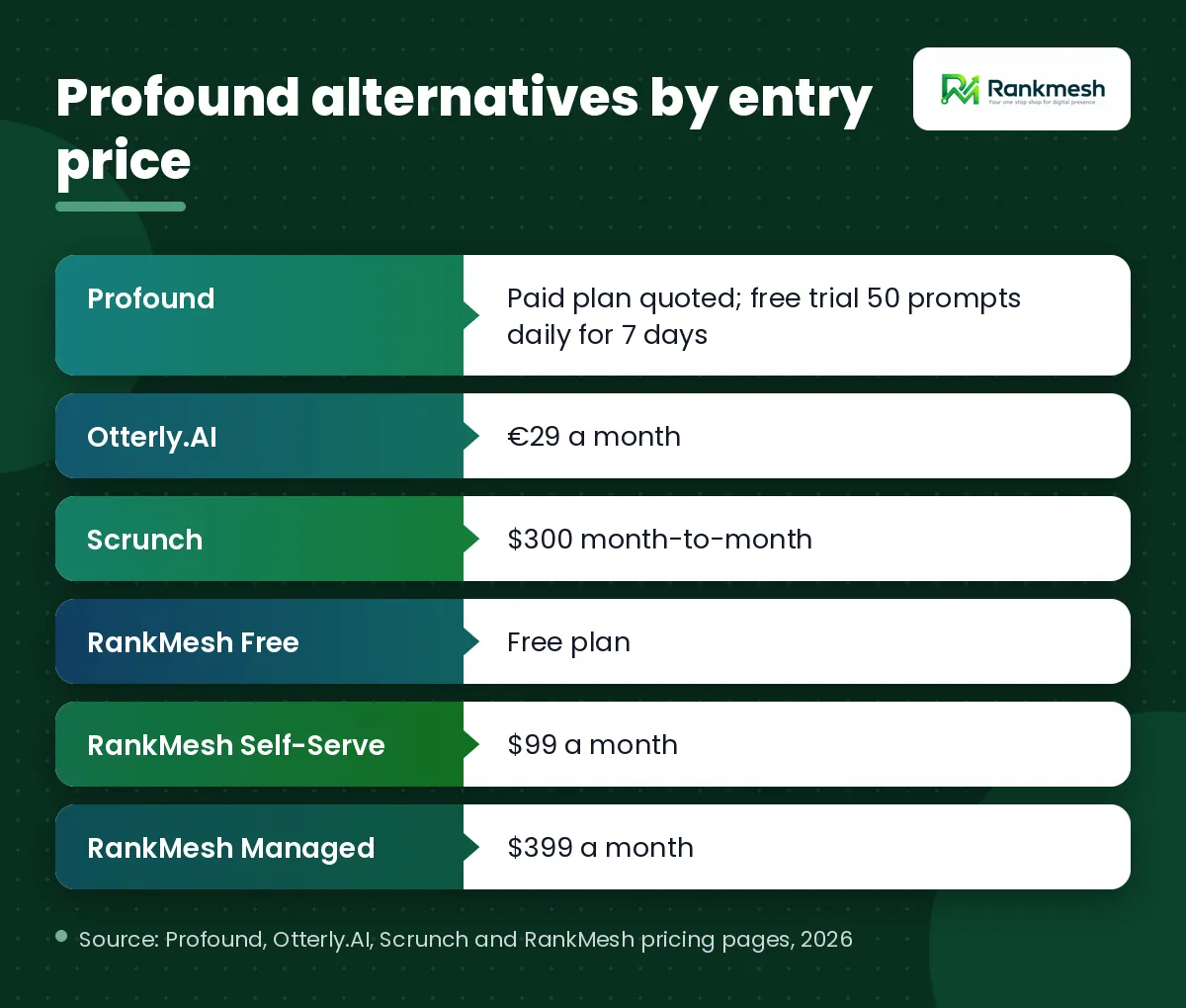
- Profound's free trial runs 50 prompts daily for 7 days across ChatGPT, Gemini and Google AI Overviews, and the paid plan is quoted rather than listed (Profound, 2026).
- Otterly.AI, Peec AI, Semrush and Scrunch all publish entry prices, from €29 a month at Otterly.AI (Otterly.AI, 2026) up to $300 month-to-month at Scrunch (Scrunch, 2026).
- Most of these tools measure AI visibility. Few of them fix the pages that cause low visibility.
- RankMesh pairs tracking with execution, with a Free plan, Self-Serve at $99 a month and Managed at $399 a month (RankMesh, 2026).
- Run every tool against the same fixed set of real buyer questions before you commit to an annual plan.
At a glance
- Profound: free trial, then a custom Enterprise quote (Profound, 2026)
- Otterly.AI: from €29 a month excluding tax, 16 prompts (Otterly.AI, 2026)
- Peec AI: from $95 a month, 50 prompts, three engines of your choice (Peec AI, 2026)
- Semrush AI Visibility Toolkit: $99 a month as a standalone toolkit (Semrush, 2026)
- Scrunch: from $300 month-to-month, seven AI platforms monitored (Scrunch, 2026)
- RankMesh: Free, then $99 or $399 a month for tracking plus fixes and content (RankMesh, 2026)
Prices in this guide come from each vendor's own pricing page at the time of writing. Vendors in this market change plans often, so confirm the current numbers before you buy.
Why are startups looking for Profound alternatives?
Startups look for Profound alternatives because Profound's pricing page shows only a free trial and a custom Enterprise plan, with no public price for a single brand. Small teams want a known monthly cost, a short commitment and enough AI engine coverage to learn whether ChatGPT, Gemini and Perplexity mention them at all.
Profound's breadth is real. Its Enterprise plan tracks up to nine answer engines, including ChatGPT, Perplexity, Google AI Mode, Gemini, DeepSeek and Claude, along with API access, exports and unlimited seats (Profound, 2026).
The free trial is much narrower. It runs 50 prompts daily for 7 days in one language and one region, with no exports and no history (Profound, 2026). That is useful for a quick look, but it ends before you can see a trend.
For a five-person startup, the issue with Profound pricing is fit, not quality. You first need one answer: do AI assistants recommend us, and if not, who do they recommend instead? A custom enterprise contract is a heavy way to get that first answer.
Why AI visibility matters for a small team
The question matters more each quarter because AI answers now sit between your buyer and your website. Pew Research Center tracked real Google browsing behaviour and found a clear drop in clicks when an AI summary appeared.
Pew Research Center found that when Google showed an AI summary, users clicked a traditional search result in 8% of visits, compared with 15% when no summary appeared (Pew Research Center, 2025).
If fewer people click, being named inside the answer becomes the new first page. That is why even early-stage teams now want some way to watch AI answers.
What should a startup look for in a cheaper Profound alternative?
A good cheaper Profound alternative publishes its price, tracks the AI engines your buyers actually use, lets you write your own prompts and shows which sources AI answers cite. For a startup, the most useful extra is help acting on the data, because a report nobody has time to act on changes nothing.
Two terms are worth defining first. A prompt is a question you track, such as "best invoicing software for freelancers." Generative Engine Optimization (GEO) is the work of shaping your site and brand signals so AI assistants can find, trust and cite you.
Use this checklist when you read any pricing page:
- Public monthly pricing: you should know the cost before a demo and be able to cancel after a month.
- Engine coverage that matches your market: a B2B SaaS buyer may lean on ChatGPT and Perplexity, while a local business cares more about Google AI Overviews and Gemini.
- Custom prompts: preset industry prompts rarely match how your buyers phrase their problems.
- Citation data: you need to see which pages the AI quoted, because those pages show you where to earn a mention.
- A path from insight to fix: someone has to rewrite pages, fix crawl issues and publish new content. Decide early whether that is you, a freelancer or the tool itself.
The last point is where most comparisons stop short. A tracker tells you that a competitor gets cited and you do not. It rarely tells your website what to change.

What are the best Profound alternatives for startups right now?
The best Profound alternatives for startups with public prices are Otterly.AI for the lowest entry cost, Peec AI for focused prompt tracking, Semrush's AI Visibility Toolkit for teams already using Semrush, Scrunch for broad engine coverage and RankMesh for teams that want tracking and execution in one place.
Otterly.AI: the lowest entry price
Otterly.AI's Lite plan costs €29 a month excluding tax and includes 16 prompts (Otterly.AI, 2026). Otterly.AI lists ChatGPT, Google AI Overviews, Perplexity, Microsoft Copilot, Google AI Mode, Gemini and Claude, and each engine uses credits. Its plan table shows 4 of the 7 engines active per plan, and Claude uses 3 credits per answer. Check the engine limits before you assume all seven are covered at €29.
The Lite allowance is enough to test brand questions and a handful of category questions, but not to map a whole market. The Standard plan steps up to 120 prompts at €189 a month (Otterly.AI, 2026).
- Best for: solo founders who want a cheap first look at AI answers.
- Watch for: credit use as you add engines, and a small prompt set on the entry plan.
Peec AI: focused prompt tracking
Peec AI's Starter plan costs $95 a month for 50 prompts, and you choose three models from ChatGPT, AI Mode, AI Overviews, Microsoft Copilot, Gemini and Naver AI (Peec AI, 2026). Extra engines cost more, and on Starter each added model is listed at $30 a month (Peec AI, 2026).
The Pro plan moves to 150 prompts at $245 a month (Peec AI, 2026). Peec AI suits teams that already know which engines matter and want clean, regular tracking on those.
- Best for: marketing managers who want a tidy prompt dashboard.
- Watch for: the cost of add-on engines if you need Perplexity or a fourth model.
Semrush AI Visibility Toolkit: for teams already in Semrush
Semrush sells its AI Visibility Toolkit as a standalone product at $99 a month, with 25 prompts tracked daily and no free trial (Semrush, 2026). The toolkit covers visibility scoring, competitor research, prompt research, brand sentiment, daily prompt tracking on Google AI Mode and ChatGPT, and an AI search site audit that flags crawl issues for AI bots.
Semrush also bundles AI visibility into its SEO and AI Search plans, where Starter is listed at $199 a month and tracks 50 prompts daily (Semrush, 2026). If your team already lives in Semrush, keeping keyword and AI data in one login has real value.
- Best for: teams already paying for Semrush.
- Watch for: which engines the daily prompt tracking covers on your plan before you rely on it for Perplexity or Gemini.
Scrunch: broad engine coverage
Scrunch's Starter plan costs $300 month-to-month or $250 a month billed annually, with 350 custom prompts (Scrunch, 2026). Scrunch Starter monitors ChatGPT, Claude, Gemini, Perplexity, Google AI Mode, AI Overviews and Meta, which is the widest self-serve engine list in this guide.
- Best for: funded startups that need wide engine coverage from day one.
- Watch for: the highest entry price on this list, and the work of acting on what the data shows.
RankMesh: tracking plus the work that fixes it
RankMesh works differently from the four tools above. It runs as an autonomous SEO department, where 40+ specialised AI agents across six divisions audit the site, fix technical issues, publish content and track visibility across Google and AI search (RankMesh, 2026). AI visibility tracking covers ChatGPT, Gemini and Perplexity today, with Claude and Grok tracking coming soon.
Self-Serve costs $99 a month and covers 200 keywords, 10 competitors and 15 articles, with your team approving the work (RankMesh, 2026). Managed costs $399 a month with 500 keywords, 30 competitors and unlimited articles, and a dedicated account manager publishes for you (RankMesh, 2026).
Every RankMesh change is reviewable. Technical fixes can go out as GitHub pull requests, and content publishes through WordPress, Shopify, Webflow, Framer, Wix or Notion Sites, so you can approve, reject or reverse any action. You can read the side-by-side detail in the RankMesh Profound alternative comparison.
- Best for: startups with no SEO hire that want the fixes shipped, not just reported.
- Watch for: fewer engines tracked than Scrunch today. If you only want a dashboard, a pure tracker can cost less.
Which is the best Profound alternative for startups in India?
For startups in India, the best Profound alternative is usually one billed in rupees with GST shown clearly, or a low-cost tracker billed in dollars or euros if you only need monitoring. RankMesh lists rupee pricing, while Otterly.AI, Peec AI, Semrush and Scrunch list their prices in euros or US dollars.
RankMesh Self-Serve is ₹10,000 a month and Managed is ₹40,000 a month, both excluding 18% GST (RankMesh, 2026). Rupee billing makes monthly budgeting simpler for an Indian company. Check the invoice details with your accountant if you plan to claim input tax credit.
Indian buyers also phrase questions differently from the preset prompts many tools ship with. Track prompts in local wording, such as "GST billing software for small shops" or "best CA firm in Jaipur for startups," and set the tracking region to India wherever the tool allows it.
This matters for trials too. Profound's free trial is limited to one region (Profound, 2026), so pick India deliberately if your buyers are here. For a wider view of local options, see our guide to the best AI SEO tools for small businesses in India.

The fastest way to test AI visibility tools for startups is to run the same fixed prompt set through two or three tools for one week. Then compare which engines each tool covers, which sources it shows and how clearly it points to a next step. Identical prompts keep the comparison fair.
Use this plan:
- Monday, write your prompt set: pull real questions from sales calls, support tickets and search queries. Mix brand questions ("is [your brand] good for X?") with category questions ("best tool for X").
- Tuesday, start free tiers and trials: open the RankMesh Free plan, the Profound trial and one paid tracker with a monthly option. The Profound trial uses a fixed prompt set, so compare it only on the questions that overlap with yours. Run your full custom prompt set in RankMesh and in one paid tracker that allows custom prompts.
- Wednesday, read the citations: note which pages the AI answers quote. Review sites, comparison posts and forums often show up more than vendor homepages.
- Thursday, fix one thing: rewrite one key page so it answers a tracked question directly in its first paragraph, and add clear facts about who you serve.
- Friday, decide: keep the tool that showed you the clearest next step, not the one with the prettiest chart.
An illustrative example
Here is a made-up scenario, not a real customer. A small invoicing startup for Indian freelancers tracks "best invoicing app for freelancers in India." The AI answers keep citing a review roundup and a larger competitor's comparison page, and never name the startup.
The useful next step is not another report. The startup needs a clear comparison page, a direct-answer FAQ and consistent company details across its site and listings, which is exactly the kind of answer engine optimization work that a tracker flags but does not do.
What this means for you
Your choice depends less on the tool and more on who will do the work after the data arrives.
- Founder with no marketer: start with a free report, then pick a tool that also ships fixes and content, because you will not have time to act on a dashboard.
- Marketing manager on Semrush: test the Semrush AI Visibility Toolkit first, then compare its engine coverage with one dedicated tracker.
- Agency or growth team: look for custom prompts, citation data and exports, since clients will ask why a competitor got named.
- Startup in India: favour rupee billing where you can, and track prompts in the words your local buyers use.
Whichever path you choose, keep your prompt set stable for at least a few months. A changing prompt list makes any trend line meaningless.
Frequently asked questions
Is there a free Profound alternative?
Yes. RankMesh has a Free plan with an AI visibility report and an automated site audit, and no card is required (RankMesh, 2026). Profound itself offers a free trial, but it is time-limited and uses a fixed prompt set.
How much does Profound cost?
Profound's pricing page lists a free trial and a custom Enterprise plan, so the paid price is quoted after a sales conversation (Profound, 2026). Startups that need a known monthly cost usually compare it with tools that publish prices.
Do I need an AI visibility tool if I already rank on Google?
Probably, if your buyers use AI assistants to shortlist vendors. Pew Research Center found that people clicked fewer search links when Google showed an AI summary (Pew Research Center, 2025), so ranking alone may not bring the same traffic it once did.
Can one tool both track and improve AI visibility?
Most AI visibility tools only track. RankMesh is built to do both. It monitors AI answers and prepares fixes and content. Your team can approve or reject each change before it goes live, set changes to auto-approve, or reverse them later. Every action is logged.
You do not need an enterprise contract to learn whether AI assistants recommend your startup. Get your free AI visibility report. It takes about 2 minutes and needs no card. When you know where you stand, you can compare RankMesh plans and choose the coverage that fits.