Most AEO tools can tell you whether ChatGPT or Perplexity mentions your brand. Far fewer help you change the answer. That gap decides whether your monthly spend buys a chart or a better result.
This guide compares six options on price, engine coverage and one key question: does the tool only watch, or does it also fix?
Key takeaways
- Answer engine optimization (AEO) is about becoming the quoted source in featured snippets, voice answers, AI Overviews and chatbot replies, not just ranking a link.
- Most AEO platforms are monitoring tools. They track prompts and citations but leave the fixes to your team.
- Prices range from free (HubSpot's AEO Grader) to enterprise-only custom quotes (Profound).
- If nobody on your team has time to act on the data, pick a tool that ships fixes for you, with your approval.
- You can start AEO this week with a list of real customer questions, answer-first rewrites and FAQ schema.
What is the answer engine optimization definition?
Answer engine optimization (AEO) is the practice of structuring content so search engines and AI assistants can pull a direct, quotable answer from it. The goal is to be the source behind featured snippets, People Also Ask boxes, voice answers, Google AI Overviews and chatbot replies, not just one blue link among ten.
Traditional SEO asks, "Where does my page rank?" AEO asks, "Whose words does the engine use when it answers?" On many queries the searcher never clicks, so being the quoted source is the visibility that counts.
AEO shows up in a few common forms:
- Featured snippets: the short answer box at the top of Google results.
- People Also Ask (PAA): the expanding question boxes further down the page.
- Voice answers: what Siri, Alexa or Google Assistant read aloud.
- AI Overviews and AI Mode: Google's generated summaries with source links.
- Chatbot citations: brands and pages named inside ChatGPT, Gemini, Perplexity and Claude answers.
That last form overlaps heavily with generative engine optimization (GEO). In practice, the same work helps both: clear structure, schema markup and consistent facts about your business. Schema markup is code that labels your content for machines, for example "this is a question" and "this is its answer."
What does the answer engine optimization Wikipedia entry say?
Wikipedia covers answer engine optimization inside its generative engine optimization article rather than as a separate topic. The article lists AEO as another name for GEO, defined as improving visibility in responses generated by AI systems, and notes that the industry has not settled on one definition.
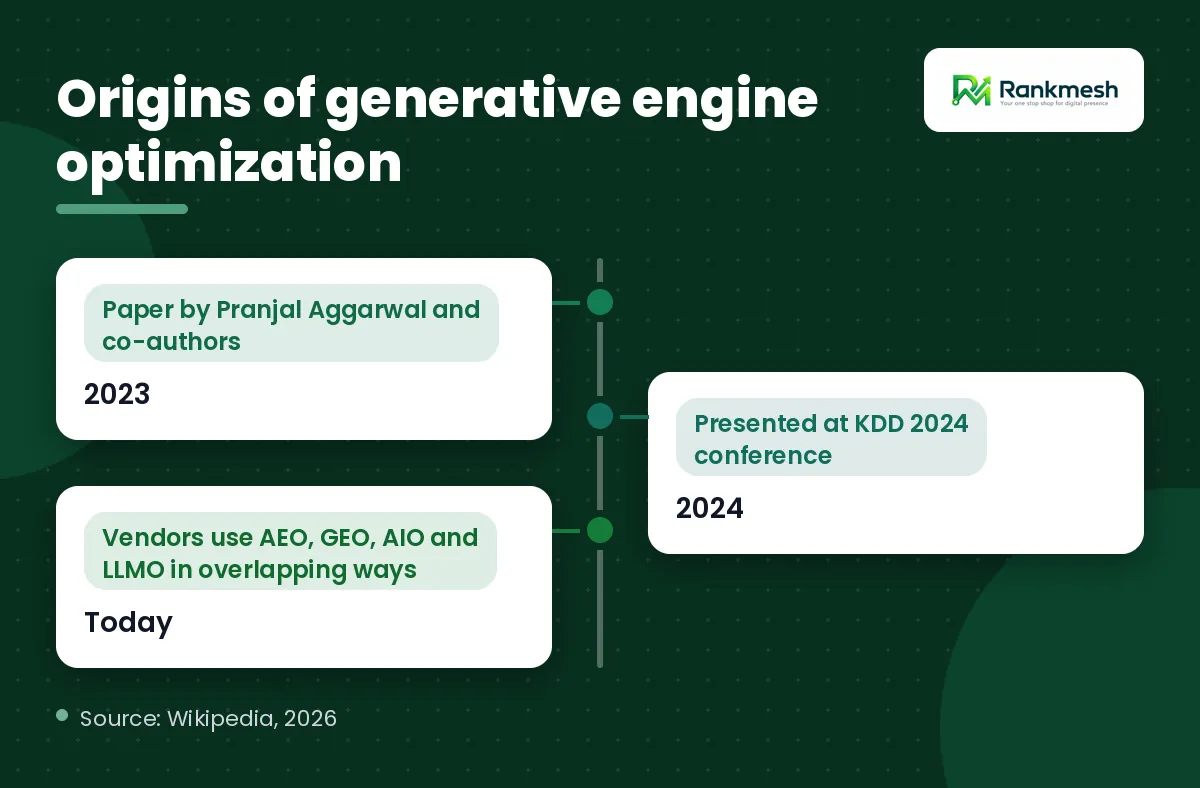
The Wikipedia article traces the term "generative engine optimization" to a 2023 paper by Pranjal Aggarwal and co-authors, later presented at the KDD 2024 conference (Wikipedia, 2026). The same article points out that vendors use AEO, GEO, AIO and LLMO in overlapping ways.
Wikipedia's generative engine optimization article describes AEO, GEO and related labels as overlapping terms with no consensus definition (Wikipedia, 2026).
Share on LinkedIn · Share on X
For buyers, that matters more than it sounds. Two tools can both say "AEO" on the homepage and do very different jobs. One might only track chatbot mentions, while another rewrites your pages for featured snippets. Judge each tool by what it does, not by the label it uses.

Good AEO tools should do four core jobs: show where AI engines and answer boxes mention you, explain which sources they trust instead, recommend specific page and schema changes, and help you ship those changes. The checklist below breaks those four jobs into six specific requirements. Most products cover the first two well. The real difference is in the last two.
Use these requirements as a checklist when you compare options:
- Prompt tracking across engines. The tool should run the questions your buyers ask on ChatGPT, Gemini, Perplexity and Google AI features, and log who gets named.
- Citation and source analysis. Seeing which URLs an engine cites tells you which pages, directories or forums to improve or earn a place on.
- Competitor share of voice. Share of voice means how often each brand appears across your tracked questions. You want to know who wins the answers you are losing.
- Actionable recommendations. "Your visibility is 34" is not a plan. "Add a 50 word answer to the top of this page" is.
- Execution. Someone has to rewrite pages, deploy FAQ schema and fix entity details. Check whether the tool does this or hands it back to you.
- Human control. Any tool that changes your site should let you review, approve and reverse its changes.
E-commerce brands should add one more check: product schema and product Q&A support. Shoppers ask AI assistants which product to buy, and those answers depend on clean, structured product data.
We checked each vendor's own pricing page in November 2026. Prices change often, so confirm them before you buy. RankMesh is our product, and we have tried to describe it as fairly as the others.
At a glance
- Semrush AI Visibility: $99 a month per domain, billed annually; 25 tracked prompts; ChatGPT, Google AI, Gemini and Perplexity; best for existing Semrush teams (Semrush, 2026).
- HubSpot AEO (beta): $50 a month, or $45 billed annually; 25 prompts; ChatGPT, Gemini and Perplexity; best for HubSpot users (HubSpot, 2026).
- HubSpot AEO Grader: free on-demand snapshot you can rerun anytime, scored out of 100; ChatGPT, Perplexity and Gemini; best for a quick baseline (HubSpot, 2026).
- Frase: $39, $103 or $239 a month, billed yearly; 20 to 75 prompts; more engines on higher plans; best for content-led teams (Frase, 2026).
- Otterly.AI: €29, €189 or €489 a month; 16 to 403 prompts; best for budget monitoring (Otterly.AI, 2026).
- Profound: enterprise only, custom pricing; up to 10 engines, including Claude and Google AI Mode; best for large brands (Profound, 2026).
- RankMesh: free plan; $99 a month self-serve or $399 a month managed (Rs 10,000 or Rs 40,000 + GST in India); ChatGPT, Gemini and Perplexity today; best for teams that want fixes shipped (RankMesh, 2026).
Semrush AI Visibility
Semrush sells its AI visibility features as a standalone base plan and also bundles them into its SEO plans. The base plan includes an AI readiness site audit, competitor analysis and prompt research. It makes most sense if your team already lives in Semrush for keyword and backlink work. You will still need people to act on what it finds.
HubSpot AEO and the free AEO Grader
HubSpot offers two different things, and they often get mixed up. The free AEO Grader gives a one-time score across five areas, including sentiment, share of voice and brand recognition. The paid HubSpot AEO product tracks prompts over time and gives ranked recommendations. If your CRM and blog already run on HubSpot, it is an easy place to start.
Frase
Frase began as a content brief and writing tool and has added AI visibility tracking. Its pricing page states plainly that AI Visibility "does not auto-fix" content, which is an honest statement of scope. Frase suits teams that write a lot of content and want tracking next to the editor.
Otterly.AI
Otterly.AI is a focused monitoring tool with a low entry price. It is a reasonable choice when you mainly want to watch a small set of prompts and report on trends. Fixing what it finds is still up to you.
Profound
Profound has moved to enterprise-only plans. Its Starter and Growth tiers were retired in September 2026, according to its pricing page. It covers the widest set of engines in this list, which matters for global brands with dedicated teams to act on the data.
RankMesh (our product)
RankMesh takes a different approach. Instead of a dashboard, 40+ specialized AI agents work across six divisions to find issues and then fix them. For AEO, that means FAQ schema deployed on relevant pages, existing pages rewritten so the answer appears in the first two or three sentences, and People Also Ask gaps turned into new Q&A blocks. You can see how this works on the RankMesh AEO solution page.
Every change stays reviewable. Technical fixes can go out as GitHub pull requests, or publish through WordPress, Shopify, Webflow, Framer, Wix and Notion Sites, and your team can approve, reject or reverse anything. The honest tradeoff: AI tracking covers ChatGPT, Gemini and Perplexity today, with Claude and Grok coming soon, so Profound tracks more engines right now.

Choose based on who will do the work. If you have writers and developers with spare time, a monitoring tool is enough. If you don't, pay for execution, either from an agency or from a platform that ships fixes. Tracking alone rarely changes which brand an AI engine recommends.
Here is a simple way to think about your options:
- DIY with free tools: lowest cost, highest time cost. Good for testing whether AEO matters in your category.
- Monitoring platform plus your own team: Semrush, HubSpot, Frase and Otterly.AI fit here. Good when you have people to act on the reports.
- Agency retainer: human capacity, but usually slower cycles and higher monthly cost.
- Execution platform: RankMesh fits here. Agents ship the changes, and you keep approval rights.
Most tools for AEO and GEO overlap, because the same changes (clear answers, schema and consistent business facts) help in both featured snippets and chatbot answers. Don't buy two separate products unless you have a clear reason.
Answer engine optimization tutorial: how do you start in five steps?
Start with a list of real customer questions, check who currently answers them, then rewrite your pages so each one opens with a 40 to 60 word direct answer. Add FAQ schema, make your business details consistent everywhere, and recheck monthly. You can do all of this before paying for any tool.
- Collect 20 to 30 real questions. Pull them from sales calls, support tickets, Google's People Also Ask boxes and your own site search.
- Run a baseline. Ask those questions in ChatGPT, Gemini and Perplexity, and note who gets named and which pages get cited. A free grader or audit speeds this up.
- Rewrite answer-first. Put a direct answer in the first two or three sentences of the relevant page, then add the detail. Name the subject instead of writing "it", so the passage still makes sense when quoted alone.
- Add structured data. Mark up question-and-answer sections with FAQPage schema and describe your business with Organization schema. Run the page through our free AEO checker to spot gaps.
- Fix entity signals. An entity is the "thing" engines recognise, such as your brand. Keep your name, description, location and services consistent across your site, LinkedIn and Google Business Profile.
Then repeat the baseline every month. For a deeper walkthrough of the concepts, read our guide to answer engine optimization.
Is answer engine optimization Reddit advice worth following?
Answer engine optimization Reddit threads are useful for honest, first-hand tool reviews and complaints you won't find on vendor sites. Treat them as anecdotes, not evidence. Test any tactic against your own baseline before you change many pages, because what works in one niche may do nothing in yours.
A few ways to use those threads well:
- Look for patterns, not single posts. One angry review means little. Ten people reporting the same limitation means something.
- Check the date. AI engines and AEO tools change quickly, so year-old advice may already be stale.
- Watch for hidden sellers. Some "recommendations" come from people who build or resell the tool.
- Be useful there yourself. Forums are one of the places AI engines can learn about brands, so genuinely helpful answers in your niche may support your visibility. This is our view, not a measured result.
What this means for you
The right choice depends less on features and more on your team's time. Here is how we would approach it by audience:
- Founders and small businesses: Run a free baseline first. If AI engines already recommend competitors for your core questions, put your budget into fixes rather than more reports.
- E-commerce brands: Prioritise product schema, clear product Q&A and consistent product facts. Shopping questions are where AI answers can send buyers straight to a competitor.
- Marketing teams on HubSpot or Semrush: Their built-in AI visibility features are a sensible first step. Budget for the writing and development hours needed to act on the findings.
- Agencies: Per-domain pricing adds up quickly across clients. Compare that cost with a platform that executes the work and logs every change for client review.
- Enterprise teams: Wide engine coverage matters at scale, so Profound or an enterprise plan is worth a look, alongside a plan for who ships the changes.
Whichever route you pick, measure the same set of questions before and after. That is the only fair way to judge any of these AEO tools.
FAQs
What are AEO tools used for?
AEO tools track whether answer engines like ChatGPT, Gemini, Perplexity and Google AI Overviews mention or cite your brand. Better ones also show which sources those engines trust and recommend changes. A few, like RankMesh, also make those changes for you, with your approval.
Is AEO different from SEO?
AEO builds on SEO rather than replacing it. SEO aims for ranking positions, while AEO aims to be the quoted answer inside snippets, voice results and AI responses. The core work, clear content, schema and a healthy site, supports both.
Can I do answer engine optimization for free?
Yes, you can start for free. Collect real customer questions, test them in AI assistants, rewrite pages answer-first and add FAQ schema. Paid tools mainly save time and add ongoing tracking.
How long does AEO take to show results?
Schema and on-page fixes can go live right away, but AI engines re-crawl on their own schedule. In our experience at RankMesh, most brands see early citation movement within a few weeks, and results build as more pages get reformatted.
Ready to see whether AI engines quote you or a competitor? Get your free visibility report and see if AI Overviews and featured snippets are quoting you today. When you want agents to ship the fixes, with every change reviewable before it goes live, see the RankMesh pricing page.