Most SEO programs still break at execution. Findings get documented, priorities get debated, and the fix waits behind client calls, development queues, and reporting cycles. autonomous SEO matters only when diagnosis connects to action, which is why the latest trends in SEO point toward coordinated agents rather than another dashboard. This blueprint explains how to evaluate a multi-agent SEO system before you trust it with a production website.
Key takeaways
- Specialization beats breadth when each agent owns one recurring job and is measured against one outcome.
- Coordination matters more than agent count, because dozens of agents without one shared plan create noise instead of progress.
- Autonomy still needs boundaries, with routine work separated from changes that deserve review before release.
- AI search visibility and classic Google visibility should be evaluated together, since both reward structure, clarity, and credible entity signals.
- Judge any SEO automation platform by integration depth, control settings, logging, and evidence that work ships.
At a glance
- Publishing targets: WordPress, Shopify, Webflow, Framer, Wix, Notion Sites, plus custom and GitHub-managed codebases.
- Change paths: technical fixes can be prepared as GitHub pull requests or published through a connected CMS.
- Control verbs: approve, reject, auto-approve, or reverse actions from the customer dashboard.
- Operating record: every action is logged so teams can inspect what changed, when, and why.
- Supervision model: a human growth manager supervises workflows while agents handle routine execution.
What are specialized AI agents in SEO, really?
Specialized AI agents are software workers built around one narrow SEO responsibility, such as watching canonical tags, maintaining internal links, or keeping business profile content active. Unlike a generalist assistant that tries to do everything in sequence, each agent carries a smaller context and a clearer definition of done. That makes the work easier to test, audit, and improve.
The category matters because AI SEO agents are no longer limited to drafting meta descriptions. In an agentic SEO setup, agents can monitor crawl data, map keyword gaps, prepare technical changes, draft content, and track whether a brand is cited inside AI answers. The value is not that software types faster. The value is that recurring work keeps moving after the audit deck would normally go stale.
If you want the fundamentals first, read our guide to what AI SEO agents are and how they work. The rest of this article assumes that baseline and focuses on the harder question: how many agents should work together, and what controls prove the system is safe.
What makes autonomous SEO succeed or fail at execution?
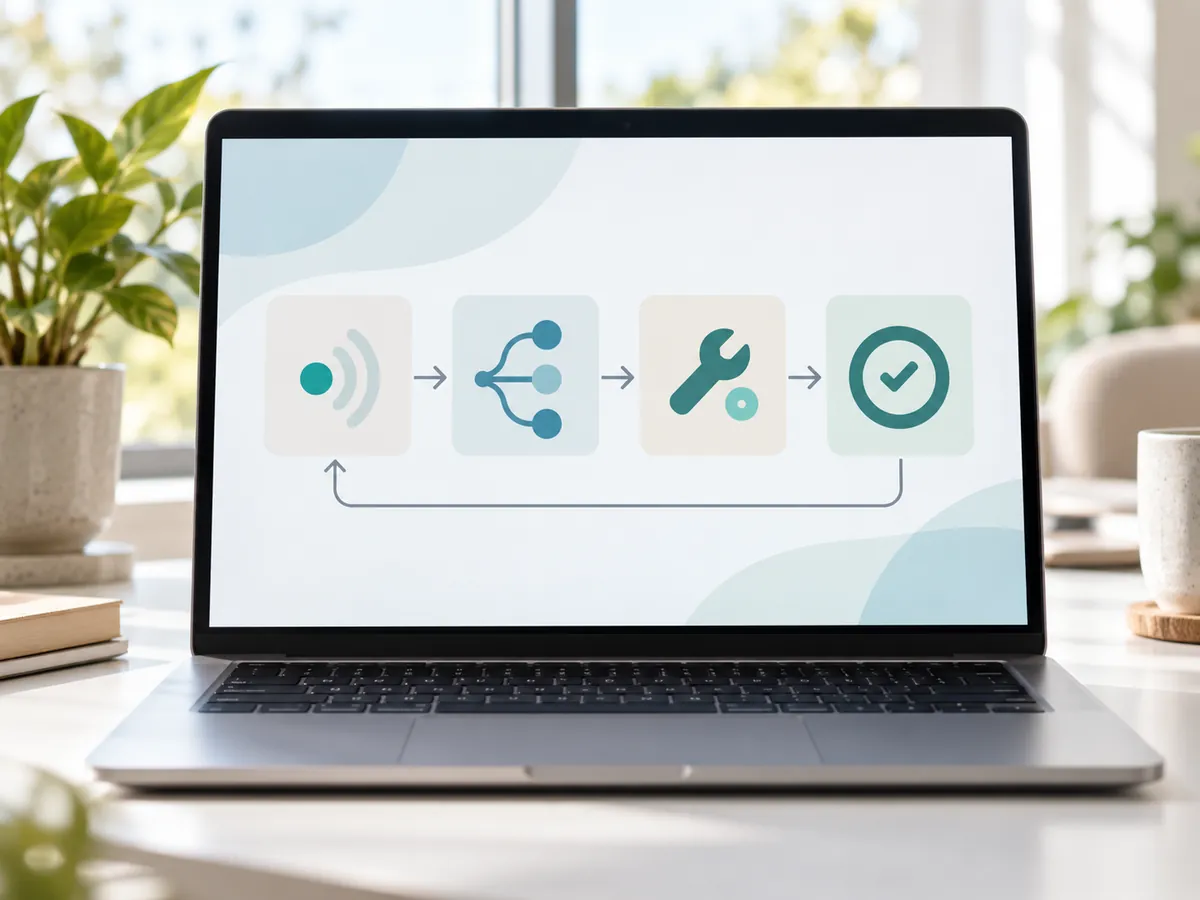
autonomous SEO succeeds when the system can detect an issue, decide the next action, complete the assigned work, and leave a reviewable record. It fails when automation only produces more notifications. The dividing line is closed-loop execution: the same operational system that finds the problem also prepares the resolution, subject to the approval rules the business has chosen.
A useful mental model is a relay race rather than a single marathon runner. Detection hands structured context to planning, planning hands a scoped task to the right specialist, and the result returns as a change, draft, or listing update. When that handoff is explicit, the system can repeat the cycle every day without losing the thread.
This is where automated technical SEO differs from a recurring report. A report still needs a person to read it, translate it, open a ticket, and chase completion. An execution system shortens that distance, but it must also make the boundary between prepared work and released work unmistakable.
Why can a multi-agent SEO system cover more ground than one agent?
A multi-agent SEO system divides search optimization across narrow agents that work from one shared plan. It can cover more ground than a single-agent workflow when tasks are independent enough to run in parallel and similar enough to share priorities. The comparison that matters is coordinated specialists versus one agent forced to context-switch through every job.
Three advantages explain most of the difference:
- Concurrency: one agent can inspect crawl errors while another maps content gaps and another checks local profile freshness, because none has to finish the others queue first.
- Depth: an agent assigned to entity signals can keep detailed knowledge of schema, brand mentions, and AI citations without diluting that focus across unrelated tasks.
- Continuity: search surfaces change daily, so coverage benefits from workers that do not wait for a monthly meeting to resume the same responsibility.
The wider surface area now includes Generative Engine Optimization, often shortened to GEO. GEO is the practice of making a brand easier for AI assistants to understand, trust, and cite. It sits beside Answer Engine Optimization, or AEO, which structures pages so direct answers can be extracted cleanly. Both depend on the same foundations as strong technical SEO: crawlability, clear entities, consistent facts, and content written to be quoted.
The market context has been discussed for years, but forecasts should be handled carefully:
By 2026, traditional search engine volume will drop 25%, with search marketing losing market share to AI chatbots and other virtual agents (Gartner, 2024).
Share on LinkedIn · Share on X
That sentence was a prediction published in 2024 about what 2026 might look like. It is not proof of current behavior, and teams should treat it as directional planning input rather than a measured outcome. The practical point is narrower: buyers now ask assistants for recommendations before they ever open a conventional result page, so visibility work has to include those assistants.
What do the six divisions of an autonomous SEO department own?
The cleanest way to understand autonomous SEO agents is to group them by division rather than by model name. RankMesh describes six divisions that mirror the work of a search department: technical SEO, AI visibility and entity signals, keyword and competitor research, local listings and reputation, content and authority building, and reporting. Each division contains agents with one job instead of a broad mandate.
The operating picture looks like this:
- Technical SEO: site health, crawlability, broken links, missing schema, slow assets, and the fixes prepared for those issues.
- AI visibility and entity signals: work aimed at being cited and recommended inside ChatGPT, Claude, Perplexity, Gemini, and Google AI Overviews.
- Keyword and competitor research: gap discovery, priority setting, and the inputs that tell content and technical teams what matters next.
- Local listings and reputation: Google Business Profile activity across posts, photos, Q&A, and reviews, kept current rather than refreshed once a quarter.
- Content and authority building: articles researched against real gaps, plus outreach and authority work that runs continuously.
- Reporting: a reporting division and live action log that record executed work so teams can inspect progress without rebuilding the history by hand.
This division model is useful even if you never adopt RankMesh. It gives buyers a checklist for vendor claims. If a provider says it has many agents but cannot explain which division owns technical debt, which owns AI citations, and which owns the record of change, the architecture is probably branding rather than operations.

How does work move from a detected issue to a reviewable fix?
In a healthy system, the agent that detects an issue also prepares the resolution, but preparation and release remain separate events. Consider a canonical tag problem affecting twelve product pages. The agent can identify the pattern, propose the correct target logic, and open a pull request that a developer or marketer can inspect before merge.
That sequence matters because agent completion is not the same as publication. The agent has finished its task when the fix is scoped, documented, and attached to a reviewable change. A person still decides whether the proposed canonical targets are correct, especially where parameter pages, regional variants, or faceted navigation could make a wrong rule costly.
Risk depends on which pages are affected and which canonical targets are chosen. A template correction on low-traffic test URLs is different from a rule that changes how hundreds of revenue pages consolidate signals. This is why review settings should be configured by impact, not by the comforting idea that a common technical fix is automatically harmless.
For teams comparing operating models, the question is simple: does the vendor show a path from issue to prepared change, and can your team see the difference between drafted work and released work? If the answer is vague, autonomy is being used as a slogan.
How should human approval work in an agentic SEO setup?
Human approval works best as a tiered control system. Routine, low-impact actions can run continuously when the customer chooses auto-approval. High-impact changes route through an approval panel before going live, and the customer can approve, reject, auto-approve, or reverse actions while the action log preserves the history.
The important design principle is accountability. Automation handles execution at scale, while a person stays responsible for what ships and for the brand context agents cannot infer alone. That context includes positioning, product constraints, legal sensitivities, and the difference between a technically valid answer and an answer the business should publish.
Approval design also keeps speed from becoming fragility. A crawler may find hundreds of small issues that deserve immediate cleanup. A pricing page template, a migration rule, or a canonical pattern across product URLs deserves a slower lane. Mature buyers ask vendors to show these lanes before asking how many agents are included.
Full autonomy has limits, and pretending otherwise creates avoidable risk. Our earlier analysis of why full AI autonomy is risky for SEO makes the same point from the risk side: execution should be fast, but irreversible decisions should remain visible.
How does AI search visibility change what agents must monitor?
AI search visibility means a brand is discoverable, understandable, and citable when assistants compose answers. Monitoring therefore expands beyond rank tracking. Agents need to watch whether the brand appears in AI answers, whether the facts attached to the brand are consistent, and whether pages provide answer-ready evidence that models can reuse.
Entity SEO becomes central here. An entity is a distinctly identifiable thing, such as a company, product, person, or place, and search systems try to connect entities through consistent names, attributes, sources, and relationships. Knowledge graph optimization strengthens those connections so machines are less likely to confuse a brand with a generic category or a similarly named competitor.
This changes the content brief as well. Pages need definitions near the top, direct answers that survive being quoted alone, and schema that clarifies organization, product, FAQ, and local details where relevant. The goal is not to chase every assistant differently. The goal is to make the same verified facts easy for Google and AI search systems to trust.
A practical evaluation question is whether the platform treats Google and assistants as one connected problem. If AI visibility is only a checkbox while technical debt, content gaps, and local accuracy live elsewhere, the system has recreated the silos it claims to remove.
What this means for you
Founders should evaluate autonomous SEO as an operating model, not as a feature bundle. Ask whether the system connects to your stack, whether changes arrive as reviewable work, and whether approvals match the risk of each page type. Then compare the monthly cost of delay against the cost of the platform, using planning math rather than promised rankings.
Marketing leads should map current bottlenecks before buying. If technical tickets die in engineering queues, prioritize pull request workflow and reversal controls. If content stalls after research, prioritize the path from keyword gap to published article. If local demand matters, ask how Google Business Profile posts, photos, Q&A, and reviews stay active without manual chasing.
Agency operators should test whether agents increase account capacity without hiding quality. The strongest use case is not replacing strategists. It is removing repetitive execution so strategists can spend time on positioning, offers, measurement, and client judgment. For a deeper economic view, see our breakdown of SEO agency cost versus AI automation.
A simple evaluation sequence works across vendors:
- Connect a staging site or limited section first.
- Require every proposed change to show source evidence and expected impact.
- Set stricter approval for templates, migrations, canonical rules, and revenue pages.
- Review the action log weekly for patterns, not just individual fixes.
- Expand autonomy only after the system proves it can prepare clean work repeatedly.
Frequently asked questions
Are autonomous SEO agents the same as AI writing tools?
No. AI writing tools mainly generate text when prompted. Autonomous SEO agents monitor conditions, prepare actions, and move recurring work toward completion under approval rules, which can include technical fixes, listings, content, outreach, and reporting.
Do specialized AI agents replace an SEO team or agency?
They replace repetitive execution more than they replace judgment. Strategy, positioning, legal review, and final accountability still need people, while agents reduce the backlog that usually stops good recommendations from shipping.
What is Generative Engine Optimization in plain terms?
Generative Engine Optimization is the practice of making a brand easier for AI assistants to understand and cite. It overlaps with technical SEO and AEO because assistants rely on clear structure, consistent entities, credible sources, and direct answers.
How risky is automated technical SEO?
Risk depends on impact and control. Small fixes can often run with lighter review, while templates, migrations, redirects, and canonical rules need tighter approval because they can affect many URLs at once.
Can a multi-agent SEO system work on Shopify or Webflow?
It can when the platform integrates with the site stack instead of demanding a rebuild. RankMesh publishes through WordPress, Shopify, Webflow, Framer, Wix, and Notion Sites, and can prepare reviewable pull requests for custom or GitHub-managed sites.
Put the blueprint to work
The right next step is not buying the largest agent count. It is proving that one connected system can find work, prepare it cleanly, respect approval boundaries, and leave a record your team trusts. See how RankMesh runs autonomous SEO when you are ready to evaluate that model against your own site.
Related resources