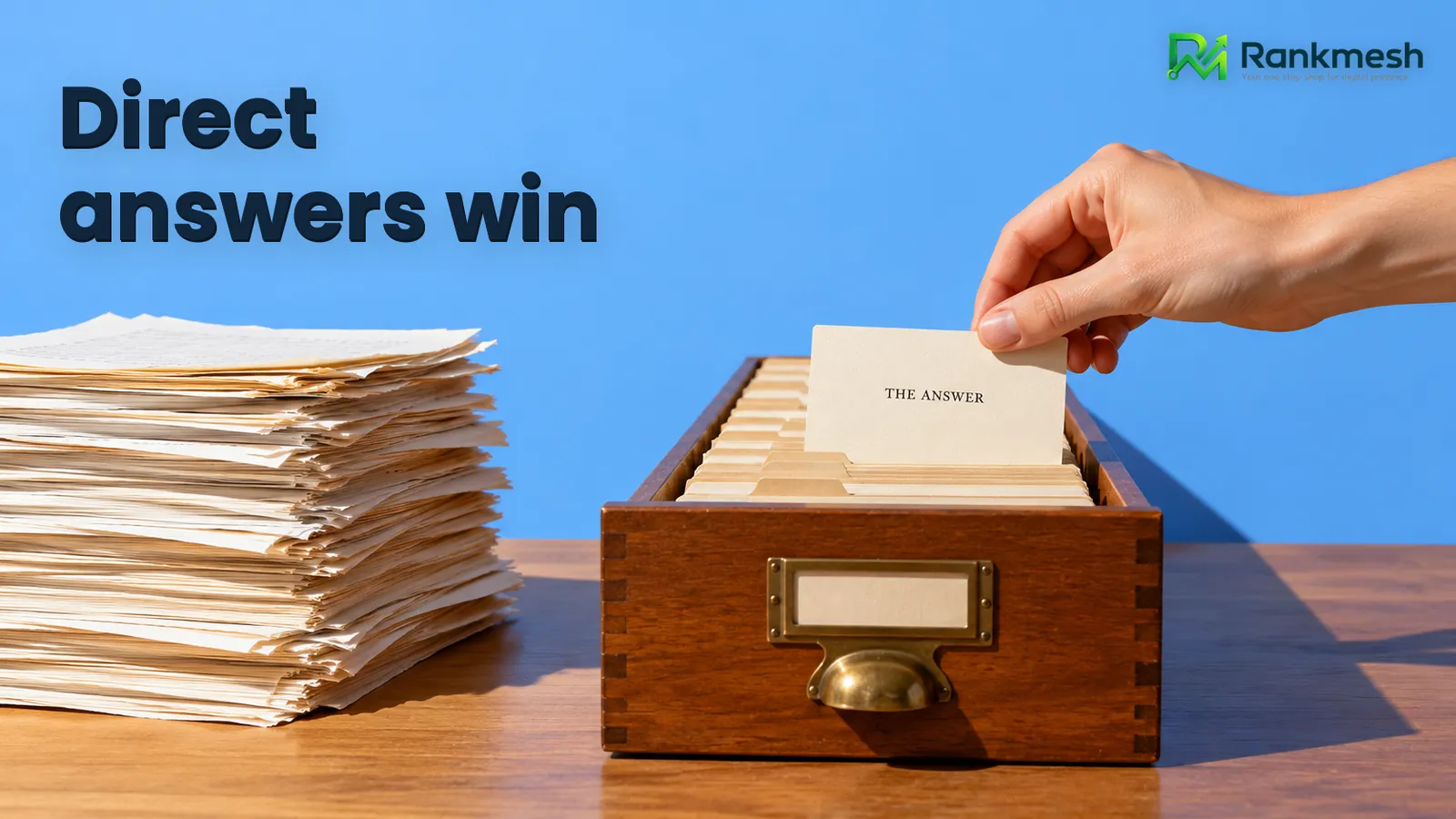
Most business blogs are written to be read. AI search engines do not read; they extract. When a page presents its substance as flowing prose, generative engines such as ChatGPT, Perplexity, and Google AI Overviews will bypass it in favor of a competitor whose content states the answer within the first two sentences.
This article dissects the structural difference between a conventional long-form blog post and a purpose-built answer page, enumerates the specific formats from which AI engines preferentially extract, and explains how RankMesh converts existing content into answer infrastructure as a continuous, automated operation.
Key takeaways
- AI engines extract direct definitions, scoped lists, and step-by-step processes rather than admiring prose; structural clarity now outweighs stylistic elegance.
- Only 11% of domains earn citations from both ChatGPT and Perplexity, which means a single content format cannot win every platform simultaneously (Leapd, 2026).
- Semantic completeness, defined as a self-contained answer requiring no external context, is the strongest predictor of AI Overview citation selection, with a correlation of r=0.87 (Leapd, 2026).
- The atomic unit of an answer page is a 40-60 word direct answer positioned immediately beneath a question-style heading, reinforced with FAQPage structured data.
- RankMesh operates answer engine optimization (AEO) and generative engine optimization (GEO) as one continuous workflow: mining questions, rewriting answers, deploying schema, and verifying whether the snippet or citation was actually secured.
At a glance
- Blog post objective: Rank within a list of links and earn a click-through.
- Answer page objective: Be quoted verbatim inside the generated answer, with or without a click.
- Core format: Question-phrased heading, 40-60 word direct answer, supporting detail, FAQPage markup.
- Where it wins: Featured snippets, People Also Ask boxes, voice assistants, Google AI Overviews, ChatGPT, Claude, Perplexity.
- Who operates it: AEO structures answers inside traditional search surfaces; GEO earns citations inside generative answers. RankMesh runs both as a single system.

RankMesh deploys 40+ specialized AI agents that audit, restructure, and track your content across Google and every major AI answer engine.
What is an answer page, and how is it different from a blog post?
An answer page is content engineered so that search engines and AI assistants can lift a complete, quotable answer directly from it, whereas a blog post is engineered to rank in a results list and sustain human reading. The answer page treats the machine as its first reader and the human as its second.
That distinction appears minor on the surface, yet in practice it reorganizes every decision made during the page's construction.
A conventional long-form blog post opens with contextual framing, develops an argument across roughly two thousand words, and delivers its most valuable sentence somewhere near the midpoint. That architecture functioned adequately when a search engine's responsibility was ranking ten blue links and delegating the excavation to the user. It fails when the engine's responsibility is composing a single synthesized answer and citing two or three sources.
An answer page inverts that architecture entirely. Each section commences with the answer itself, approximately 40 to 60 words, situated directly beneath a heading phrased as the question a genuine user would pose. Detail, qualification, and exemplification follow afterward. Should an AI model ingest only the opening paragraph of every section, it nonetheless receives a complete, accurate, and citable unit.
Neither format is inherently defective. The blog post accumulates topical depth and internal link equity; the answer page captures snippets, People Also Ask placements, and AI citations. The brands achieving durable visibility in AI search during 2026 operate both formats, frequently upon the same URL.
Why do generative engines extract structure instead of ranking prose?
Generative engines extract structure because they must assemble a coherent answer from discrete fragments rather than redirect users toward a page. They seek direct definitions, scoped lists, step-by-step processes, and stable facts they can reproduce without interpretation; keyword density matters considerably less than extractability (AIClicks, 2026).
"One of the clearest generative engine optimization trends for 2026 is the shift toward structured, succinct content. Why? Because AI engines extract. They don't admire your prose." (AIClicks, 2026)
Share on LinkedIn · Share on X
The citation data renders the stakes concrete. An analysis of 680 million citations across ChatGPT, Google AI Overviews, and Perplexity determined that only 11% of domains receive citations from both ChatGPT and Perplexity, because each platform operates upon fundamentally divergent citation logic (Leapd, 2026). A page optimized for one engine's preferences is not automatically visible within another.
The disparity extends further than cross-platform overlap. A separate study of 34,234 AI responses identified a 46-times difference in brand citation rates between platforms: ChatGPT cited brands in 0.59% of responses, Perplexity in 13.05%, and Grok in 27% (Leapd, 2026). A content strategy calibrated to a single platform's preferences leaves a brand effectively invisible across the remainder.
What, then, predicts selection? Seven factors consistently govern AI Overview citation selection, based on an examination of nearly 16,000 AI Overview results spanning 63 industries (Leapd, 2026). The strongest is semantic completeness, whether the content furnishes a self-contained answer requiring no external context, which demonstrated a correlation of r=0.87 (Leapd, 2026). Content combining text with images or video exhibited 156% higher selection rates than text-only material (Leapd, 2026).

What does a properly constructed answer page actually contain?
A properly constructed answer page contains four extractable elements: direct definitions for every key term, a 40-60 word answer block beneath each question-style heading, FAQPage structured data marking up the question-and-answer pairs, and People Also Ask formatting that mirrors how users phrase queries.
The first element is the direct definition. Generative engines resolve definitional queries by locating a sentence that defines a term completely and unambiguously, without requiring the reader to have consumed preceding paragraphs. Every specialized term on the page should receive such a sentence at its first appearance, a practice this article itself follows.
The second element is the answer block, a self-contained paragraph of approximately 40 to 60 words positioned immediately beneath a heading phrased as a question. This length corresponds to the format Google preferentially elevates into featured snippets (RankMesh AEO documentation). Anything shorter tends to lack substance; anything longer forces the engine to truncate, and truncated answers are frequently attributed to a different source.
The third element is FAQPage markup, a form of structured data (machine-readable code embedded in the page that labels each question and its answer explicitly). FAQPage schema tells Google and AI crawlers precisely which text constitutes a question and which constitutes its resolution, eliminating the interpretive guesswork that causes extraction failures.
The fourth element is People Also Ask alignment. The questions appearing in Google's People Also Ask boxes represent verified, high-frequency user phrasings, so an answer page that addresses those exact formulations inherits demand that has already been demonstrated rather than hypothesized.
How do FAQPage markup and People Also Ask formatting win snippets?
FAQPage markup wins snippets by labeling each question-and-answer pair in machine-readable code, so Google and AI assistants can extract the answer with certainty rather than inference. People Also Ask formatting wins by matching the exact conversational phrasing users type and speak, which is the phrasing engines are built to resolve.
Structured data functions as a disambiguation layer. Without it, an extraction system must probabilistically infer which paragraph answers which heading; with it, the relationship is declared explicitly, and the cost of citing the page falls to nearly zero.
People Also Ask optimization operates on a different mechanism but produces a complementary result. Each PAA question a page answers becomes an additional surface on which that page can appear, and PAA boxes propagate: answering one question frequently generates exposure to the adjacent questions Google derives from it.
RankMesh mines PAA boxes across a client's category daily, converting unanswered gaps into new on-page Q&A blocks that competitors have not yet addressed (RankMesh AEO documentation). The same pipeline rewrites key answers into the conversational phrasing people speak to voice assistants, which diverges measurably from typed query syntax.

Where does an answer page win that a long-form post cannot?
An answer page wins on zero-click surfaces: featured snippets, AI Overviews, voice responses, and chat citations, where the engine quotes one source directly and the user may never visit any website. Long-form posts rank in link lists; answer pages become the answer itself, capturing brand exposure even when no click occurs.
Consider a concrete query: "migrate shopify store without losing rankings." A long-form post addressing this topic typically buries the operative answer beneath introductory context about why migrations matter. An answer page opens with the resolution: migrating a Shopify store without losing rankings means preserving every URL's content, 301-redirecting old paths to their new equivalents, and resubmitting the sitemap on launch day (RankMesh AEO documentation).
That two-sentence answer is precisely what a featured snippet, an AI Overview, or a chat assistant can quote intact. The three-thousand-word narrative surrounding it remains available for the human reader who clicks through, but the machine's requirement has already been satisfied in the opening lines.
The commercial consequence is straightforward. Queries that trigger zero-click answer boxes still confer brand visibility upon whoever is quoted; the risk runs against whoever is not, since a competitor occupying the answer box absorbs the exposure regardless of whether a click materializes (RankMesh AEO documentation).
How does RankMesh turn existing content into answer infrastructure?
RankMesh converts existing content into answer infrastructure through a continuous loop: it identifies queries where a site ranks in the top five to ten positions without holding the snippet, rewrites the relevant section into the 40-60 word format Google features, deploys FAQPage and QAPage schema automatically, and tracks whether the placement is won (RankMesh AEO documentation).
The process operates in sequence. First, question-mining agents scan People Also Ask boxes across the client's category daily, surfacing unanswered gaps. Second, direct-answer rewriting restructures existing pages so the core answer appears within the first two or three sentences, with supporting detail repositioned afterward.
Third, FAQPage and QAPage structured data deploy across every relevant page without manual implementation, so Google and AI assistants can extract direct answers for rich results. Fourth, zero-click defense monitors queries that already trigger answer boxes, verifying that the client's brand rather than a competitor's is the source being quoted.
On the generative side, the same reformatted pages feed the GEO workflow: daily citation monitoring scans ChatGPT, Perplexity, and Gemini for brand mentions, while prompt-level tracking reports week by week whether the business appears in the answers that matter to it (RankMesh AI Recommendations documentation). This is what generative engine optimization services look like when they are executed as infrastructure rather than delivered as a monthly audit: the system that detects the missing citation is the same system that restructures the page to earn it.
Every high-impact change routes through an approval panel before going live, so automation handles execution at scale while a person remains accountable for what ships. Schema and entity fixes deploy immediately, and because AI engines re-crawl on their own schedules, most brands observe initial citation movement within a few weeks, compounding as additional pages are reformatted (RankMesh AI Recommendations documentation).
What this means for you
For founders and marketing leads, the operational implication is that content strategy now has two distinct outputs: pages that rank and pages that get quoted. A quarterly content calendar built exclusively around long-form posts addresses only the first, ceding snippets, PAA boxes, and AI citations to whichever competitor restructures first.
A pragmatic sequence looks like this:
- Audit existing rankings for snippet proximity. Identify queries where you already hold positions five through ten; these are the cheapest snippet wins because Google already trusts the page.
- Restructure the top sections into answer blocks. Place a 40-60 word direct answer beneath each question-style heading, and move narrative context below it.
- Deploy FAQPage markup on every page containing Q&A content. Schema is a one-time technical change with recurring returns.
- Mine People Also Ask weekly. Each unanswered PAA question in your category is an extraction surface a competitor can claim before you do.
- Track citations, not just rankings. Monitor whether ChatGPT, Perplexity, and AI Overviews quote you on the prompts that drive pipeline, because ranking reports will not show it.
For agency operators, the same sequence constitutes a deliverable that traditional retainers rarely include, because manual answer restructuring at portfolio scale is labor-intensive. Automation changes that calculus: an autonomous answer engine optimization workflow executes the mining, rewriting, schema deployment, and verification continuously rather than quarterly.
If you are uncertain whether your current content is being quoted or bypassed, the fastest diagnostic is a direct audit of your answer surfaces. RankMesh offers a free report showing whether AI Overviews and featured snippets are quoting you or a competitor today, which establishes the baseline before any restructuring begins. For a broader treatment of how the underlying discipline differs from traditional SEO, see our explainer on answer engine optimization.
Frequently asked questions
What is the difference between answer engine optimization and generative engine optimization?
Answer engine optimization (AEO) targets structured answer formats inside traditional search, namely featured snippets, People Also Ask boxes, and voice responses, all of which have existed for years. Generative engine optimization (GEO) targets citations inside AI-generated answers from ChatGPT, Claude, and Perplexity. Both reward clear structure and schema, which is why RankMesh operates them as one workflow.
Do answer pages still rank in normal Google results?
Yes. Answer-first structure does not penalize conventional rankings, because the supporting detail, topical depth, and internal links remain on the page beneath the answer blocks. The format adds extractability without subtracting the signals that drive positions one through ten.
How long should the direct answer under each heading be?
Approximately 40 to 60 words is the range Google preferentially elevates into featured snippets, and it corresponds to the length AI assistants can quote intact without truncation (RankMesh AEO documentation). Shorter answers often lack substance, while longer ones force the engine to cut the quotation short.
Will winning answer boxes reduce my click-through rate?
The larger risk runs in the opposite direction: if a competitor holds the answer box, they absorb the exposure and you lose the click regardless. Holding the snippet or PAA placement keeps your brand in front of the searcher even on queries that resolve without a visit.
How quickly does restructured content start earning AI citations?
Schema and structural fixes deploy immediately, but AI engines refresh their retrieval indexes on their own schedules. Most brands observe initial citation movement within a few weeks, with gains compounding as more pages are reformatted (RankMesh AI Recommendations documentation).
Related resources